
Former Labor Secretary Lori Chavez-DeRemer’s record is a reminder that the Cabinet serves Trump, not the American people.
In the early days of the second Trump administration, we exhorted Democrats to use confirmation hearings to set the tone for oversight and opposition to Trump 2.0. Unfortunately, this did not happen.
Senator Cory Booker said the party was “not looking to make this partisanship.” We documented Senator John Hickenlooper’s bizarrely cordial posture during the hearing for now-Energy Secretary Chris Wright, who has since led the administration’s assault on renewable energy and forceful takeover of Venezuela’s oil reserves. As former colleagues of Marco Rubio, Senate Democrats were evidently uncomfortable opposing the man who now unapologetically stands at the forefront of Trump’s murderous and unpopular foreign policy, unanimously approving his nomination. Lori Chavez-DeRemer, the now-disgraced former Labor Secretary, rode the backing of the Teamsters and other unions to convince 17 Democrats to cross the aisle and support her nomination.
By granting these cabinet members the legitimacy of bipartisan support, the ostensible opposition party failed to meet the moment, misinterpreting both its responsibility at this critical juncture and the function Trump appointees would serve. As we noted at the time, Trump’s cabinet members were “chosen for their loyalty both to him and the moneyed interests they’ll ostensibly be tasked with overseeing.” Chavez-DeRemer’s abysmal policy record as Labor Secretary—not to mention the troubling alleged conduct by both her and her husband towards DOL employees—is perhaps most indicative of this dynamic.
Bipartisan Support
Prior to her appointment, Chavez-DeRemer served one term in Congress representing Oregon’s 5th district before losing her reelection bid in 2024. During her tenure, Chavez-DeRemer received a 29% score for her voting record on the AFL-CIO’s report card—not good, but a fair bit better than the 10% score for an average House Republican in 2024. The real feather in her cap was co-sponsoring two major pro-labor pieces of legislation. The first was the Protecting the Right to Organize (PRO) Act, which would have dramatically improved collective bargaining rights and strengthened enforcement against lawbreaking employers. The second was the Public Service Freedom to Negotiate Act, which would have guaranteed the rights of public sector employees to collectively bargain. While Chavez-DeRemer was one of only a handful of Republicans to back the bills, neither had a real chance of becoming law and never made it out of committee.
Still, this was enough for the Teamsters, who declined to endorse either candidate in 2024 and whose President, Sean O’Brien, spoke at the Republican National Convention, to advocate for Chavez-DeRemer’s selection as Labor Secretary. In O’Brien’s eyes, the now-disgraced Chavez-Deremer was an “excellent choice.”
Chavez-Deremer’s plan for marshalling the DOL was a key issue raised during her confirmation hearing. Her answers were not encouraging. Senator Bernie Sanders (I-VT) grilled her on whether she would “rubber stamp” Trump’s orders or uphold federal labor laws. Chavez-DeRemer said she “[does] not believe the president is going to ask me to violate the law.” She also walked back support for provisions of the PRO Act that would overturn “right-to-work” state laws, which prohibit union agreements requiring dues from employees covered by a collective bargaining agreement.
Chavez-DeRemer still received 17 Democratic votes on her way to confirmation. In addition to the Teamsters, unions like the AFL-CIO, who had backed Chavez-DeRemer’s Democratic opponent in 2024, applauded her confirmation while remaining skeptical of the administration’s commitment to helping working people. This skepticism turned out to be prescient.
Having left the agency in disgrace, it’s clear that Chavez-DeRemer’s personal political positions—whether she still supports the PRO Act or not—had no influence on the output from the Department of Labor. Rather, she served as the pro-labor figurehead carrying out the decidedly anti-labor agenda of Trump and Russell Vought’s Project 2025—another case in point that there is no such thing as a reasonable Trump appointee.
Staff and Funding Levels
Under Chavez-DeRemer’s leadership, the Department of Labor saw its capacity decimated through a combination of DOGE cuts, reductions in force, and retirements. According to the latest data from the Office of Personnel Management, the agency has lost over 3,200 employees, roughly 22% of its total workforce, since Trump’s inauguration. Nearly 2000 employees left through the Deferred Resignation Program introduced by DOGE.
These trends that started under Chavez-DeRemer are poised to continue, with the White House requesting $10.3 billion for the department for fiscal year 2027, representing a nearly 25% decrease, along with a 17% decrease in full time equivalents. These capacity cuts were not uniform across the department—the subagencies most impacted are those whose functions are at odds with the agendas of the President and Russell Vought. The Women’s Bureau, for example, has lost around 60% of its employees since Trump’s inauguration, down to only 20 staff members.
The Bureau, which was established in 1920 to improve working conditions for women, has been a top target for DOL budget cuts pushed by the White House. Trump’s proposed budgets have aimed to eliminate the agency altogether, though Congress has not been on board. The budget also aims to eliminate the Bureau of International Labor Affairs (ILAB), which works to raise the labor standards in foreign countries to prevent poverty wages or slave labor from undercutting American workers, and the Office of Federal Contractor Compliance Programs, which investigates and enforces non-discrimination laws among federal contractors.
It’s unclear the extent to which Chavez-DeRemer was involved in the formulation of her own department’s budget. Given the parallels with Project 2025, it seems likely that Russell Vought is the driving force. Indeed, Vought has used his Office of Management and Budget to slow, or in some cases impound, tens of millions of dollars in disbursements to these offices.
Still, Chavez-DeRemer showed no urgency in having these crucial subagencies perform their duties and spend their appropriations. Just weeks after her confirmation, the DOL cancelled nearly $240 million in grants from ILAB, $70 million of which was going to the AFL-CIO’s Solidarity Center. She also allowed DOGE to cut dozens of grants aimed at improving opportunities for women in construction and manufacturing before reposting the grant opportunities months later. Chavez-DeRemer was seemingly more interested in throwing a birthday party for herself or going on leisure-filled trips than ensuring the department carried out the functions Congress intended.
In addition to the dismantling of these core subagencies, the DOL is also looking to decrease enforcement against lawbreaking employers. In its FY27 budget request, the department said it will “shift resources from [OSHA’s] Federal Enforcement activities to Federal Compliance activities.” In other words, OSHA will be conducting fewer inspections and investigations and issuing fewer fines to keep employers in line. Instead, Chavez-DeRemer took the position that lawbreaking employers are simply ignorant about their compliance requirements rather than actively choosing to save a few bucks at the expense or worker safety. This is evident in requests for decreases in both funding and staffing levels for the Occupational Safety and Health Administration (OSHA), Mine Safety and Health Administration (MSHA), and the Wage and Hour Division, three sub-agencies with enforcement capabilities.
Rulemaking
As I wrote in The New Republic in 2024, Trump’s labor record from his first term was abysmal, and, despite campaign promises to the contrary, his second term was poised to be more of the same if he was reelected. That prediction has, sadly, since come to pass. Though Chavez-DeRemer was supposedly a more labor-friendly appointee than the staunchly pro-corporate appointees of Trump’s first term, the resulting rulemaking efforts have been nearly identical.
Worker Safety
Under her leadership, the DOL has begun rolling back regulations that make workplaces safe. In 2024, Biden’s MSHA finalized a rule lowering the legal amount of exposure to respirable silica dust that was allowed in coal mines and metal/nonmetal plants. Exposure to silica dust is a key contributing factor to coal miners developing severe black lung disease. Still, industry groups filed suit to block the rule and, in April 2025, Chavez-DeRemer and MSHA voluntarily paused enforcement of the rule pending judicial review. In November, the DOL filed a status update asking the court to pause the case as it was working on a revised rule and later announced an indefinite pause in enforcement of the rule pending the court’s ruling, leaving miners to suffer from exposure and deadly lung disease in the meantime.
It’s not just miners who are suffering. On Chavez-DeRemer’s way out the door, OSHA proposed a rule to remove protections for workers operating on ladders over 24 feet. Under OSHA’s 2016 Walking-Working Surfaces rule, all new ladders over 24 feet were required to include personal fall arrest or ladder safety systems, which use harnesses and cables or ropes to either catch workers in the case of a fall or prevent falls altogether. Employers were also required to retrofit or replace old ladders to comply with the rule by November 2036.
Despite the nearly two decade deadline for compliance, industry groups found these basic safety protections untenable. In July 2025, the American Fuel & Petrochemical Manufacturers (AFPM), American Chemistry Council (ACC), and American Petroleum Institute (API) petitioned OSHA to revisit the rule, claiming ladder cages were a sufficient safety measure. OSHA complied, both proposing to remove the compliance deadline for old ladders and asking for input on removing the requirement for personal fall arrests even on new ladders. The proposal took the petitioners’ estimated cost savings for employers and safety impact—specifically claims that new systems have “very little, if any, safety enhancement”—at face value, without any real consideration of the cost to workers in lives lost and injuries resulting from falls. According to OSHA’s original justification of the rule, the fall prevention systems would prevent 29 deaths and 5,842 injuries per year.
Worker Classification
In addition to making work more dangerous for miners and construction workers, Chavez-DeRemer’s DOL has proposed two rules regarding employee classification that shield employers from liability for workplace violations and make it easier to classify workers as independent contractors, exempting them from protections like minimum wage and overtime laws.
In February 2026, the DOL’s Wage and Hour division issued a proposed rule to repeal a Biden-era regulation that installed a six-part evaluation to look at the “totality-of-the-circumstances” when determining whether a worker should be classified as an independent contractor or employee. Instead, the DOL will revert to the two-part test that was enacted during Trump’s first term, which looks only at an individual’s “control over their work” and “opportunity for profit or loss.” In practice, this means employers will classify more workers as independent contractors, despite having immense power over them, and workers will suffer through lack of wage and hour protections.
Just two days after Chavez-DeRemer exited the agency, the Wage and Hour division also released its proposed joint employer rule. Much like the independent contractor rule, the proposed rule rolls back improvements made under the Biden administration. Under the new rule, the definition of a joint employer will be narrowed through a four-part test of whether an employer: hires or fires the employee; supervises and controls the employee’s work schedule or conditions of employment to a substantial degree; determines the employee’s rate and method of payment; and maintains the employee’s employment records. This standard could allow employers—sometimes massive corporations like Perdue Farms or Hyundai that allegedly violate child labor laws—to evade liability by arguing their subcontractors or franchisers are the only employer.
401(k) Rule
In one of the final rules issued during Chavez-DeRemer’s tenure, the DOL moved to permit 401(k) account officers to offer the option to invest in “alternative investments” like private equity and cryptocurrency. Under the proposed rule, retirement plan fiduciaries will effectively have immunity from lawsuits as long as they evaluate investments based on a set of factors like performance and fees. The rule will be a boon for those industries, which have spent years cozying up to the administration, while putting the retirements of working people at risk through the extreme volatility of these markets.
Conclusion
In the end, Chavez-DeRemer’s pro-labor bona fides, regardless of whether you viewed them as legitimate at the time, had no effect on her tenure heading the Labor Department. Time and again, the department took the side of corporations and appeased the far right ideologues that take issue with any efforts to improve the working conditions of women or immigrants. Indeed, the DOL’s social media regularly posted white supremacist dog whistles.
But even the department’s claim to be working in the interests of “one people” in “one homeland” is nonsense. American workers were not helped by Chavez-DeRemer’s actions. Their workplace protections against deadly particles and fall hazards have been rolled back while the people responsible for inspecting violations have been taken off beat. Their wage protections and legal recourses to violations will be undermined by the joint employer and independent contractor rules. And even if they manage to earn a good wage and contribute to their retirement accounts, they could see their nest egg wiped away thanks to bad investments by private equity and crypto interests. Chavez-DeRemer did not represent workers or unions in her role as Secretary of Labor, she represented the most powerful corporate and right wing interests that have the President’s ear.
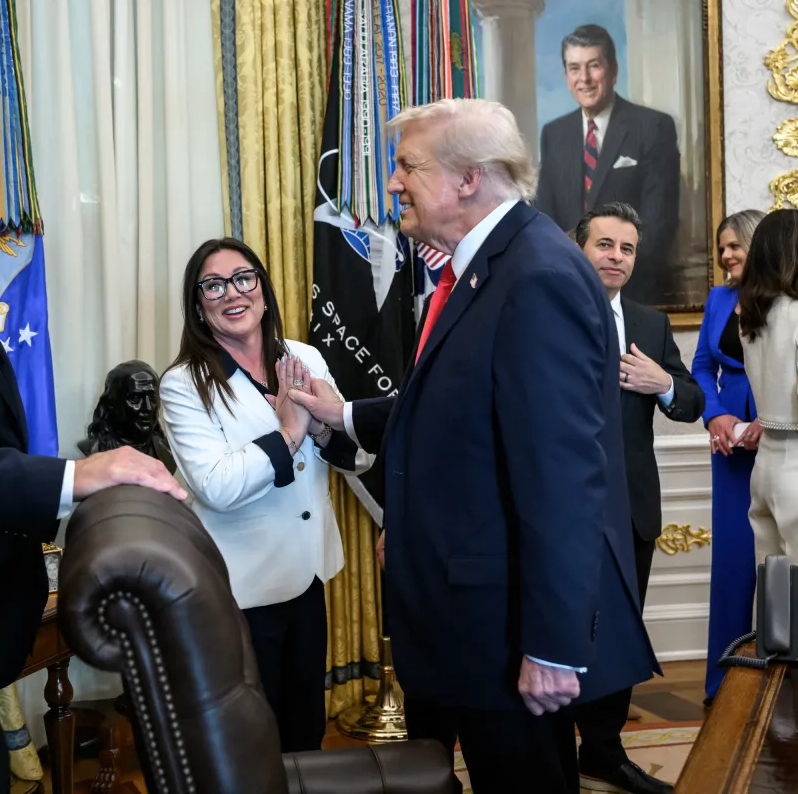
Image Credit: White House Gallery: President Donald Trump Delivers Remarks Regarding Access to Fertility Drugs
Related Articles
July 3, 2026
Map: Trump Has Often Delayed or Denied Disaster Aid
June 16, 2026
Illuminating the Home Insurance Crisis
June 2, 2026
TRACKER: Trump's Disastrous Disaster Policy
June 2, 2026