
This piece was originally published in Slate. Read the full piece on the original site.
Last month, when the Supreme Court agreed to grant a petition from two oil companies, Suncor and Exxon, in a long-running dispute over whether the companies can be held liable under state law by Boulder, Colorado, for climate damages ensuing from their corporate misconduct, the most notable sentence was the one that was missing: “Justice Alito took no part in the consideration or decision of this petition.”
Three years ago, when the Supreme Court denied a petition from these same oil companies to take up this same case, Justice Samuel Alito recused himself from participation. The reason, though unspecified, was not hard to guess. Alito owns individual stock in several oil, gas, and mining companies including ConocoPhillips and Phillips 66. Though neither company is directly named in Boulder’s lawsuit, they are named in some of the dozens of parallel lawsuits across the country being brought by city, state, and tribal governments against oil and gas companies. Indeed, the last time the companies petitioned the Supreme Court to take up the Boulder case, they hoped to use it as a vehicle to get around Alito’s need to recuse in the other cases. Nevertheless he recused from all the connected cases, and the petitions were dismissed.
These lawsuits broadly claim that the fossil fuel companies violated state laws when they failed to admit the known harms of their products and actively deceived the public about its risks. If the local and state governments prevail, they could receive billions of dollars to go towards the rising costs of recovery from climate-fueled disasters. In Boulder, that includes fires like the 2021 Marshall fire that wiped out over 1,000 homes.
For eight years, Boulder’s case against Suncor and Exxon has survived the oil companies’ attempts to have the case dismissed, claiming that federal law should preempt the state law claims. Last year, the Colorado Supreme Court held that the case should be allowed to proceed to discovery and trial in state court.
Fearing the possibility of “potentially enormous judgments” should Boulder succeed, Suncor and Exxon again petitioned the Supreme Court to review the lower court decision in Boulder’s favor. This time, the court obliged. The companies hope that a favorable decision from the Supreme Court in this case will shut down the parallel lawsuits too, arguing that Boulder’s claims are “representative of the claims being brought in parallel suits across the country, meaning that resolution of the question presented here will have immediate impact elsewhere.”
It is at this high-stakes juncture that Justice Alito, well-known for his fossil fuel holdings and track record of deciding in the industry’s favor, decided not to recuse from the decision to grant the oil companies’ petition. Alito offered no justification for his reversal. As recently as January 2025, Alito had recused himself from considering a petition from the oil companies in Honolulu’s parallel climate liability case which asked the same question as Suncor and Exxon’s petition.
This piece was originally published in Slate. Read the rest of the piece on the original site.
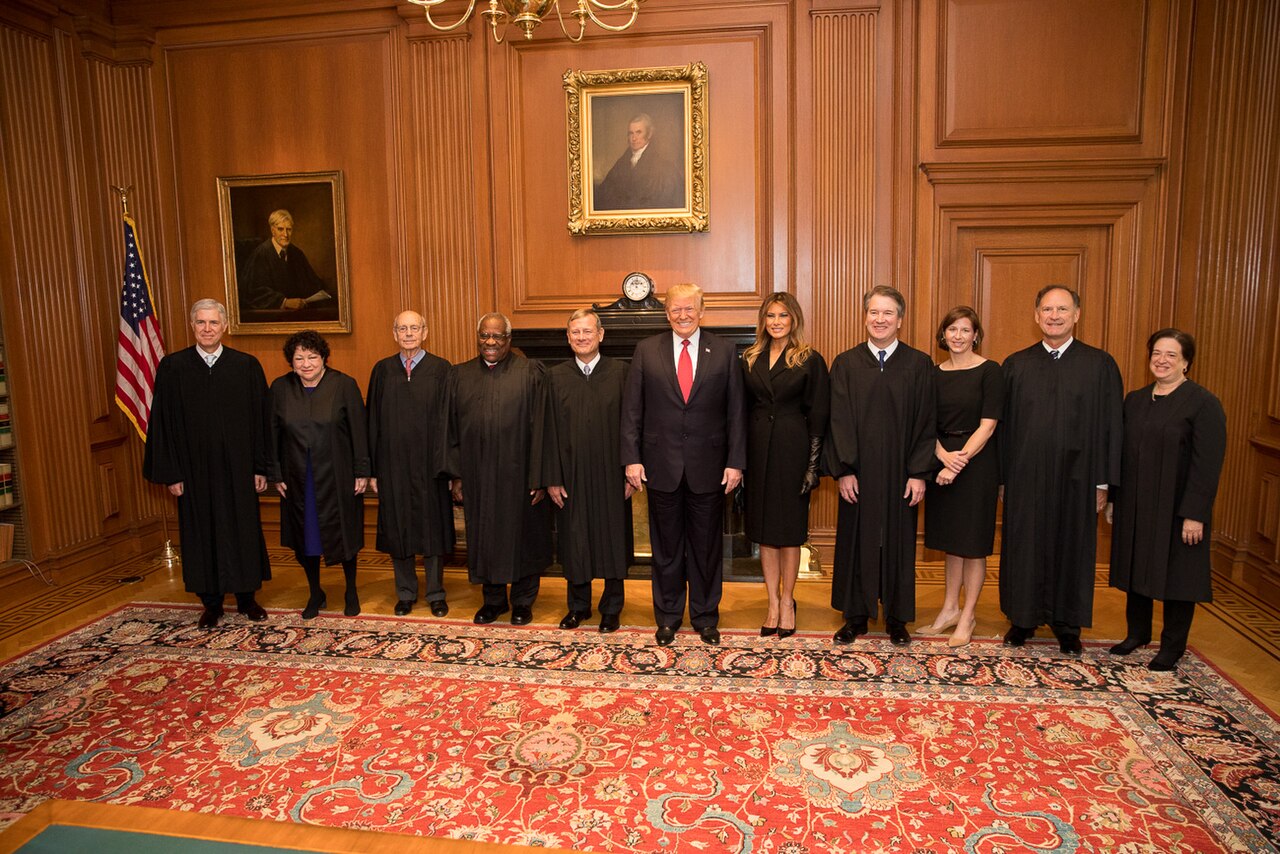
Image: President Donald Trump and First Lady Melania Trump with the Supreme Court justices is in the public domain.
.jpg)