
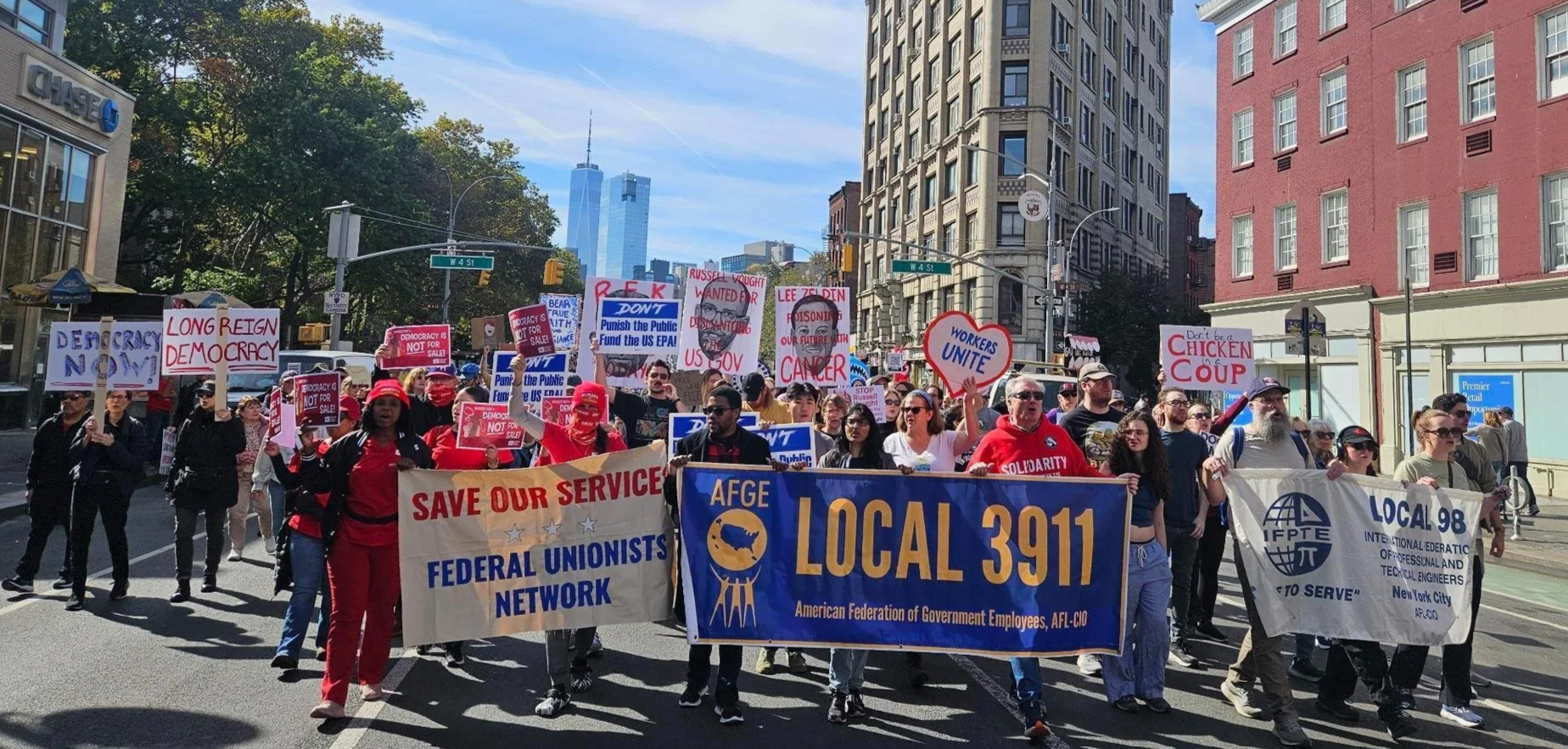
Federal unions can connect the dots to reveal the dangers of gutting government capacity.
This piece was originally published by Can We Still Govern?
Key Insights
| Because civil servants do work that is designed to protect the public from adverse outcomes, the ongoing Vought-led assault presents an opportunity to popularize the solidaristic notion that an attack on the federal workforce is an attack on our collective well-being. We need to figure out ways to communicate the shared interests of the public and public employees as broadly as possible. The Chicago Teachers Union (CTU) has long excelled at “bargaining for the common good”—making it clear that what is in the best interests of educators (not only better pay but also smaller class sizes, healthier buildings, etc.) is also in the best interests of students, parents, and the city. This is a union fond of reminding people that “the working conditions of teachers are the learning conditions of our students.” Federal employee unions can take a page from CTU’s playbook to combat the White House’s attempts to pit public sector workers against “hardworking taxpayers.” What is in the best interests of government workers is in the best interests of other working people, environmental quality, and public health around the United States. “Our working conditions are your working conditions”; “Our working conditions are your living and eating conditions.” The current foodborne illness crisis was foretold by current and former federal government workers who warned against Trump’s shredding of our food safety net. This is one, but far from the only, consequence of Trump’s ongoing war on the federal workforce. Current federal employees, and their unions, are uniquely situated to explain the mundane yet lifesaving achievements of government for a twofold purpose: 1) to prevent future attacks on critical government services and 2) to increase public support for the establishment of a more democratic and responsive government during post-Trump reconstruction. Given their intimate knowledge of the inner workings of government, federal employees are well-positioned to sound alarms, connect dots, and build solidarity in the fight against the destruction of state capacity. With help from their unions, federal workers can use political storytelling and a “common good bargaining” approach to delegitimize right-wing attacks on public good-oriented government and lay the groundwork for building back better. |
In the United States today, it’s hard to know whether the food you buy will land you in the hospital. There are currently dozens of active recalls—precisely the sort of outcome foretold by current and former federal government workers who warned against President Donald Trump’s shredding of our food safety net. It’s one example of where the public would have been better off if Trump listened to public servants rather than berating and firing them.
Before the current foodborne illness crisis erupted, the Trump regime dismissed thousands of public employees tasked with ensuring the soundness of our food supply. This is one, but far from the only, consequence of Trump’s ongoing war on the federal workforce. Although often solely attributed to Elon Musk’s Department of Government Efficiency (DOGE), the White House’s regressive reconfiguration of the administrative state has been, and is being, orchestrated by Office of Management and Budget (OMB) Director Russell Vought, who has been described as the “shadow president.”
As DOGE recedes from headlines and memories, DOGE-style attacks continue. On July 4, the day DOGE officially expired, Office of Personnel Management (OPM) Director Scott Kupor described it as a “catalyst for work that is now taking place across the government.” That work bears Vought’s imprint. The OMB director, a self-described Christian nationalist and champion of the unitary executive theory, has been in charge of Trump 2.0’s selective government demolition project all along; he even drew up the playbook for it in Project 2025.
No one is better suited to predict and describe the deleterious effects of Voughtism than past and present federal workers. Current federal employees, and their unions, are uniquely situated to explain the mundane yet lifesaving achievements of government for a twofold purpose: 1) to prevent future attacks on critical government services and 2) to increase public support for the establishment of a more democratic and responsive government during post-Trump reconstruction. For far too long, the right has successfully positioned itself as the authoritative critic of government. But civil servants are best positioned to diagnose the government’s shortcomings and ultimately, to improve it.
As the canaries in the coal mines, federal employees can protect the rest of us. Given their intimate knowledge of the inner workings of government, they are well-positioned to sound alarms, connect dots, and build solidarity in the fight against the destruction of state capacity. With help from their unions, federal workers can use political storytelling and a “common good bargaining” approach to delegitimize right-wing attacks on public good-oriented government and lay the groundwork for building back better.
One of the things that makes Trump’s damage to public services difficult to explain is that to a large extent, a government’s job is risk reduction. It stops bad things from happening. By dismantling the very arms of the state dedicated to preventing and minimizing harm, the Trump administration has all but ensured a cumulative increase in adverse outcomes. We need federal workers to forecast the myriad debacles we’re likely to see in the coming years and then, when each incremental example unfolds, to explain how “Trump and Vought did that” and outline the scale of public investment needed to keep people safe.
“The Largest Individual Episode of Union Busting in U.S. History”
If federal employees are a critical source of voice for us, Trump is doing all he can to silence them. As the Trump regime was firing civil servants en masse and bullying others into quitting, it moved simultaneously to weaken the agencies tasked with protecting those employees.
Established alongside OPM by the 1978 Civil Service Reform Act, the Federal Labor Relations Authority (FLRA) affirms federal workers’ rights to form and join unions and bargain collectively, and the Merit Systems Protection Board (MSPB) hears federal employees’ appeals of adverse actions. Trump’s removal of FLRA Chair Susan Tsui Grundmann and MSPB Chair Cathy Harris enabled his administration to ignore existing collective bargaining agreements.
Making matters worse, the White House officially stripped about one million federal workers of unionization and collective bargaining rights on March 27, 2025, when Trump signed Executive Order 14251. The order, which was accompanied by OPM guidance, affected roughly 600,000 of the 800,000-plus workers represented by the American Federation of Government Employees (AFGE), more than 100,000 of the 150,000-plus represented by the National Treasury Employees Union, and tens of thousands of the 110,000 represented by the National Federation of Federal Employees. A related executive order, issued in August 2025, expanded the universe of affected workers.
Labor historian Joseph McCartin recently assessed the damage. In his words, “The fierce velocity of the rollback of collective bargaining in the federal sector has no equal in the post-New Deal era.”
According to OPM, the percentage of federal workers represented by a union decreased from 56% at the beginning of Trump’s second term to 34% as of July 2026. This was mirrored by a dramatic increase in the percentage of civil servants deemed “not eligible” for union representation; the category doubled from 30% to 60% of the federal workforce during the same period. (About another 6% are eligible to be in a bargaining unit but are not).
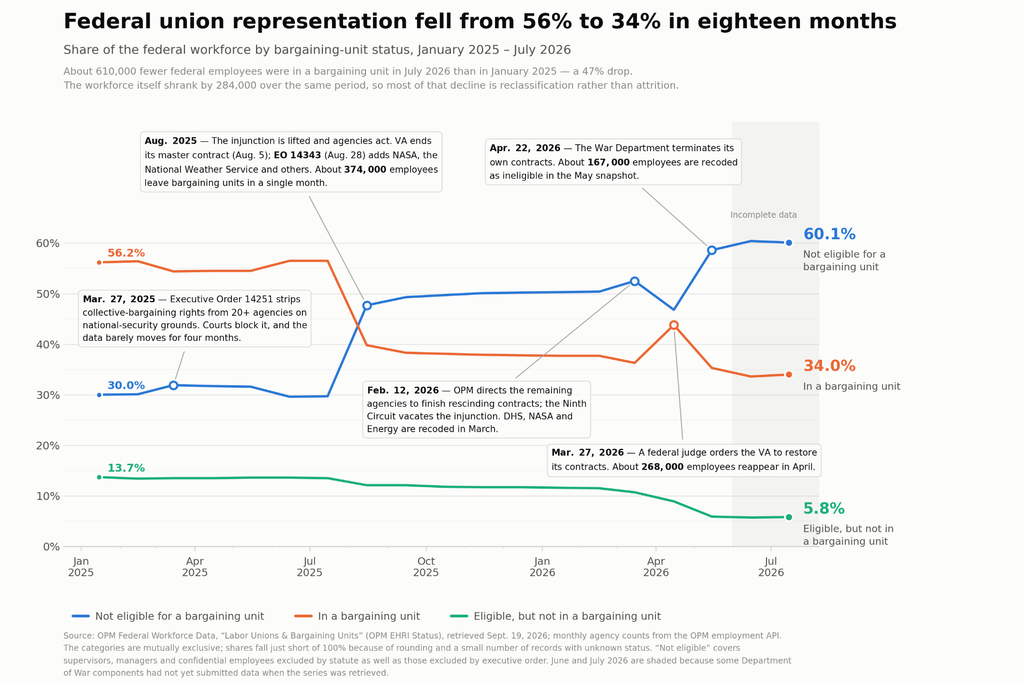
Though justified on “national security” grounds, the White House revealed the true motivation for its punitive assault when it accused federal employee unions of having “declared war” on Trump’s agenda. Multiple lawsuits are ongoing, and the Supreme Court has yet to adjudicate the president’s authority to eradicate federal workers’ labor rights, but that hasn’t stopped the administration from plowing ahead. Multiple agencies disregarded their collective bargaining and union dues check-off agreements, undermining the financial stability of some unions before temporary injunctions could stem the bleeding. As a result, AFGE cut its national staff nearly in half by May 2025.
What Trump accomplished (with technical assistance from Vought) was, according to McCartin:
“the largest individual episode of union busting in U.S. history. In a matter of months, he had not only dealt the union movement one of the most serious blows it had sustained in a century, but he also shredded the legal and institutional protections that workers had won over the course of decades and begun remaking the employment terms offered by the nation’s largest employer, the federal government.”
Connecting the Dots Between Vought-Led Cuts and Ensuing or Probable Harms
At a time when many other institutions have bent the knee to Trump, public sector unions have not. At this moment, their representation of public employees is also a public good that benefits the rest of us by protecting a non-partisan group of officials who manage the systems that protect us. Empathy and solidarity don’t happen automatically, however, so we need to figure out ways to communicate the shared interests of the public and public employees as broadly as possible.
The Chicago Teachers Union (CTU) has long excelled at “bargaining for the common good”—making it clear that what is in the best interests of educators (not only better pay but also smaller class sizes, healthier buildings, etc.) is also in the best interests of students, parents, and the city. This is a union fond of reminding people that “the working conditions of teachers are the learning conditions of our students.”
That approach enabled CTU to defeat Chicago Mayor Rahm Emanuel’s administration in the court of public opinion in 2012 despite mainstream media skepticism. Through a victorious strike and grassroots campaign, the city’s rank-and-file educators subdued the union-busting school privatization agenda pushed by Emanuel and other neoliberal Democrats. Rejecting the inevitability of austerity, CTU fought for “a fair contract which will give our students the resources they deserve,” including more nurses and social workers—proudly portraying public education as a catalyst for social justice. At a time when pro-corporate education “reform” efforts were strong, CTU helped shift popular opinion in favor of public schools and organized labor.
This is precisely the approach we need today to discredit Voughtism and relegitimize government. Federal employee unions can take a page from CTU’s playbook to combat the White House’s attempts to pit public sector workers against “hardworking taxpayers.” What is in the best interests of government workers is in the best interests of other working people, environmental quality, and public health around the United States. “Our working conditions are your working conditions”; “Our working conditions are your living and eating conditions.”
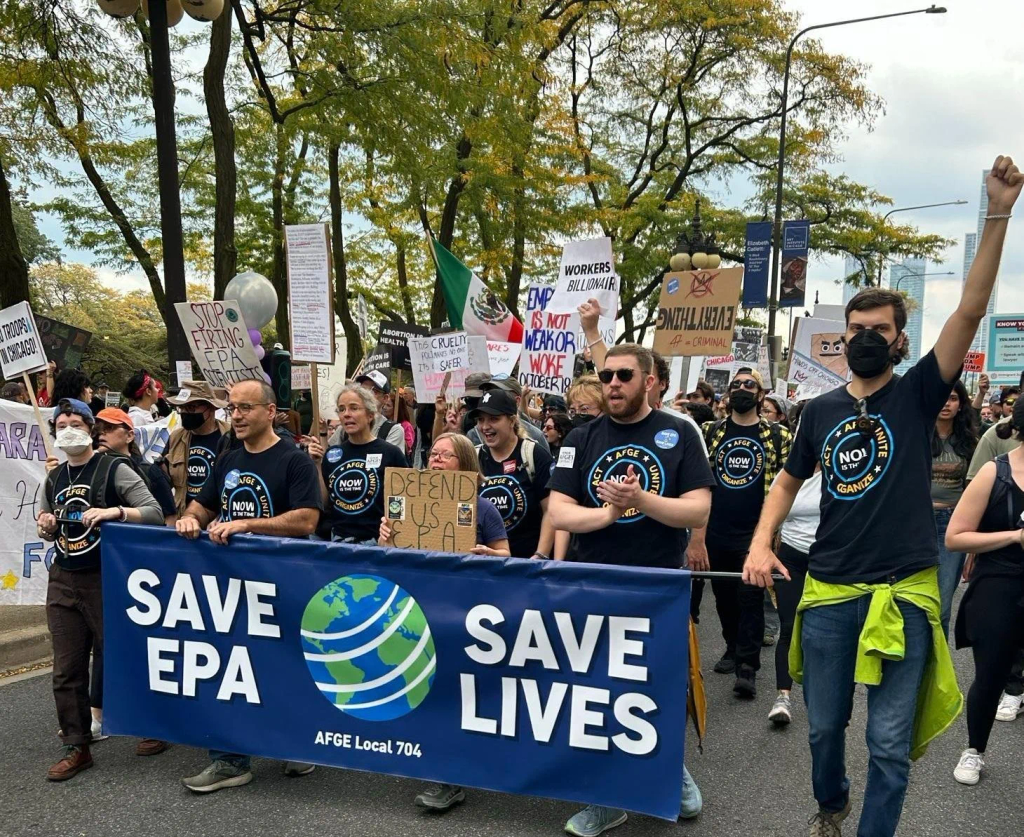
Indeed, AFGE locals at the National Institute for Occupational Safety and Health (NIOSH) saved their agency from Vought’s chainsaw, in a “victory for workers and [the] public,” by engaging in common good unionism. The work done by scientists, engineers, and technical experts at NIOSH—including research on heat stress, chemical hazards, and other workplace risks—is essential to protecting working people around the country. After nine months of organizing and collective action, during which AFGE’s NIOSH locals teamed up with the non-federal workers they serve, the Trump administration rescinded layoff notices for roughly 1,000 NIOSH employees.
Rank-and-file federal unionists want that sort of thing to happen more often and to serve as a model for labor movement resistance to Trump 2.0. The NIOSH fight illustrates a promising strategy: connect the dots between real and proposed cuts engineered by Vought and current or likely material harms facing ordinary people. More recently, the American Postal Workers Union did exactly this in pushing back against plans to undermine vote-by-mail.
How Trump 2.0 Gave Us The Shittiest Summer Yet
The current surge in food-related illnesses has unfolded in the wake of Trump and Vought’s dismantling of the nation’s food safety net. Foodborne pathogens are poised to thrive amid rising temperatures. That the Trump White House has undermined our ability to track and contain food-related illnesses at a time when outbreaks are becoming more likely does not bode well for the future. The following facts ought to be repeated ad nauseam by federal unionists as part of a long-term political education effort.
In the summer of 2025, the Centers for Disease Control and Prevention (CDC) weakened its FoodNet surveillance program, a collaboration between federal and state regulators. In its alleged pursuit of “government efficiency,” the Trump regime eliminated mandatory reporting requirements for six foodborne pathogens—campylobacter, cyclospora, listeria, shigella, vibrio, and yersinia—and maintained them for just two disease-causing bacteria: salmonella and E. coli.
One year later, tens of thousands of people around the country are suffering from explosive diarrhea triggered by cyclospora linked to iceberg lettuce. So far, the parasite has sent more than 1,000 people to the hospital across 49 states, and at least two cyclosporiasis-related deaths have been recorded. Another person died from a listeria infection linked to ricotta cheese.
Given that the two pathogens still fully monitored by the CDC’s FoodNet surveillance program—salmonella and E. coli—have caused hundreds of illnesses this summer, it’s clear that factors besides that one tracking effort are important. The overarching problem is chronic public health austerity. The Trump regime’s comprehensive assault on various federal, state, and local agencies has intensified weaknesses caused by long-term disinvestment.
Health and Human Services (HHS) Secretary Robert F. Kennedy Jr. slashed about 20% of the Food and Drug Administration’s (FDA) entire staff (pushing out more than 4,600 workers) and at least 25% of the CDC’s (removing more than 3,200 workers). The lab tasked with identifying and responding to cyclospora outbreaks was not spared.
As career civil servants were purged from HHS, the number of political appointees soared. Brooke Rollins reduced the U.S. Department of Agriculture’s (USDA) Food Safety and Inspection Service staff by around 10% (ousting more than 1,100 workers). What’s more, much of the agency’s research into cyclospora was shuttered in 2026 amid budget cuts and relocation turmoil.
To blame the nationwide “shit show” on Trump, Kennedy, and other administration officials is fair in light of their reckless gutting of the country’s food safety apparatus and other public health infrastructure.
Cyclosporiasis isn’t the only ongoing scourge precipitated by the Trump White House’s liquidation of the federal government. The recent resurgence of screwworm in the United States was also preventable. But preventing the spread of the flesh-eating parasite required continued public investment in poorly understood and largely invisible work done by federal employees. Unfortunately, DOGE defunded that work based on the presumption that it was “wasteful.”
Do you trust DOGE or federal scientists about the necessity of anti-screwworm measures? The Trump administration is now deploying tens of millions of dollars to contain a mess that it created in a bid to allegedly “save” money. Animal welfare, farmworker safety, and the cost of living are likely to suffer as a result.
Behind-the-scenes work done by federal employees is what allowed you to go grocery shopping without fear. The Trump administration’s attacks on them have jeopardized the safety of your food. For all of our sakes, we need a strong federal government—fully staffed by empowered workers—committed to enhancing the public’s well-being.
The simultaneous screwworm, cyclospora, etc. outbreaks exemplify the fundamental importance of government in a complex society like the one we live in. They are the first high-profile domestic instances of DOGE chickens coming home to roost. They won’t be the last.
Experts on Promoting the General Welfare Can Popularize Solidarity
Because civil servants do work that is designed to protect the public from adverse outcomes, the ongoing Vought-led assault presents an opportunity to popularize the solidaristic notion that an attack on the federal workforce is an attack on our collective well-being. Federal employee unions have an indispensable role to play in this pedagogic effort—a necessary component of reversing Voughtism and burying its long-term prospects.
And it’s particularly strategic for them to do so in groups with their co-workers, with the backing and protection of their own unions while soliciting the solidarity of the broader labor movement and community organizations which must defend public services across the board. Such collectivized efforts are far more politically effective than what might otherwise be left to risky individual heroism.
Federal workers shouldn’t be expected to act in isolation. Government personnel can tell stories alongside community and labor organizers, some of whom they may have already collaborated with in the course of their work. When unions representing NIOSH employees staved off 1,000 layoffs earlier this year, they worked in concert with other labor and public health champions. It’s not hard to envision EPA staffers teaming up with environmental justice activists, VA personnel with veterans group leaders, CFPB employees with consumer protection organizations, and so on. To synergize federal workers’ general risk reduction expertise with local advocates’ specific knowledge of on-the-ground ramifications could prove fruitful.
Out of the wreckage of Voughtism, we can build a government that is truly of, by, and for the people.
Photos: Federal Unionists Network