
Corruption Calendar Week 47-48: Trump’s giveaways to corporations continue to pile on as Americans suffer from an affordability crisis.
This newsletter was originally published on Revolving Door Project’s Substack.
Welcome to Revolving Door Project’s Corruption Calendar, where we provide in-depth explanations of the material consequences—real and potential—of the Trump administration’s corrupt policymaking, with an emphasis on tangible harms to working people. Read our first thirty-nine issues here, and follow us on Bluesky and X for more updates on this work.
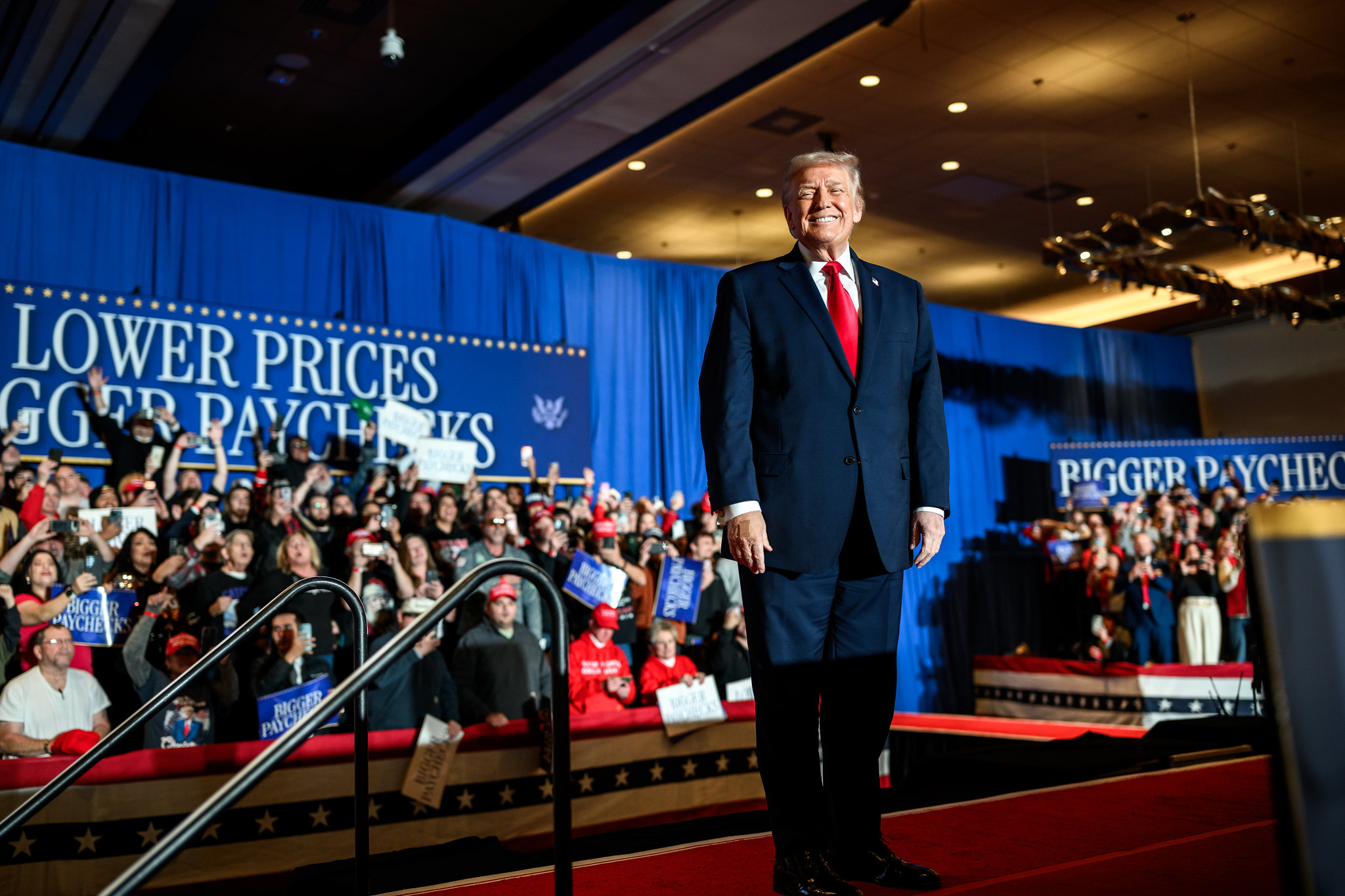
Trump does not care about the cost of living crisis Americans are facing. There are many more pressing, law-defying priorities on his list, including retribution against his political enemies, attempting to instigate a war against Venezuela, and renaming the Kennedy Center in Trump’s own honor.
When it comes to decreasing prices for everyday Americans, the thing he was ostensibly elected to do, Trump is failing miserably. When it comes to his true desire to hand free rein of the economy over to his corporate benefactors, however, Trump continues to outdo himself.
Affordability is just a word
Two fossil fuel billionaires are under fire for buying up stock in their own liquefied natural gas (LNG) company days after meeting with the White House. Robert Pender and Michael Sabel took their company, Venture Global, public in January. But, after meeting with senior White House officials in March, the two execs bought more than a million shares in Venture Global. Days later, the White House issued the company “a key regulatory permit that helped expand the company’s business in Europe.”
Maryland Senator Chris Van Hollen called the incident a “blatant use of cronyism and pay-to-play politics,” saying the Trump administration is “padding the pockets of billionaires at the expense of working Americans.” Senator Jeff Merkley called for the stock trades to be investigated “for potential conflicts of interest and insider trading.”
It’s not just a matter of bad ethics; as Senator Ro Khanna pointed out, “LNG exports will raise energy prices for American families and businesses,” which will inevitably hurt Americans’ pocketbooks at a time when Trump purports to care about “affordability.”
Trump’s faux concern about cost of living has always been merely lip service. Even so, his betrayal of even the performance of concern for everyday people continues to reach ever new lows. Consider, for example, that it was left to a judge to order the release of an unredacted lawsuit lodged by Lina Khan’s FTC that was killed by Trump’s appointees and gets to the heart of contemporary profiteering. In January 2025, the FTC accused Pepsi of “illegal business practices that raise prices for Pepsi products at every retailer besides Walmart.” Trump’s FTC smugly dismissed the lawsuit as a “nakedly political effort to commit this administration to pursuing little more than a hunch that Pepsi had violated the law.”
But now that the evidence of Pepsi’s scheme to drive up prices for competitors and their customers is public, the administration has egg on their faces. Trump may find it even more difficult to convince Americans that his administration is serious about bringing down consumer prices when they so clearly prefer empty political theater over accountability for abusive corporations.
DOGE in space
As Wired reminded us earlier this month, DOGE isn’t dead. Despite Elon Musk’s (very) public falling out with President Trump, Musk’s minions have burrowed deep into the executive branch, and have continued carrying out “the DOGE ethos” of cutting contracts, the federal workforce, and consolidating federal data for nefarious means, all while continuing to do irreparable damage to the programs Americans depend on.
This week, the Senate confirmed Musk’s man and fellow billionaire Jared Isaacman as the new administrator for NASA. Though Trump withdrew Isaacman’s nomination in the midst of his public feud with Musk, he renominated the former SpaceX private astronaut in November.
Isaacman will now lead NASA, which had its workforce and budget slashed by upwards of 20 percent under DOGE’s direction. Per Isaacman’s nomination hearing, his priorities for the agency will include space exploration developments that do not “rely exclusively on the taxpayer;” in other words, handing off publicly-funded developments and discoveries for the benefit of private corporations (like, hypothetically, SpaceX). Isaacman’s leaked plan for NASA also includes taking the agency “out of the taxpayer funded climate science business,” the long term effects of which will inevitably harm Americans as climate catastrophes grow worse and more frequent. Isaacman has also embraced Trump’s mission to mine the moon.
Chemical industry loyalists say formaldehyde isn’t that bad for you, really
The Trump administration isn’t only willing to concede to greedy corporations when it comes to prices – Americans’ health is on the menu as well. ProPublica reported that chemical industry lobbyists have succeeded in pushing the Trump administration “to adopt a less stringent approach to gauging the cancer risk from chemicals.” To that end, the EPA announced this month that it will revise the agency’s assessment of “the health dangers posed by formaldehyde, a widespread pollutant that causes far more cancer than any other chemical in the air,” increasing the amount of formaldehyde considered safe to inhale to nearly double what the Biden administration considered safe.
What government servant would be willing to risk Americans’ health for loosened regulations? As is often the story for the Trump administration, those calls are now being made by revolvers from the industry in question – in this case, former lobbyists for the American Chemistry Council Nancy Beck and Lynn Dekleva, who have long “pushed back against the EPA’s efforts to regulate formaldehyde.” Dekleva is now the deputy assistant administrator of the EPA’s Office of Chemical Safety and Pollution Prevention, which carried out the formaldehyde assessment. Beck is a principal deputy assistant administrator who signed off on the official agency memo on the change.
(Sidenote: Corporate power is so pervasive in this administration that Beck and Dekleva aren’t even the only chemical industry lobbyists of note within it! Other admin staffers associated with the industry include people like the EPA’s Deputy Assistant Administrator for the Office of Land and Emergency Management, Steven Cook, who was previously in-house counsel for the chemical giant LyondellBasell; Mallory Richardson, the EPA’s Senior Advisor for the Office of Policy, who was a Government Affairs manager at Chemours from 2023-2024; and Douglas Troutman, a Senior Advisor at the EPA, and current nominee to be the agency’s Assistant Administrator for Toxic Substances who revolved to the admin from the American Cleaning Institute—a chemicals industry trade association whose board includes reps from chemical giants like Dow Inc and Shell Chemicals. For more on chemical industry revolvers check out this report from October.)
Crypto is off the hook
The New York Times this week did a deep dive confirming a story that may have already been evident to readers of this newsletter: under Trump’s leadership, enforcement officials overwhelmingly dropped their cases against crypto firms. The SEC’s retreat included a dropped lawsuit against Binance and a softened punishment for Ripple Labs. In all, the NYT reported that the SEC “had eased up on more than 60 percent of the crypto cases that were ongoing when Mr. Trump returned to the White House, moving to pause litigation, lessen penalties or outright dismiss the cases.” Meanwhile, the SEC “has not brought a single crypto case” since Trump’s takeover. ‘Will of the people’ this is not — Americans are in agreement that crypto is not good for society.
Clawing back ethics during an administration of corruption
In a time when public trust in our institutions has understandably floundered (see: every edition of this newsletter), House Democrats have a rare opportunity to take action on a popular ethics policy: a congressional stock trading ban. As The American Prospect reported earlier this week, “legislation banning stock trading by members of Congress is favored by more than 80 percent of Democrats, Republicans, and independents.” Encouragingly, a new ban effort backed by House minority leader Hakeem Jeffries would also expand the stock trading prohibition to the president, the vice president, and their families.
As one might expect, Republicans aren’t so enthusiastic about removing one of Trump’s pay-to-play tools, possibly dooming the effort. But Democrats shouldn’t let perfect be the enemy of good — a congressional-only stock ban is a worthy first step to re-normalizing the idea that our government officials shouldn’t have rampant conflicts of interest, even if it’s one step among many.
One of those many steps to restore our institutions: creating brighter lines for conflicts of interest where Trump’s White House advisors have muddied them. The New York Times reported that Trump advisor Stephen Miller sold his shares of a mining company, MP Materials, at a historic high “following a lucrative deal between the company and the government.” Public Citizen co-president, Robert Weissman, said it was not obvious that the sell off violated any ethics rules, but Miller’s “large investment in an obscure company that just happened to massively benefit from the unusual interventions of the Trump administration” is “a really bad look.” Our government’s ethics rules and regulations have been blown out of the water by the corrupt actions Trump and his lackeys are willing to take, and rebuilding those norms for the future will be a laborious and important effort.
Quick Corruption Hits
- A donor to the America First Policy Institute, the definitive MAGA think tank, has been awarded a $1 billion contract with the Department of Homeland Security to ‘help’ immigrants self-deport.
- Still trying to make heads or tails of Trump’s pardon of the drug-trafficking former president of Honduras? Mother Jones followed the tech bros and uncovered Juan Orlando Hernández’s connection to a Thiel and Andreessen-funded effort to build a rightwing utopia.
- Donald Trump Jr. joined the board of Unusual Machines, a drone company, last year. Now the company has received a $620 million Pentagon loan.
Want to help document Trump’s corruption and the ways his administration is harming Americans? Consider applying to the Revolving Door Project Research Internship! Apply by January 9, 2026.