
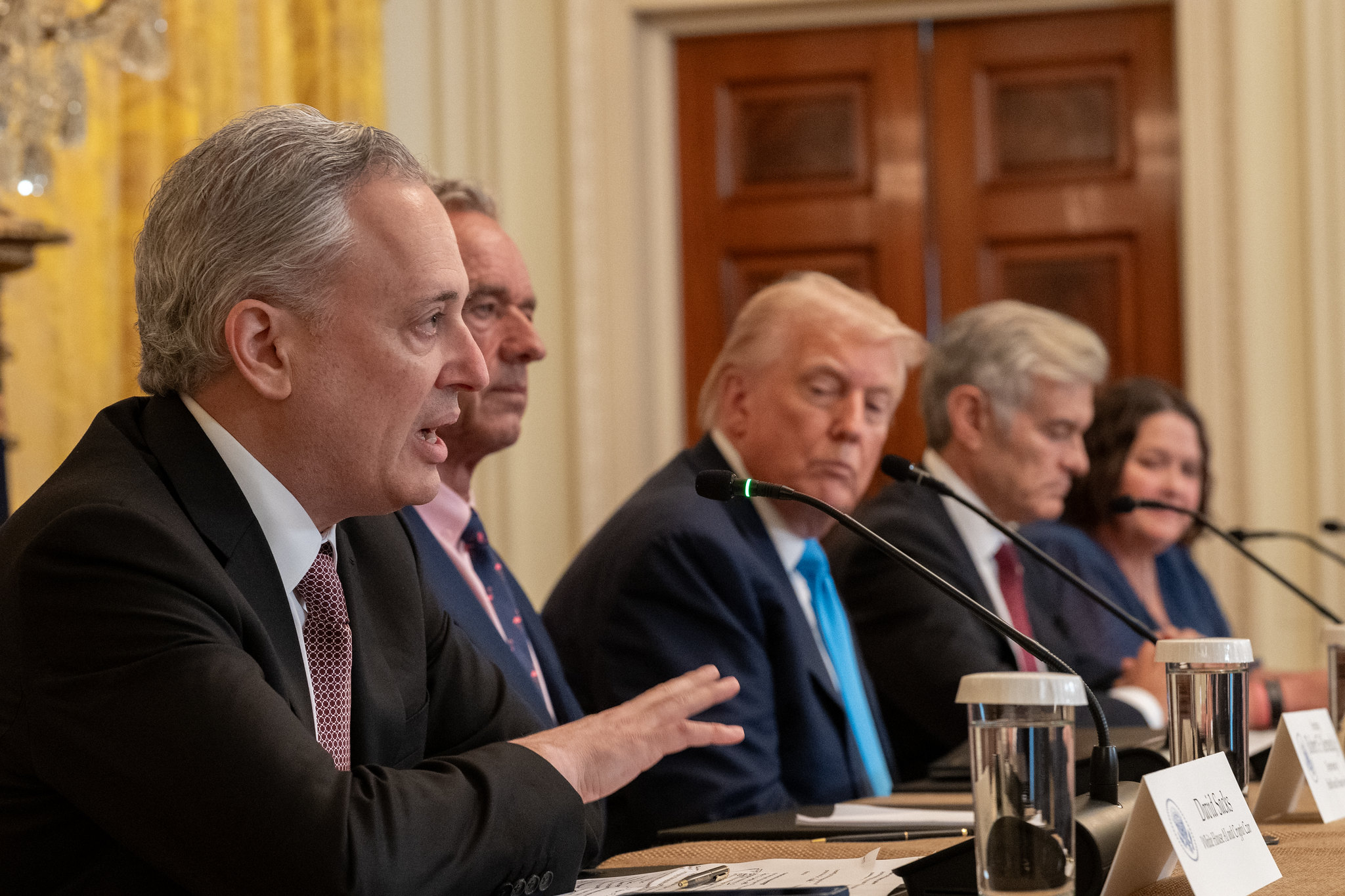
As the AI and crypto czar, Sacks led policies that exposed Americans to economic instability, environmental dangers, and fraud – and he’s not done yet.
On March 26, billionaire investor David Sacks stepped down from his White House role as the Special Advisor on AI and Crypto. This may come as welcome news to people stupefied by the extent of Trump administration’s constant corporate giveaways to the AI and crypto industry, which Sacks orchestrated. But don’t be fooled: just a day before his departure as an advisor, Trump announced that Sacks would be co-chairing the President’s Council of Advisors on Science and Technology (PCAST). The council is a who’s who of Sacks’ venture capitalist peers like Marc Andreessen and Silicon Valley executives like Sergey Brin and Mark Zuckerberg. With Sacks at the helm, we can reasonably presume that PCAST’s advice on “strengthening American leadership in science and technology” will miraculously end up lining their own pockets.
As Sacks transitions into his new role, a post-mortem on the policy guidance provided by the Trump administration’s crypto and AI czar is a necessary imperative. Below, we breakdown a slew of ethics violations and the consequences of a move-fast-and-break-things approach to tech policy before forecasting what may be to come in Sacks’ new role.
A Walking Conflict of Interest
Sacks joined the White House as a “Special Government Employee,” (SGE) a rank that was first created to allow the federal government to hire individuals with issue-specific expertise on a temporary or intermittent basis. For example, an SGE might be appointed to a Federal Advisory Board based on their knowledge of a particular scientific field, and be tasked with “attending committee meetings, writing reports, and voting on potential government actions.” SGEs may serve for up to 130 days within one year, and as their positions are temporary, their ethics requirements are less stringent than those required of full-time federal employees.
The Trump administration’s use of SGEs, however, is well outside the norm of the role. The administration used SGE appointments to hand Elon Musk and his minions unprecedented power over the government. Sacks’ turn as an SGE was yet another instance of taking a role created to help the executive branch govern more effectively and turning it into a position that facilitates corporations’ free rein over their regulators.
Sacks’ financial disclosure revealed his investments in hundreds of tech, AI, and crypto companies, both directly and through his venture capital firm, Craft Ventures. Even after selling $200 million in crypto-related holdings, Sacks’ long list of active investments conflicted with the tech, AI and crypto policy he was tapped to lead. Yet the White House waved their wand (read: issued an ethics waiver) and allowed Sacks to take up the role.
SGE rules, like many of our government’s ethics norms, rely on a presumption of good faith. SGEs are expected to police their 130 day limit on their own (including determining what their ‘days of service’ are), and there’s no enforcement mechanism to remove SGEs who have outstayed their 130 day limit.
When Sacks was 165 business days into his 130 day role, a group of lawmakers concerned with the administration and its crypto czar running roughshod over ethics law, launched an investigation. It took another 127 business days for Sacks to claim to have “used up” his time as an SGE. Under an administration that ignores ethics on a daily basis, it’s hard to believe that ‘good faith’ played any role in Sacks’ departure.
While SGEs are recruited to provide specialized expertise that the government might lack, there is also an expectation that the scope of an SGE’s work be narrower than the broad range of services executed by regular government employees. But Sacks’ responsibilities were well outside the narrow scope of a Federal Advisory Committee or even one government agency. Sacks’ work in the White House impacted policy at every agency that has anything to do with tech, AI or crypto. His decisions affected the financial future of entire industries, including the hundreds of specific companies he’s tied to.
Sacks’ Heavy Hand in Trump’s Soft-touch AI Policy
Sacks’ fingerprints are all over two of the Trump administration’s most sweeping documents on AI policy: the July 2025 AI Action Plan and the March 2026 National Policy Framework for AI. The more ambitious of the two is the Action Plan, which was mandated by a January 2025 executive order. In this document, Sacks and his co-author Michael Kratsios, director of the Office of Science and Technology Policy (and former Scale AI exec), justify an all-in approach to AI by arguing that “the United States is in a race to achieve global dominance in artificial intelligence.” Since July 2025, the White House has largely heeded Sacks’ advice. As detailed by Data and Society’s “Big AI State” report from January 2026, the Trump White House has pursued the AI race by de-risking the creation of data centers through subsidies, tax incentives, loan guarantees, and the selling of federal lands to developers.
By March 2026, when Sacks ended his time as SGE, the downstream effects of the “AI race” that Sacks wanted had become clear. The data center buildout had sparked local protest movements over pollution, job loss, and skyrocketing utility rates. Children had been the subjects of AI-generated deepfake pornography and allegedly coached into suicide by chatbots. According to one NBC poll, only 26% of Americans held a positive view of AI. When Sacks unveiled the National Policy Framework the week of his change in title, he was forced to recognize the immense unpopularity of his policy advice, and tried reassuring voters that it would resolve public concerns about “the 4 Cs”: child safety, community, creators, and censorship.
Inflating the AI Bubble
One outcome of Sacks’ legacy is that the AI industry now looks a bit like an irremovable tumor on the American economy. Last October, Harvard economist Jason Furman concluded that nearly all of U.S. GDP growth in the first half of the year came from data center investment. Data and Society’s Big AI State report adds that the White House’s de-risking strategies have substantially increased AI spending by private investors. This level of investment has led to reasonable concerns that AI-related investments are a bubble and that this bubble could pop. If overinvestment in AI creates a financial crisis that leads to a dot-com or even a 2008 mortgage-style recession, then Americans should rightly drop some of the blame on Sacks’ doorstep.
AI Policy’s Deterioration of the Workplace
In December 2025, Sacks claimed that “we are seeing an overall AI boom that’s benefiting the economy.” More honest observers have found that this is not the case. The journalist Brian Merchant has documented the impact of AI in a variety of sectors through his “AI Killed My Job” series. From teachers and copywriters to software engineers and translators, AI has been cited by a variety of companies as cause for mass layoffs. What’s more, Merchant’s reporting and other emerging research have shed light on how those employees who haven’t been laid off are working more rather than less. While communities were promised that the push for more AI infrastructure would create jobs, the evidence for that claim is unconvincing to say the least.
If increasing layoffs and fear of financial contagion weren’t bad enough, AI is also making everything else more expensive, as our Kenny Stancil detailed in January. Data center construction has contributed to increases in local energy costs by as much as 267%, and the federal government is using AI to automatically reject Medicare claims.
AI Policy’s Harms to Children
Of all the Cs in Sacks’ list, the one that’s aroused the most bipartisan anger is child safety. One September 2025 poll from the Institute of Families found that 90% of voters believe Congress should prioritize regulations which protect children over the growth of the AI sector. OpenAI has been on trial for multiple high-profile suicide cases, in which their tool ChatGPT allegedly coached teens into suicide or otherwise encouraged suicidal ideations. Character Technologies and its partner Google have had to settle multiple lawsuits, including a wrongful death suit filed by Megan Garcia over her son Sewell’s suicide. Grok, the chatbot from Elon Musk’s xAI has also been a source of scandal. In a March lawsuit, the plaintiffs alleged that Grok was used to virtually “undress” photos of underage girls.
Sacks claimed that the new federal policy framework leaves space for states to regulate chatbots to reduce harms to minors, but this is a gross mischaracterization. Sacks’ framework asks that Congress allow states to enforce “generally applicable laws protecting children,” but it also encourages Congress to penalize states for creating new laws which might safeguard minors—or anyone else for that matter.
The Fossil Fuel’s Industry’s AI Payday
Propping up the AI industry has also created disastrous knock-on effects for the environment. A growing body of research, including a March 2026 report from Food and Water Watch, shows that the data center buildout is a boondoggle for the natural gas industry and has even revitalized demand for coal. Over 220 new natural gas facilities are currently being constructed in the US to support the AI boom, and four states have cut green energy investments to extend the lives of soon-to-be decommissioned coal plants near data centers.
People living in proximity to fossil fuel-powered data centers are at increased risk of developing cancer. Water use is another major concern. As our partners at the Climate and Community Institute pointed out in November, two-thirds of new data center projects occur in water-stressed areas. Considering the fact that major drinking water sources like the Colorado River are already being strained by factory farming, Sacks’ data center buildout could prove to be the straw that breaks the camel’s back.
The Crypto President’s Advisor
As we and many other groups have been documenting, crypto has been Trump’s main vehicle for corrupt self-enrichment during his second term as president. Sacks’ role as crypto czar means that he’s been in the driver’s seat, allowing crypto companies to extract their regulatory wishlist from the Trump administration while Trump and his family cash in on their schemes.
One of Trump’s first acts in the White House was to pass an executive order on crypto that established Sacks as the co-chair of a new National Economic Council working group on Digital Asset Markets, giving him a hand in crypto policy across the administration.
In March 2025, the White House established a “Strategic Bitcoin Reserve,” a move praised by Sacks for helping to make the US the “crypto capital of the world.” Rather than some sort of public good, the move solely benefits crypto investors and puts taxpayer dollars at risk if the value of the reserve falls.
In July 2025, Congress passed the GENIUS Act to ‘regulate’ crypto, which Sacks called a “massive win.” Consumer advocacy group Americans for Financial Reform blasted the legislation, saying it “rewards crypto tycoons driving the assault on democratic governance,” while making it easier for crypto schemers like Trump himself to “issue their own money, giving them even more control over our data and financial system.” In addition to engendering even more corruption, AFR rang the alarm that “the GENIUS Act’s inadequate anti-money laundering provisions allow bad actors to use stablecoins in harmful ways that threaten our safety and security.” Overall, AFR warned, the legislation “will make our financial system less stable and less safe.”
The Trump administration engaged in an across-the-board effort to let crypto companies off of the regulatory hook. This spans from dropping SEC cases against crypto giants—including Binance, Ripple, and Coinbase—to shuttering the DOJ’s crypto enforcement unit. After Trump’s inauguration, cases against crypto firms plummeted to literally zero. All the while, Sacks was celebrating the administration’s anti-regulatory actions. He cheered on Russell Vought’s destruction of the CFPB, calling the effort his “personal favorite” administrative action and describing the agency as Elizabeth Warren’s “personal goon squad to terrorize crypto companies.” In reality, regulation protected Americans from crypto-facilitated fraud, investment scams and extortion, threats that are made all the more real because of the Sack-led rollbacks.
Sacks’ Influence Is As Powerful As Ever
Make no mistake: Sacks is still directing the White House’s AI agenda. As the new co-chair of the President’s Council of Advisors on Science and Technology, he’s still “the face of the Trump Administration’s AI policy.” He admitted that his shift from advisor to leading PCAST formalizes his influence rather than ends it. And there’s plenty of harm Sacks could still direct when it comes to AI and crypto policy, especially should either of those precarious industries start to falter.
A looming possibility is that Sacks could steer the Trump administration’s response to a financial crisis started by the tech sector. Who could forget when the collapse of Silicon Valley Bank sent Sacks & Co. into histrionics over the need for a bailout? Considering mounting concerns in private credit markets, Sacks’ council of tech luminaries may get a say sooner rather than later in how to restructure a post-crash economy. As our Timi Iwayemi noted on the three year anniversary of the SVB collapse, Trump’s Fed regulators have been hard at work rewriting the history of the bailout, where the public was put on the hook for the carelessness of VCs and crypto investors.
Before the end of the Trump administration, we may find that there’s plenty of money to bail out tech firms for the trillion-dollar bet that AI dominance would lead to unlimited profits. If this happens, we shouldn’t be surprised if there’s a repeat of what our Dylan Gyauch-Lewis observed during the SVB bailout: we will suddenly have funding aplenty to make wealthy investors whole, but policies that would help everyday people like Medicare for All or subsidizing child care will simply die on the vine.
While Sacks is currently in Trump’s inner circle, we also must be wary of him switching sides should Democrats come back into power. He was, after all, once a donor to Hillary Clinton and Gavin Newsom. Even now, as he pushes Congress to pass legislation for an AI policy framework, he’s making inroads with Democratic lawmakers. His legacy thus far under the Trump administration should be more than enough evidence to prevent him joining the Democratic fold in the future.
For more of RDP’s work on Sacks, read:
- How the AI Industry’s Race To Dominance Has Harmed Children – RDP tracker
- Reclaiming an Abundant and Democratic Future in the Age of AI – RDP Newsletter, December 3, 2025
- How Crypto Is Buying DC One Revolver At A Time – RDP Blog, June 18, 2025
- Graft And Scams Rule The Republican Party. Let Them Have It. – RDP Newsletter, July 16, 2024
- Celebrating A Year Of All In – RDP Newsletter February 9, 2024