
Bad Bunny’s climate politics: loving people and place
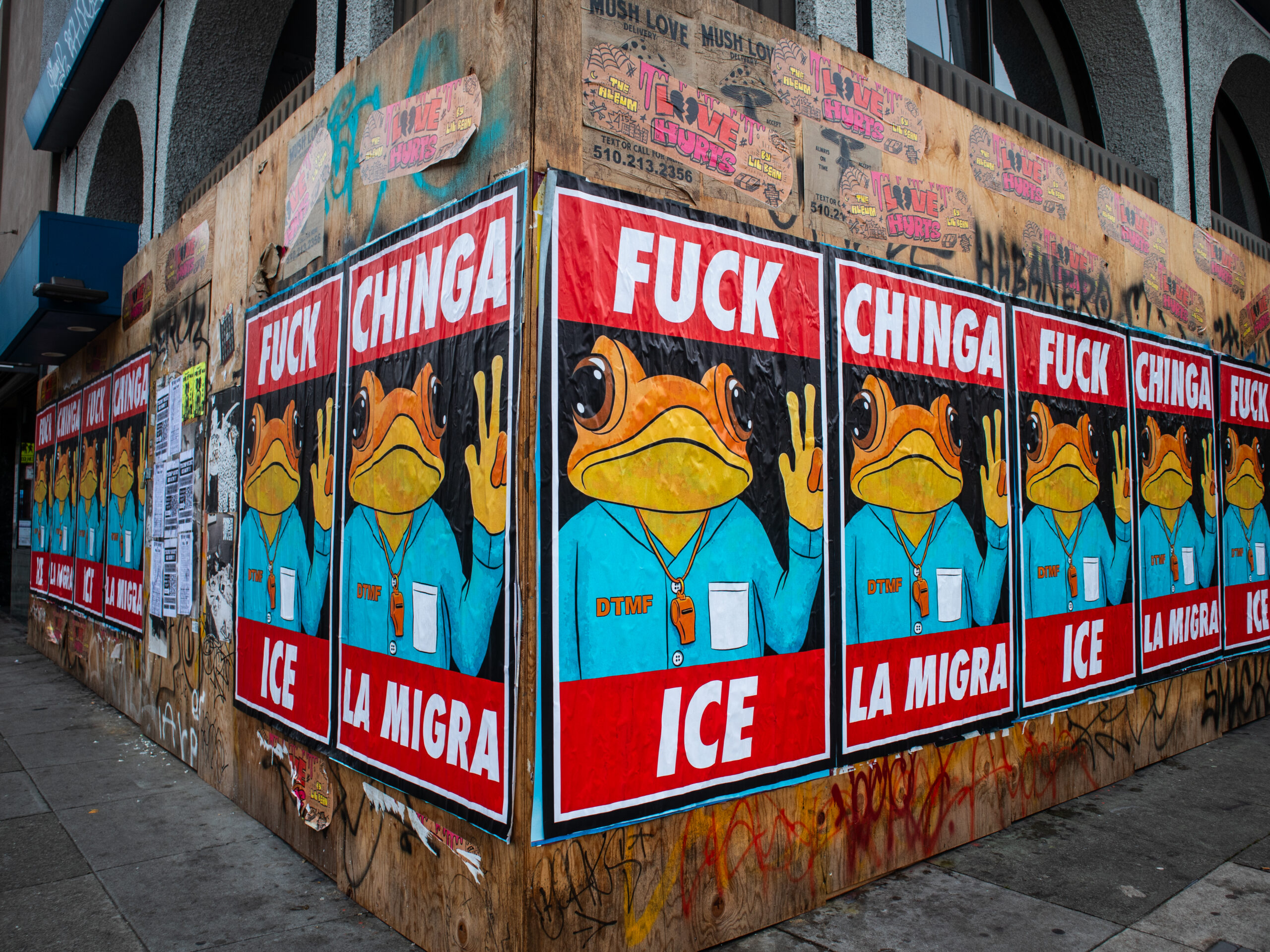
Photo of posters on Mission Street in San Francisco by Mariana Garcia.
In the days leading up to the Super Bowl, posters went up around the Bay Area with images of el sapo concho, the endangered Puerto Rican crested toad, saying “ICE OUT,” “FUCK ICE,” and “CHINGA LA MIGRA.” This canny combination owes its inspiration to Benito Antonio Martínez Ocasio, aka Bad Bunny, who incorporated the toad as a mascot for his Grammy award-winning album DeBÍ TiRAR MáS FOToS. Bad Bunny has been outspoken against ICE. He decided not to play any shows in the continental U.S. during his 2025-26 world tour for fear that ICE would target his fans, before making just one exception: the Super Bowl halftime show.
Bad Bunny put on a tremendous performance, loaded with cultural and political symbolism that kicked the cottage industry of social media explainers into overdrive. Sandwiched between hours of ads for and made by AI, where one second of airtime cost hundreds of thousands of dollars, Bad Bunny’s celebratory humanism was especially striking. The Puerto Rican community populates every corner of his creative world, and his practice is a continual act of honoring them. He shows us how these relations extend outward, holding us together: from Chile to Panama to Mexico to Canada, “together we are America.”
But as Federico de Jesus points out, Bad Bunny’s advocacy shouldn’t be reduced to a celebration of a “generic pan-Latino version of America.” He is a vocal critic of the colonial status of Puerto Rico, and “is insisting, in the most public way possible, that Puerto Rico exists, that it is being hollowed out, and that this process has a political cause.”
This love of people and place animates his outspoken politics on issues affecting Puerto Rico. In his music and public comments, he’s addressed gentrification, gender-based violence, political corruption, the biodiversity crisis, racism, colonialism, and the push for Puerto Rican independence. He has been vocal about governmental failures in the wake of Hurricane Irma and Hurricane Maria, including stalled disaster aid, land grabs, and the destructive privatization of the electrical grid.
Power and Who Has It
Three-quarters of the way through the half-time show, the stadium lights began to flicker. As Bad Bunny sang “El Apagón” (The Blackout), dancers in work harnesses propelled themselves from sparking utility poles. Bad Bunny brought the routine indignity of Puerto Rico’s blackouts to over a hundred million viewers.
The island’s electrical grid has been unstable for decades, but the one-two punch of Hurricane Irma and Hurricane Maria in 2017 dealt catastrophic damage. Over one thousand people died, 80 percent of the agricultural sector was wiped out, and the entire power grid was brought down. Some parts of the island didn’t regain power for eleven months. In 2022, Bad Bunny released El Apagón along with a 20-minute documentary music video that offers a crash course in Puerto Rico’s colonial history, cultural resilience, economic inequality, and the accelerating displacement in Maria’s wake. A few months later, Hurricane Fiona knocked out the power for millions of Puerto Ricans for weeks.
After Maria, the Puerto Rico Electric Power Authority (PREPA) declared bankruptcy and began a contested privatization process which eventually resulted in LUMA Energy taking over the island’s electric grid for a fifteen year contract. Mismanagement and blackouts have continued under LUMA, which chose to double down on expensive imported fossil fuels instead of going all-in on a distributed renewable energy system that would insulate households from grid-wide power outages. The Puerto Rican government sued LUMA in December 2025 to cancel the company’s contract.
The region was also hamstrung by President Trump’s prioritization of emergency response efforts that served him politically. Trump repeatedly undermined the recovery from Hurricane Maria during his first term. After initially offering only a $4.9 billion loan for a $90 billion disaster, Trump de-prioritized FEMA resources for Puerto Ricans in comparison with Texans suffering from Hurricane Harvey and deprived the island of $20 billion in congressionally-approved funds for years, all while blocking investigation into why that funding was stalled.
Now in his second term, Trump continues to undercut Puerto Rican resilience, cutting off hundreds of millions of dollars in funding for multiple programs that would have seen solar and battery systems installed for over 30,000 low-income families on the island.
The fight to free Puerto Rico from dependence on fossil fuels continues. Last fall, a cohort of local and environmental groups won a lawsuit against the Federal Emergency Management Agency (FEMA) for failing to consider rooftop solar and battery storage as a viable alternative when allocating billions to rebuilding the island’s energy infrastructure. A 2023 Energy Department report made it clear that the island’s abundant sunshine offered more than enough renewable energy potential for Puerto Rico’s needs. Representatives Alexandria Ocasio-Cortez (NY-14) and Nydia Velázquez (NY-07), along with Senator Richard Blumenthal (D-CT), recently wrote a letter urging FEMA to comply with the federal court’s ruling and prepare an environmental impact statement that considers distributed renewable energy as a viable alternative.
While the Trump administration pretends that rooftop solar is the cause of the grid’s “unacceptable instability and fragility,” people in Puerto Rico know that when the grid goes down, the only people who get to keep power are those with solar and battery systems, or gasoline or diesel-powered generators. Compared to noisy and polluting generators, residential solar systems are quiet, pollution-free, and don’t require waiting in lines for hours at the gas station to refill gas cans. Solar is much less disruptive to people’s lives. By rescinding funding for distributed energy systems, the Trump administration isn’t just turning off people’s power—it is sapping their time, money, peace, and clean air.
Puerto Rico has been failed for decades by administrations of both political parties. A year before Trump mangled the disaster recovery from Hurricane Maria, Obama signed PROMESA into law, deepening Puerto Rico’s political and economic subjugation to the United States. Democrats looking to draw political contrast with the right-wing backlash to Bad Bunny’s performance should not gloss over the depth and urgency of his critique, or how it implicates the entire U.S. political system.
Climate Change and Who Feels It
The Caribbean islands, like island communities around the globe, weather the injustice of being disproportionately harmed by climate change while contributing comparatively little to causing the crisis. The extreme intensity of Hurricane Maria was 4.85 times more likely to happen in the climate of 2017 than the climate of 1956, a University of Alabama study found, and the likelihood of such disasters continues to increase.
As Caribbean climate scientist Dr. Michael Taylor described in The Guardian in the wake of Irma and Maria, “even more heartbreaking [than the economic damage] is the loss of those things that are economically unquantifiable. The drastic reductions in living standards, especially for the most vulnerable, that will continue for months to come. The loss of irreplaceable culture and cultural assets, the mental anguish and loss of lives, the loss of biodiversity, and the destruction of ‘island life’ as we know it.”
In “LO QUE LE PASÓ A HAWAii,” which Ricky Martin performed during the halftime show, Bad Bunny sings:
Quieren quitarme el río y también la playa
Quieren al barrio mío y que abuelita se vaya
No, no suelte’ la bandera ni olvide’ el lelolai
Que no quiero que hagan contigo lo que le pasó a HawáiiThеy want to take my river and my beach too
They want my neighborhood and grandma to leave
No, don’t let go of the flag nor forget the lelolai
‘Cause I don’t want them to do to you what happened to Hawaii
While the lyrics of the song draw the connection between Hawai’i and Puerto Rico’s colonial histories, and warn against the displacement of local communities and culture, the music video goes a step further to connect human and ecological losses.
Bad Bunny worked with historian Jorell Meléndez-Badillo on a visualizer highlighting the species native to Puerto Rico in danger of extinction from the same forces that rip apart communities: climate disasters and economic exploitation, super-charged by the extractive forces of “disaster capitalism” that seize control in moments of crisis. In both Puerto Rico and Hawai’i over the last decade, we’ve seen land grabs from corporate real estate interests in the aftermath of disasters from Hurricane Maria to the 2023 wildfires on Maui, accelerating the displacement of locals—human and nonhuman.
El sapo concho, Puerto Rico’s only endemic toad, faces extinction from the combined forces of climate disaster and land use change. The toad’s only remaining natural breeding sites are in and around the Guánica Commonwealth Forest on the southern coast of Puerto Rico. Monitoring of the population has been spotty since Irma and Maria. According to the Fish and Wildlife Service, the toads are particularly vulnerable to climate change because they require ephemeral freshwater ponds for breeding. During the passage of tropical storm Elsa through the Caribbean Sea, scientists observed storm surge overcoming the beach barrier and flooding the breeding ponds with sea water.
“Sea level rise may eventually make most coast wetlands inhospitable for any freshwater species,” the federal agency observed in a 2022 report. “The health risk to offspring posed by rising salinity levels, as well as the deleterious effect of stress on reproduction, can be catastrophic for the reproduction on the wild toad populations in southern Puerto Rico.”
Bad Bunny, the most streamed artist in the world for the last four years, has elevated el sapo concho’s profile by transforming the toad into a symbol of Puerto Rico’s imperiled cultural and ecological heritage. At a time of historic institutional cowardice towards combating climate change, he reminds us what the fight is about: nothing less than preserving our treasured places in the world, and those we share them with.
This newsletter was originally published on our Substack. Read more and subscribe here.
Want more? Check out some of the pieces that we have published or contributed research or thoughts to in the last week:
An Abundance of Techno-Optimism
The AI Lobbyist Starting An Abundance Nonprofit
Tracking the Environmental Harms of Trump Actions
Map: Trump Has Often Delayed or Denied Disaster Aid
The Real Cost of Trump’s First Year
DOGE Lives On Through Russell Vought
For $1 Million, Donors to U.S.A. Birthday Group Offered Access to Trump