
“This article was originally published in Watchdog Weekly. Read and subscribe here.”
Note: This newsletter is an accompaniment to a related article published today in The American Prospect. For a deeper dive into my analysis of Russell Vought’s plans to “make it easier to fire federal workers while exempting political appointees,” please see the article here.
On April 1st, the Office of Personnel Management (OPM) updated the Federal Workforce Data (FWD) page to include data up until February 2026. The new data gives us the most complete picture yet as to how the Trump administration, led by Office of Management and Budget (OMB) Director Russell Vought, has torn asunder the capacity of the federal government. In September, our Will Royce detailed the disastrous early impacts, focusing on the General Services Administration, the Internal Revenue Service, the Census Bureau, and the Securities and Exchange Commission. Many of the trends that Will pointed out have continued or even worsened, and the analysis is worth revisiting.
This newsletter will focus on three key developments which underscore the need for an ambitious post-Trump revitalization of the civil service:
- The ongoing toll of the Deferred Resignation Program (DRP)
- How Vought’s rule changes have impacted the morale of federal workers
- The politicization of federal departments
A Slash and Burn Personnel Policy
Let’s start with the “fork in the road” email which was sent out to over 2 million workers–nearly the entire federal workforce–late last January. The email offered a deal to federal employees called the “Deferred Resignation Program” in which they could stop working until September 30th while still receiving pay. Federal employees who didn’t take the DRP were told that: “At this time, we cannot give you full assurance regarding the certainty of your position or agency…”
Vought and Musk’s goal was clear: convince as many federal employees to abandon their posts as possible. Indiscriminate cuts have created unintended consequences that even the Trump administration itself has attempted to reverse–who could forget their attempts to rehire Internal Revenue Service customer service representatives , or RFK Jr.’s plans to hire 12,000 new workers in the wake of last year’s massive layoffs at Health and Human Services?
The updated FWD page hints at a similar blunder happening in the Department of Veteran Affairs (VA). On the “Workforce Changes” webpage, the federal government’s HR department proudly reports the impact of Trump and Vought’s war on federal workers, including figures such as the overall decrease in employees since January of last year. In the one instance where the admin brags of a growth in the workforce, the webpage reads: “+130,195 Increase in Department of Veterans Affairs employees since FY 2015.” Someone skimming over this page could be forgiven for missing the “since FY 2015” qualifier for this statistic and the adjoining stat on the Department of Agriculture, as all other sections are dedicated to changes that have occurred as a result of Trump admin policy. The real change in VA employees is a net loss of over 28,000 people since Trump took office, making the administration’s claim that the VA is “putting veterans first” difficult to believe.
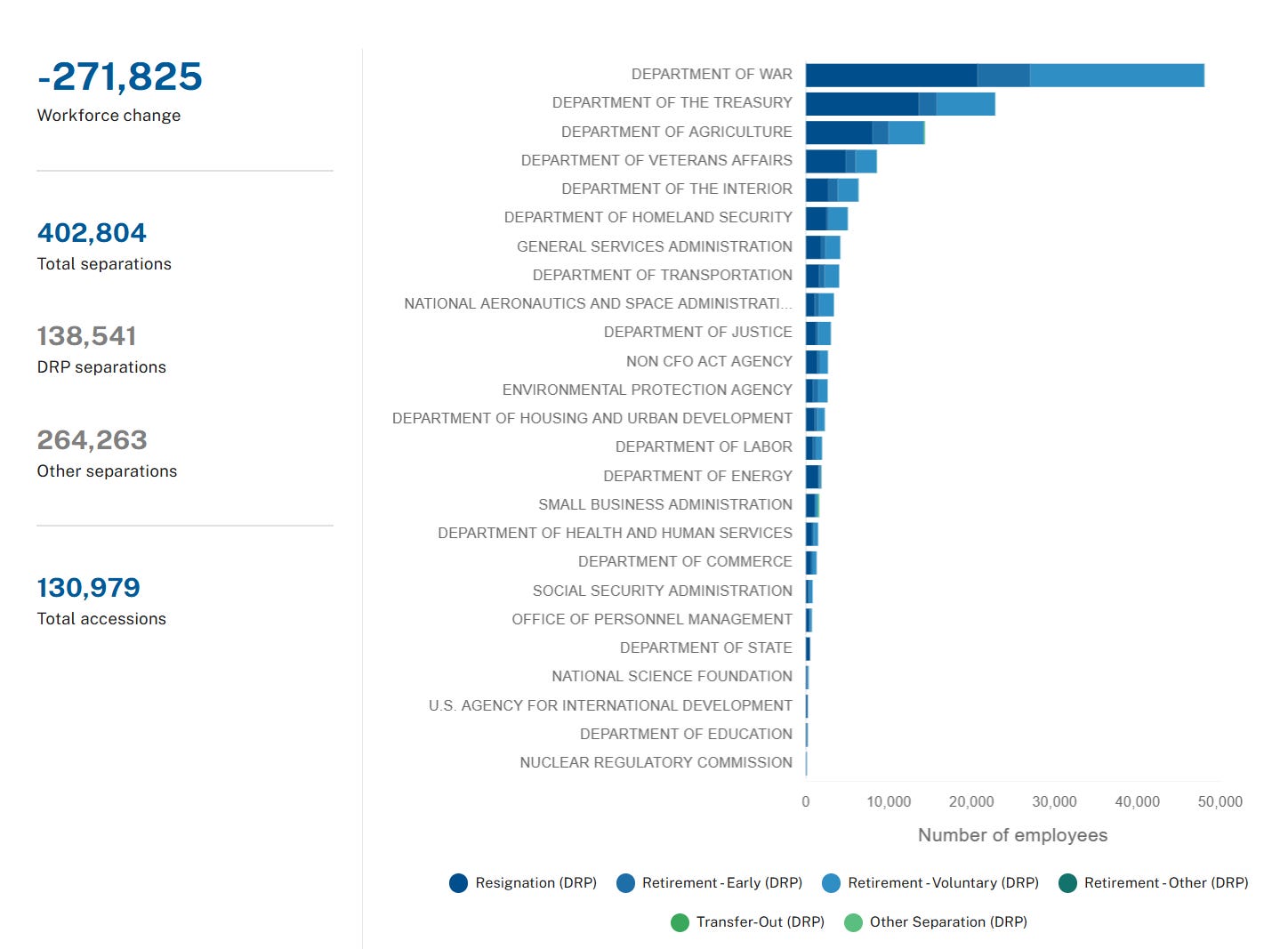
Unfortunately, the DRP was a tremendous success. According to OPM, over half of the net 271,825 jobs lost within the federal workforce can be attributed to the DRP: 138,541 people. This number is staggering, and will likely be adjusted upward with future payroll data. Even so, it doesn’t tell the full story of the damage that’s been wrought on the civil service.
Total Separations in the Federal Workforce: January 2025 – February 2026
All-Time Low Morale
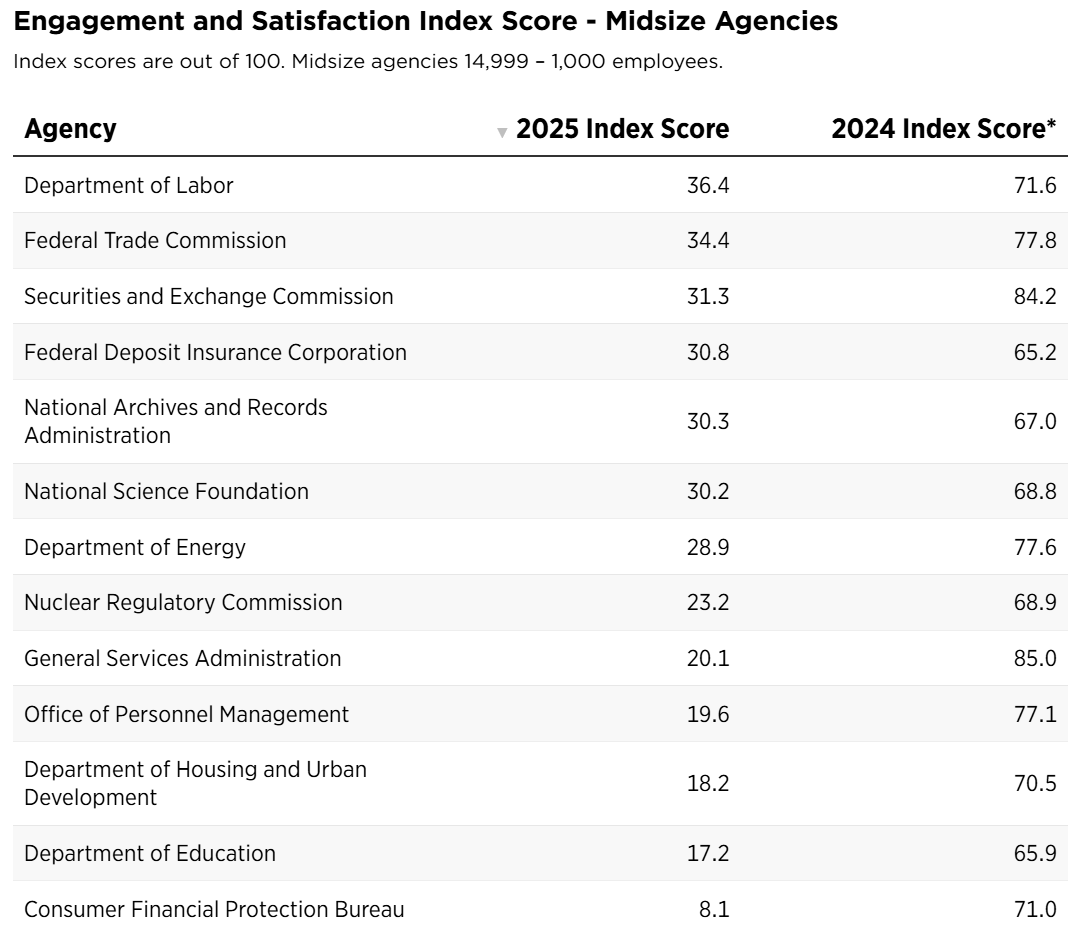
While the number of people who quit because of the DRP is huge, most federal workers still refused the option. After all, most civil servants consider themselves to be fulfilling a necessary and apolitical role in society. For instance, every agency with at least 15,000 employees earned above a 50 in the Partnership for Public Service’s (PPS) “Engagement and Satisfaction Index” in 2024. The index takes into account thousands of bureaucrats’ opinions about their workplace. In the same 2024 survey, many large agencies earned scores in the high 60s and 70s and one—NASA—even earned above an 80. Amongst mid-sized agencies with 1,000-14,999 employees, the results were similarly positive.
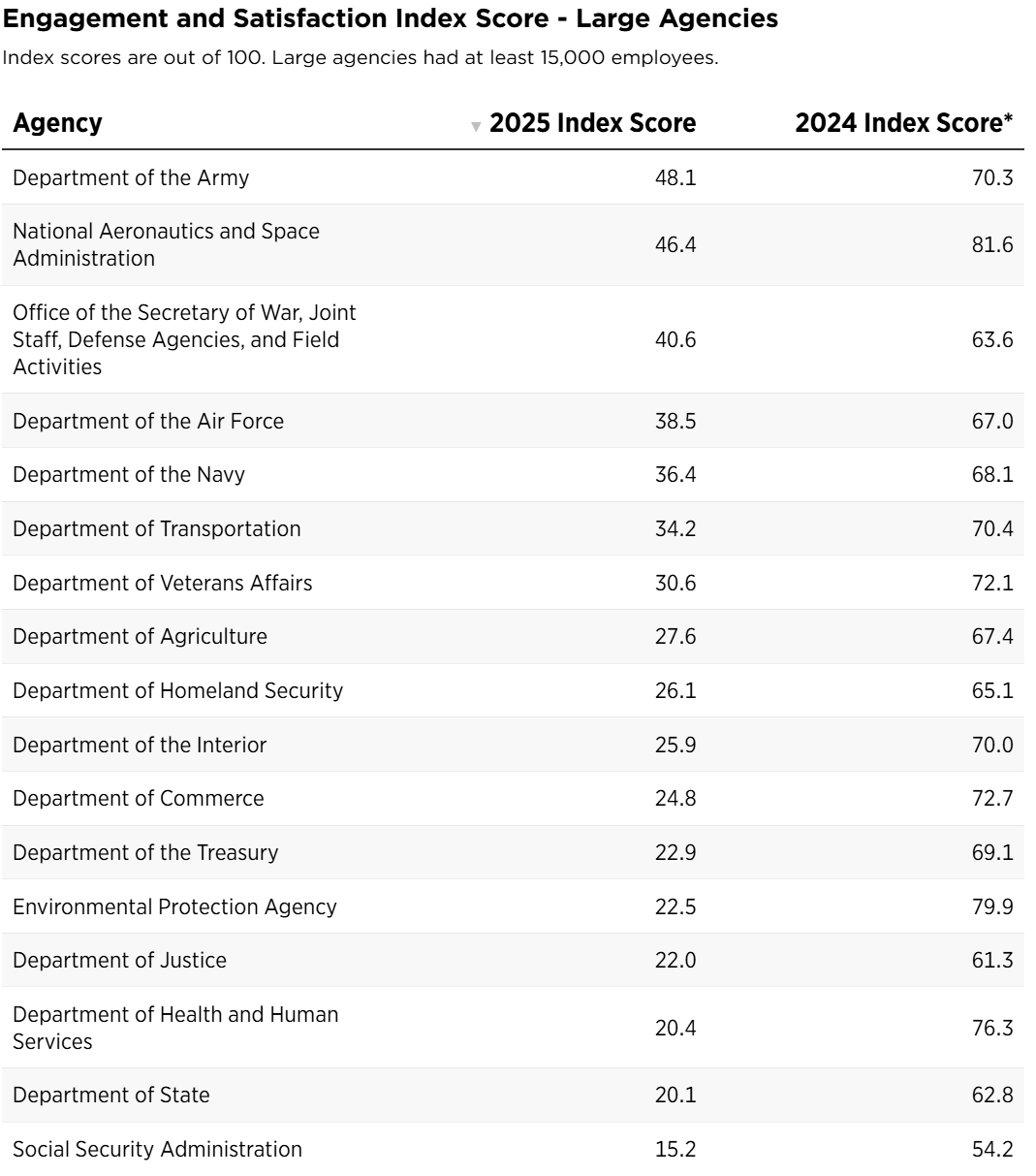
But PPS’s recent research tells a different story. PPS’s recent report, titled “Federal Public Service in Peril,” helps shed light on why so many people took the DRP buyout and how Russell Vought has made good on his promise to “traumatize” federal workers. While OPM’s cancellation of the official 2025 survey stops PPS’s data from being a perfect match to the 2024 results, comparison of the two still paints a clear picture. This year, no agency achieved a score of 50 on the Engagement and Satisfaction Index. Some of the most widely approved-of workplaces saw a precipitous drop. As a result of the Trump administration’s war on enforcement, agencies focusing on financial regulation and consumer protection were hit particularly hard. The Consumer Financial Protection Bureau’s score plummeted from a 71.0 to an 8.1, the Federal Trade Commission’s dropped from 77.8 to 34.3, and the Securities and Exchange Commission’s dropped from an 84.2 to a 31.3. Agencies charged with taking care of human health and the environment suffered similarly—Health and Human Services dropped from a 76.3 to a 20.1 and the Environmental Protection Agency dropped from a 79.9 to 22.5. Even at the Department of Homeland Security, the sole agency that has more workers now than at this time last year, approval dropped from 76.3 to 20.4.
In short, federal employees’ opinions of their workplaces have unanimously and catastrophically dropped.
Pitting Bureaucrats Against Each Other
So what’s in store for the civil servants who remained? For starters, a “competition” about as fair as a standard episode of Squid Game on Netflix. OPM data and PPS’s survey show that Vought and OPM Scott Kupor have used the “enhanced standards of conduct” hinted at in the DRP email as a cudgel. The FWD page reads:
“Traditionally, performance ratings have been inflated, with a disproportionate number of employees receiving the highest ratings. Agencies are now working towards normalizing performance ratings to more effectively distinguish between employees who meet expectations and those who displayed truly exceptional performance.”
Indeed, in February and March, OPM and OMB proposed limits to the number of employees earning positive performance reviews. This would break the long-standing practice of judging federal employees based on their completion of necessary tasks rather than ranking them against one another. As Shaun Southworth, an expert on federal-sector employment law noted: “When agencies impose caps on top ratings, high-performing teams inevitably face artificial scarcity: someone must be rated lower even if everyone met or exceeded standards.”
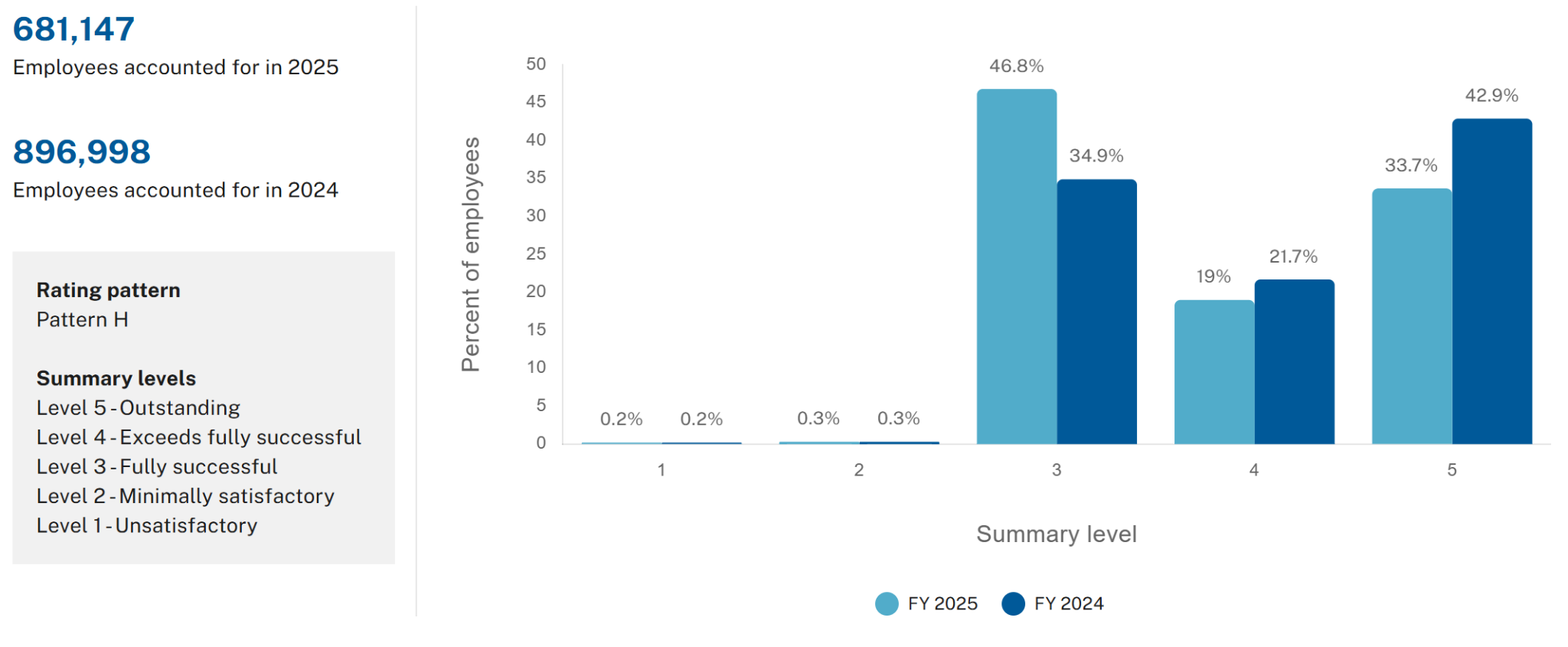
Performance rating data for 2025 reflects the early stage of these changes. The number of employees earning a score of 3 (out of 5) is up substantially from 34.9% to 46.8%. That change of roughly 12% came directly out of workers who had previously earned 4s or 5s.
Federal Employee Performance Ratings: FY 2024 vs. FY 2025
Vought’s Fight to Fill the Federal Government with Hacks
Despite Vought’s stated desire to increase productivity, these quotas have a notable exemption: The rule change exempts Schedule C and Schedule G employees from the new quota, meaning Trump’s political appointees get to soak up the benefits of ratings inflation while career civil servants have to scrap to avoid bad ratings. If implemented, this would be a serious step toward the goal of politicizing the bureaucracy that Vought and his allies set out in Project 2025.
PPS’s report contains a few more helpful surveys to contextualize the increasing politicization of the federal bureaucracy. In 2024, 56% of employees agreed that their organization didn’t tolerate favoritism or political coercion. In 2025 this number dropped to 25.2%. In 2024, 71.9% of employees agreed that they could confidently report a suspected rule violation without retaliation. The next year, the number plummeted to 22.5%. This is a breathtaking change: only one in four employees feels protected from political coercion and even fewer believe they can report lawbreaking without retaliation. Consider for a moment how troubling this is when the president has given administration officials carte blanche to commit all manner of illegalities through promises of pardons.

Conclusion
Considered in tandem with the cuts that have been made to the IRS, SEC, CFPB, and more, these changes to federal personnel policy threaten to eliminate state capacity in key sectors. If a Democratic opposition can capitalize on the Trump administration’s current unpopularity, it won’t be enough to unplug the woodchipper that federal agencies are being tossed into. Rebuilding the manpower of these regulatory agencies–as well as the EPA, HHS, and other bugbears of the Party’s business wing–needs to be priority #1.
Indeed, focusing on restoring the right kind of state capacity will be necessary to fight the ongoing nightmare of corporate abuses that have been supercharged and forgiven by the Trump administration. But building a federal government that fights for working people will also require politicians to resist the monetary siren song coming from the wing of the party that wants to scapegoat Lina Khan for Silicon Valley’s rightward turn and concede to the deregulatory ambitions of Vought and Trump. We won’t be able to reverse course on fossil fuel-driven climate change without rebuilding the EPA nor will we be able to rein in the cost of living crisis without empowering the CFPB. Whoever ends up in the White House next will either reckon with that fact or find themselves in a fight against the next stage of Trumpism.
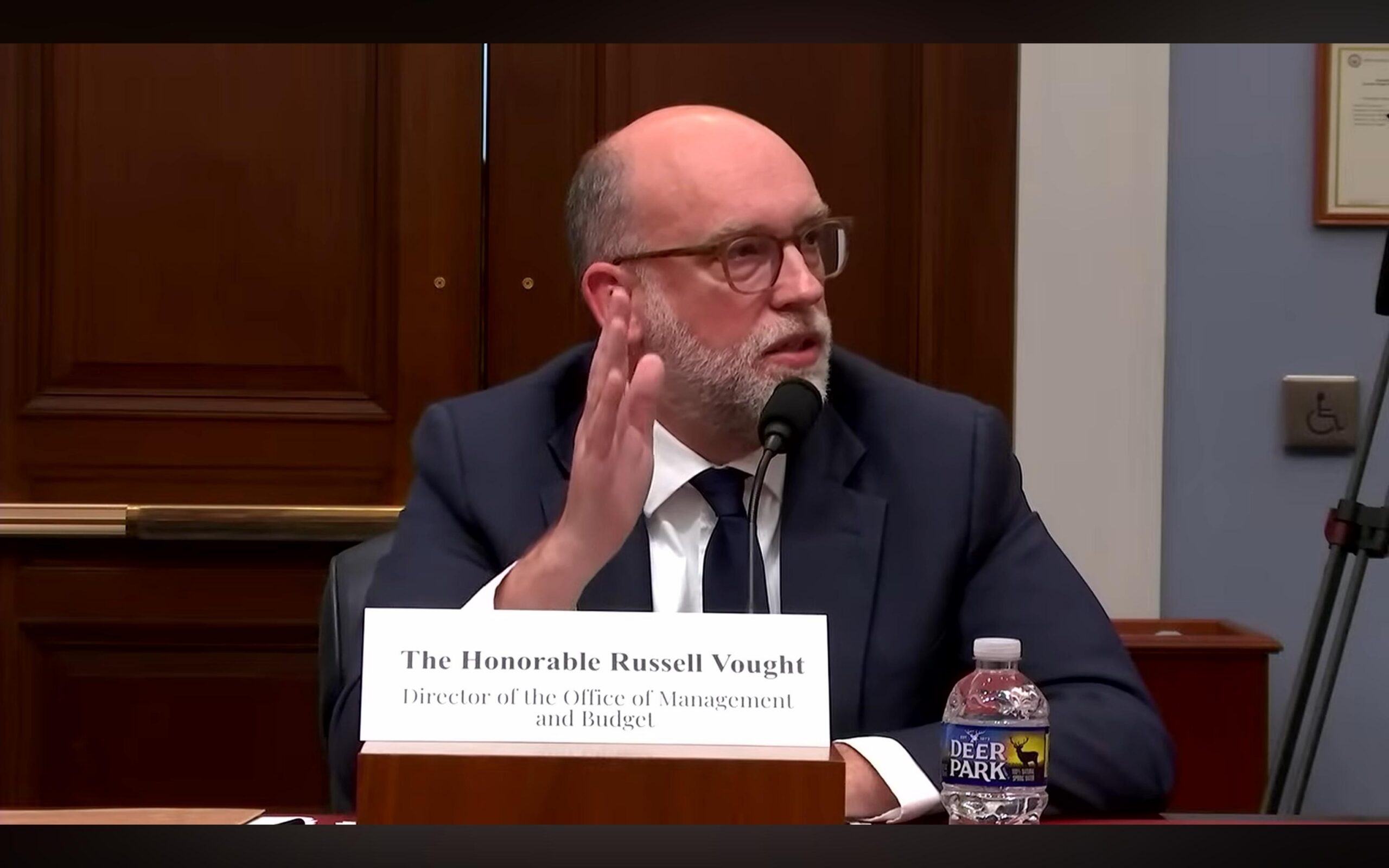
This image is a screenshot from the April 15 hearing: “The President’s Fiscal Year 2027 Budget Request”
Related Articles
October 9, 2026
Map: Trump Has Often Delayed or Denied Disaster Aid
September 30, 2026
Reversing Voughtism; or, Creating a Pro-Worker Government to Save Lives
September 25, 2026
Unions Against Voughtism
September 23, 2026