
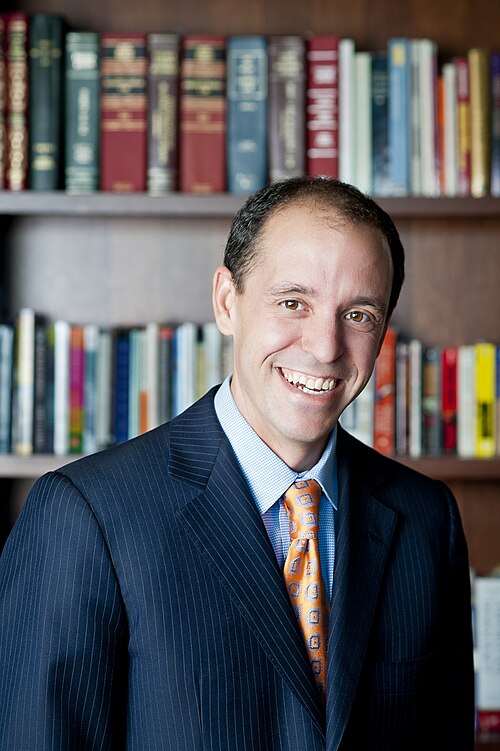
Name: Chris Lehane
Title: Chief Global Affairs Officer, OpenAI
Industry Affiliation: OpenAI, Haun Ventures, Coinbase, Airbnb, Lehane & Fabiani
- In 2001, after a stint as deputy campaign manager for Al Gore (where he masterminded the Gore campaign’s attempts to cast doubts on Bush’s narrow electoral victory in Florida), Lehane and his partner, Mark Fabiani, began a private political communications consultancy called Fabiani & Lehane. For over a decade, Lehane specialized in damage control strategies for causes and people which public opinion had soured on, including Lance Armstrong and the Weinstein Company.
- In 2015, Lehane began putting his PR expertise to work for Silicon Valley, when he was named head of global policy and public affairs at Airbnb. When San Francisco’s Proposition F threatened to put the company out of business, Lehane put a massive amount of capital to work mobilizing Airbnb operators and customers, pressuring city politicians, and proposing fig leaf tax agreements to placate those still skeptical.
- In early 2022, Lehane left Airbnb for the crypto world, becoming chief strategy officer of Haun Ventures, a crypto-focused venture capital firm. In 2023, Lehane also became an inaugural member of Coinbase’s Global Advisory Council, spearheading the industry’s response to the FTX collapse and the crypto super PAC Fairshake’s entry to the federal election space in 2023. In 2024, for his inestimable contributions to the crypto space, Lehane earned a Coinbase board seat.
- After a period of informally advising OpenAI and Sam Altman, August 2024 marked Lehane’s official entry into the AI space, as he took on the role of OpenAI’s vice president of global policy. Lehane has been tasked with solving AI’s full-blown “Reputation Crisis,” punctuated by negative opinion polls, college commencement speakers getting booed off stage for mentioning AI positively, and a molotov cocktail being tossed at OpenAI CEO Sam Altman’s home.
Revolver/Government Experience
- Lehane originally made a name for himself as Special Assistant Counsel in the Clinton White House. Starting in 1994 as a press secretary for vice president Al Gore, Lehane and his partner Mark Fabiani worked as political strategists and opposition researchers and coordinated the response to the Whitewater Scandal. Lehane and Fabiani earned the nickname “Masters of Disaster” for their role in managing Clinton’s myriad potential PR crises during his 1996 re-election bid. Rather than withholding information on the Whitewater scandal, Lehane and Fabiani drowned the press in documents, hoping that it would be near impossible to boil it all down into a compelling takedown of Clinton.
Trump Admin Ties
- During the G7 Summit hosted in June 2026, Axios reported that Trump and some of his top officials attended a meeting about coordinating global AI standards amongst top CEOs and heads of state. Trump was joined with Secretary of State Marco Rubio, Treasury Secretary Scott Bessent, and Commerce Secretary Howard Lutnick in a meeting with representatives from OpenAI, Google, Anthropic, Meta, and Salesforce. Lehane, who attended the meeting, there was “a coalescing” among countries and leading AI firms about “a forum or a space for the different democratic countries to be able to work together to ultimately see if there’s a way to establish some type of AI safety standards” and that the US would need to take a leadership role in the process.
- In March 2025 Axios reported that Lehane had been at the White House discussing a memo that outlined a list of OpenAI’s priorities to help the U.S. “lead on AI with democratic values and stay ahead of China.” The list included securing preemption of state AI laws, “balanced” rules about AI export controls, allowing AI to earn from copyrighted material, infrastructure investments for AI, and government adoption of AI.
Government Affairs
- Under Lehane’s leadership as vice president of global policy, OpenAI has expanded its efforts to lobby Congress and the White House on AI regulation. During Lehane’s first full year at OpenAI, 2025, the firm increased its federal lobbying efforts from just under $1.8 million to nearly $3 million. In April 2026, OpenAI’s first quarter federal lobbying report was its largest-ever, reaching $1,020,000.
- In addition to its handsomely-paid in-house lobbyists, OpenAI has employed Miller Strategies, DLA Piper, Akin Gump, and Hogan Lovells to lobby Congress on the regulation of AI and data centers.
- One of Lehane’s first acts at OpenAI was setting up the Leading the Future super PAC, which is funded by OpenAI president Greg Brockman and the Trump-endorsing venture capital firm Andreessen Horowitz. The goal of the organization is to render obsolete the AI “doomers” who believe that regulatory guardrails should be used to limit the technology’s potentially catastrophic impacts on jobs, the environment, and even human life.
- The most high-profile case to date of this strategy is over $8 million spent to defeat Alex Bores, a candidate running on an AI-safety platform in the Democratic primary for New York’s 12th district. Bores earned 35% of the vote, ending behind the Jerry Nadler-endorsed Micah Lasher by just over 4,000 votes.
- Across 10 Democratic House races, including Bores’ NY-12, Leading the Future has funneled support through its Think Big super PAC, and has spent over $15 million since it was registered in October 2025.
- Across 18 Republican House and Senate races, Leading the Future has funneled support through its GOP- facing American Mission super PAC, and has spent over $8 million since it was registered in August 2025.
- On June 1st, OpenAI’s Global Affairs team claimed in a statement that “OpenAI does not direct the activities of LTF, or have visibility into their operations.” This statement seemingly contradicts The Wall Street Journal’s reporting that Chris Lehane was involved in “initial conversations…about the need to help shape industry-friendly policies” or the fact that OpenAI’s president and co-founder Greg Brockman and his wife Anna have collectively donated roughly a third of LTF’s funding: $25 million.
State Level Action
- By late 2025 the Trump administration was struggling to achieve full legislative preemption—a single national policy that would take control of AI regulation out of the hands of state officials. Lehane has called this backup approach “reverse federalism” in his own posts and in discussions with the press. This strategy involves sponsoring and supporting permissive AI policies in the largest states to create a de facto national framework.
- As part of the “reverse federalism” strategy, Lehane’s global affairs team at OpenAI has pursued industry-friendly legislation in multiple states. Their input has contributed to the watering down of major AI regulatory bills in New York and California. In May 2026, OpenAI also endorsed an Illinois law that emulates the language of the other two.
- In California, OpenAI has reported over $300,000 in lobbying expenditures for the 2025-2026 legislative cycle, and nearly $140,000 across 2025 in New York. In Illinois, OpenAI has registered as a lobbying entity and retained Zephyr Government Strategies, but has not yet reported any expenditures in 2025 or 2026.
Image Credit: “Color photo of Chris Lehane” by Pupkin8r is licensed under CC BY-SA 3.0.
For more check out AI Villains and The Trump Administration