
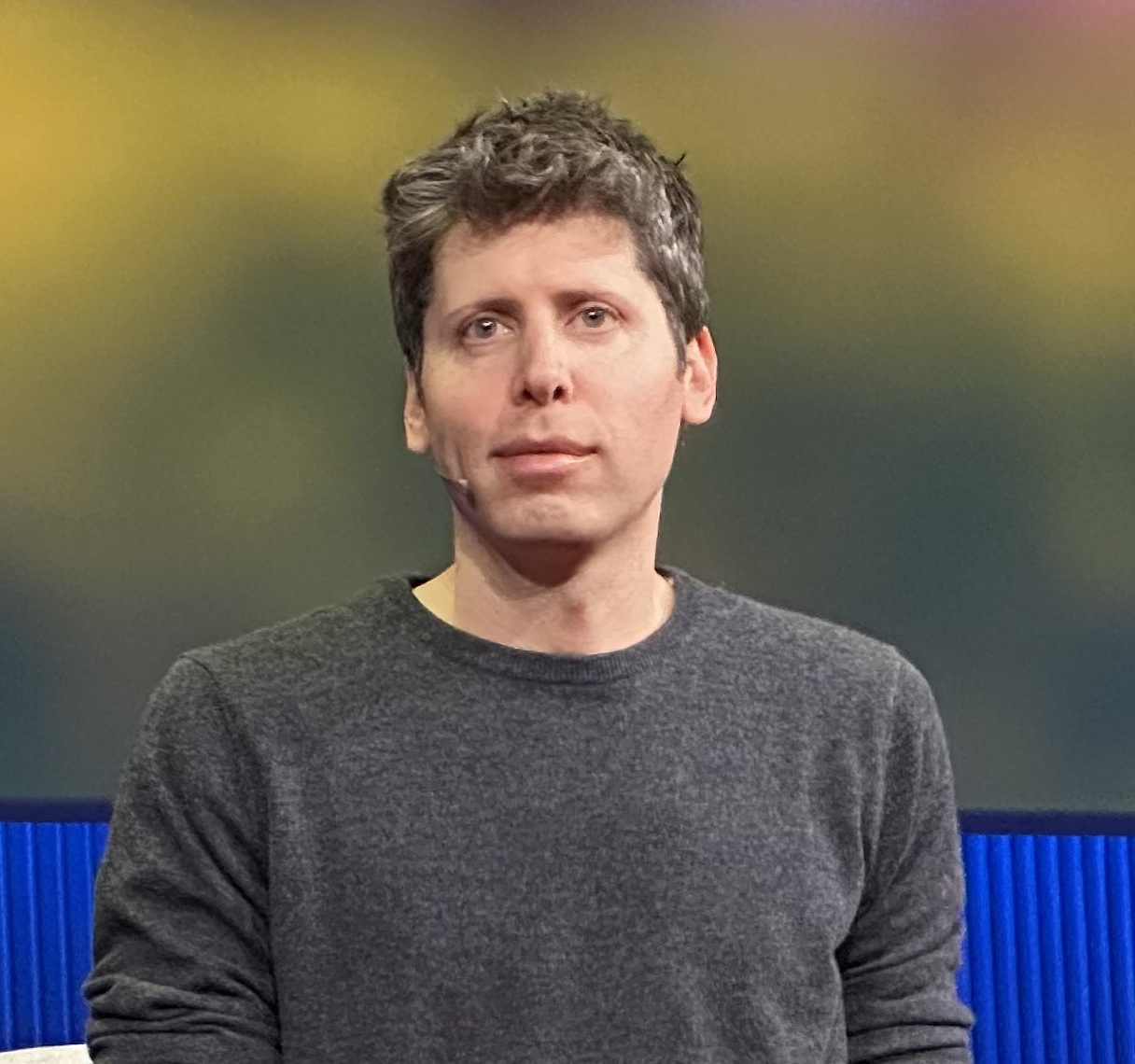
Name: Sam Altman (Net Worth: $3.4 Billion, Forbes, 7/9/26)
Title: Co-Founder, CEO, and Board Member, OpenAI
Industry Affiliation
- Chief Executive Officer of OpenAI
- OpenAI is a tech giant that went mainstream with its generative AI chatbot product, ChatGPT, which uses a question-and-answer model to engage in humanlike conversations on everyday topics.
- Altman has backed AI startups, including AirOps, Beacon AI, Boom Supersonic, Hermeus, Humane, Induced AI, Marvin, Mentra, Motion, Rain, Roboflow, Warp, and ValueBase.
Revolver/Government Experience
- In November 2024, Altman was tapped to co-chair then-San Francisco mayor-elect Daniel Lurie’s transition team and advise on ways the city can develop a working relationship with the tech industry.
- While at Stanford University, Altman worked on a drone helicopter project for the Defense Advanced Research Projects Agency (DARPA), the research and development arm of the U.S. Department of Defense.
Trump Admin Ties
- Altman donated $1 million to Trump 2.0’s inaugural fund.
- Tools for Humanity, a startup co-founded and chaired by him, contributed $5 million to MAGA Inc., a pro-Trump super PAC.
- On January 21, 2025, the day after Trump’s inauguration, Altman joined Trump, alongside Oracle Chairman Larry Ellison and SoftBank CEO Masayoshi Son, to announce a $500 billion investment in the Stargate project, an initiative to build “colossal data centers” to power AI across the U.S. The project has been hobbled by funding challenges, but if even a fraction of it goes to plan, OpenAI will have greater computing power to operate its AI applications.
- In May 2025, Altman accompanied Trump on his visit to the Middle East’s Gulf region. That same month, it was announced that the Stargate initiative was expanding to create a gigantic, five-gigawatt data center campus in the United Arab Emirates, with OpenAI poised to get the first gigawatt.
- On January 30, 2025, OpenAI held a closed-door AI policy summit in D.C., which was attended by Interior Secretary Doug Burgum. At the summit, Altman impressed upon policymakers the need for investment in AI development.
- In March 2025, Altman attended a dinner for donors hosted by Trump at Mar-a-Lago, which was also attended by David Sacks, Trump’s then-AI czar and current co-chair of the President’s Council of Advisors on Science and Technology. And in September 2025, Altman attended Trump’s Big Tech gathering at the White House to discuss ways to secure the U.S.’ global leadership on AI.
- Altman’s OpenAI wrote to the Trump administration about its support for preemption from state-based AI regulations, and in December 2025, Trump signed an executive order instructing federal agencies to challenge “burdensome” state AI laws.
- After the federal government banned the use of Anthropic’s AI tools over a dispute about ethical guardrails in February 2026, Altman announced that OpenAI had reached an agreement with the Pentagon for its AI tools to be deployed in the military’s classified systems. This follows a $200 million contract OpenAI won back in June 2025 to provide the Defense Department with AI capabilities.
- Altman has urged the Trump administration to take a small ownership stake—between 1-5%—in OpenAI. Dare Obasanjo, son of the former Nigerian president and a software engineer who helped develop Microsoft’s Windows Live service and previously served as lead product manager for Meta’s Metaverse virtual reality platform, commented that Altman’s discussions with the government signify that “[t]he groundwork is already being laid for a government bailout of OpenAI” and “will guarantee an IPO pop as the assumption is they’re now ‘too big to fail.’” (OpenAI filed to go public in June 2026.)
- In a report titled No Bailouts for Big Tech Billionaires: Policies for when the AI bubble bursts, Matthew Scherer of Open Markets Institute wrote that because bailout payments “often enrich people who played a role in the business failures and crises that necessitated the bailouts, they are particularly corrosive to public trust, creating the (not unjustified) perception that the goal of bailouts is to protect the interests of the wealthy and powerful rather than to benefit the economy as a whole.” Moreover, bailouts “damage the credibility of democratic institutions because they constitute an implicit admission that the government has failed in two of its key roles: providing economic stability and ensuring that the costs of economic harms are borne by those who caused them.”
- In April 2026, OpenAI published a proposal titled “Industrial Policy for the Intelligence Age: Ideas to Keep People First,” which pushes for sharing in the prosperity of advanced AI broadly, mitigating risks posed by the transition to AI, and democratizing access to AI. The blueprint has been described “as a sophisticated exercise in corporate reputation management, designed to support the claim that [OpenAI] takes democracy and corporate citizenship with a public interest orientation seriously while it actually preempts and shapes regulation to fight meaningful oversight where it counts.” Indeed, the company has spent $1.02 million in the first quarter of 2026 alone on lobbying Congress to stymie regulation.
- OpenAI backed and collaborated with the White House on an executive order Trump signed on June 2, 2026, which establishes a voluntary framework by which AI firms can provide the federal government with their AI models for a cybersecurity risk evaluation period of up to 30 days prior to their public release. After Trump signed the executive order, an OpenAI spokesperson confirmed that Altman would be attending meetings with Trump administration officials and Democratic and Republican lawmakers to discuss AI.
Government Affairs
- In the first quarter of 2026, OpenAI spent $1.02 million to lobby on issues related to AI, cloud computing and infrastructure, cybersecurity, copyright, and privacy. That same period, OpenAI paid Miller Strategies, LLC $150,000 to lobby on its behalf on general issues regarding AI research and deployment; Akin Gump Strauss Hauer & Feld $80,000 to lobby on its behalf on issues related to AI legislation and regulation, data centers, and AI and workforce development; DLA Piper LLP $50,000 to lobby on its behalf on legislative and regulatory proposals and oversight related to the development and deployment of AI; and Mercury Public Affairs, LLC $50,000 to lobby on its behalf on AI policy issues.
- Mercury Public Affairs has a track record of engaging in unsavory practices. The lobbying shop previously provided public, media, and government relations services to Q Cyber Technologies, the name the NSO Group—an Israeli cyber technology company—uses in Israel, around the time the NSO Group was attracting scrutiny for its Pegasus software. Pegasus is a spyware tool that has been used to target journalists and activists as well as their close associates. Additionally, in 2012, Mercury, which was lobbying on behalf of Walmart at the time, drew criticism after its employee posed as a student journalist to infiltrate an event organized by the Warehouse Workers United, a worker advocacy group that had accused Walmart of failing to ensure its warehouse contractors were providing employees with proper pay and breaks.
- From 2023-2025, OpenAI spent $5.01 million to lobby on issues related to AI, cloud computing and infrastructure, cybersecurity, copyright, and privacy as well as AI-related legislation. During that time, OpenAI paid Miller Strategies, LLC $680,000 to lobby on its behalf on general issues regarding AI research and deployment; Akin Gump Strauss Hauer & Feld $640,000 to lobby on its behalf on issues related to AI legislation and regulation; DLA Piper LLP $590,000 to lobby on its behalf on legislative and regulatory proposals and oversight affecting the development and deployment of AI; Mercury Public Affairs, LLC $120,000 to lobby on its behalf on AI policy issues; and Hogan Lovells LLP $20,000 to lobby on its behalf on AI research and deployment.
- OpenAI is partnered with the Chamber of Progress, a pro-AI and crypto advocacy group that lobbies Congress for tech-friendly legislation. The company is also a member of TechNet, a tech trade association that engages in lobbying at the federal level.
State Level Action
- California: In 2025, OpenAI paid DeVeau Burr Group LLC $151,250 to lobby on its behalf on issues related to privacy and AI policies and legislation like SB 53 (on AI models and large developers). OpenAI did not endorse SB 53, otherwise known as the Transparency in Frontier Artificial Intelligence Act (TFAIA), which was signed by California Governor Gavin Newsom (D) in September 2025. It requires safety frameworks and transparency and safety incident reporting from large AI developers. However, an OpenAI spokesperson told the Hill that the company had “productive conversations with California lawmakers” about SB 53 and was ultimately “happy with the outcome.” Shawn Chauhan, a software engineer who worked at Capgemini before launching his own AI coding company, commented that OpenAI’s public support for SB 53 and similar laws in New York and Illinois, when viewed alongside the company’s support for federal preemption of state AI laws, is notable: “It is easier to shape a federal standard when you have already positioned yourself as a responsible actor at the state level. AI policy is not lagging AI capability by accident. It is being shaped by the people who benefit most from the lag.”
- In 2024, OpenAI paid DeVeau Burr Group LLC $107,750 to lobby on its behalf on AI-related legislation, including SB 1047 (the Safe and Secure Innovation for Frontier Artificial Intelligence Models Act) and AB 2930 (on automated decision systems). Governor Newsom vetoed SB 1047 after heavy opposition from the tech industry, including OpenAI. Meanwhile, AB 2930, which sought to address algorithmic discrimination and was opposed by OpenAI, failed to pass.
- Pro-industry advocacy groups, Chamber of Progress and TechNet, which are partnered with OpenAI, lobby against state AI regulations as well. In California, both groups lobbied against AB 1064, the Leading Ethical AI Development (LEAD) for Kids Act, which would have restricted children’s access to AI chatbots unless the chatbots were “not foreseeably capable” of harming them. Newsom caved to such lobbying efforts by vetoing AB 1064. When AB 1064 was vetoed, Common Sense Media, a nonprofit advocating for kids’ online safety, filed a ballot initiative to pass more stringent child safety regulations. OpenAI filed a rival ballot initiative in response, but consistent with its other efforts to present itself as a responsible corporate actor, OpenAI then switched tactics and announced that it was collaborating with Common Sense Media on a compromise ballot initiative called the Parents & Kids Safe AI Act. The company also founded and funded a PAC called the Parents & Kids Safe AI Coalition to shore up support for the initiative, which has been accused of astroturfing—a term that describes the practice of companies imitating a grassroots movement while masking their involvement.
- New York: In 2025, OpenAI spent $2,019 to lobby on, among other matters, S6953 (on the training and use of AI frontier models). That same year, OpenAI paid Bolton-St. Johns, LLC $137,500 to lobby on its behalf on AI policy and legislation like A6453-B/S6953/S6953-B (on the training and use of AI frontier models). OpenAI took credit for watering down A6453/S6953, otherwise known as the Responsible AI Safety and Education Act (RAISE Act), which was signed by New York Governor Kathy Hochul (D) in December 2025. It requires AI labs to publish their safety protocols and incidents. Crucially, New York’s RAISE Act is closely aligned with California’s TFAIA, with OpenAI publicly claiming credit for such a result. The similarity between the RAISE Act and TFAIA has been “widely seen as a concession to the tech industry[.]”
- Illinois: OpenAI hired Zephyr Government Strategies to lobby on its behalf on AI matters. OpenAI expressed public support for Illinois’ SB 315, titled the Creates the Artificial Intelligence Safety Measures Act. It is Illinois’ equivalent to California’s TFAIA and New York’s RAISE Act. Illinois Governor JB Pritzker (D) is expected to sign the bill.
- Texas: In 2025 and 2026, OpenAI lobbied for itself and also hired DTH Strategies, T X Public Affairs LLC, and Saenz Public Affairs to lobby on its behalf. In total, OpenAI has spent a minimum of $898,880 and a maximum of $1,690,299.93 on lobbying, according to Texas lobbying client compensation codes.
- DTH Strategies was founded by Daniel Hodge, former chief of staff to Texas Governor Greg Abbott (R).
- T X Public Affairs was co-founded by Luis J. Saenz, former chief of staff to Abbott who got his start at the Heritage Foundation, the right-wing think tank behind Project 2025. Saenz also founded Saenz Public Affairs.
Image Credit: “Sam Altman speaking at TED (cropped)” by Steve Jurvetson is licensed under CC BY 2.0.
For more check out AI Villains and The Trump Administration