
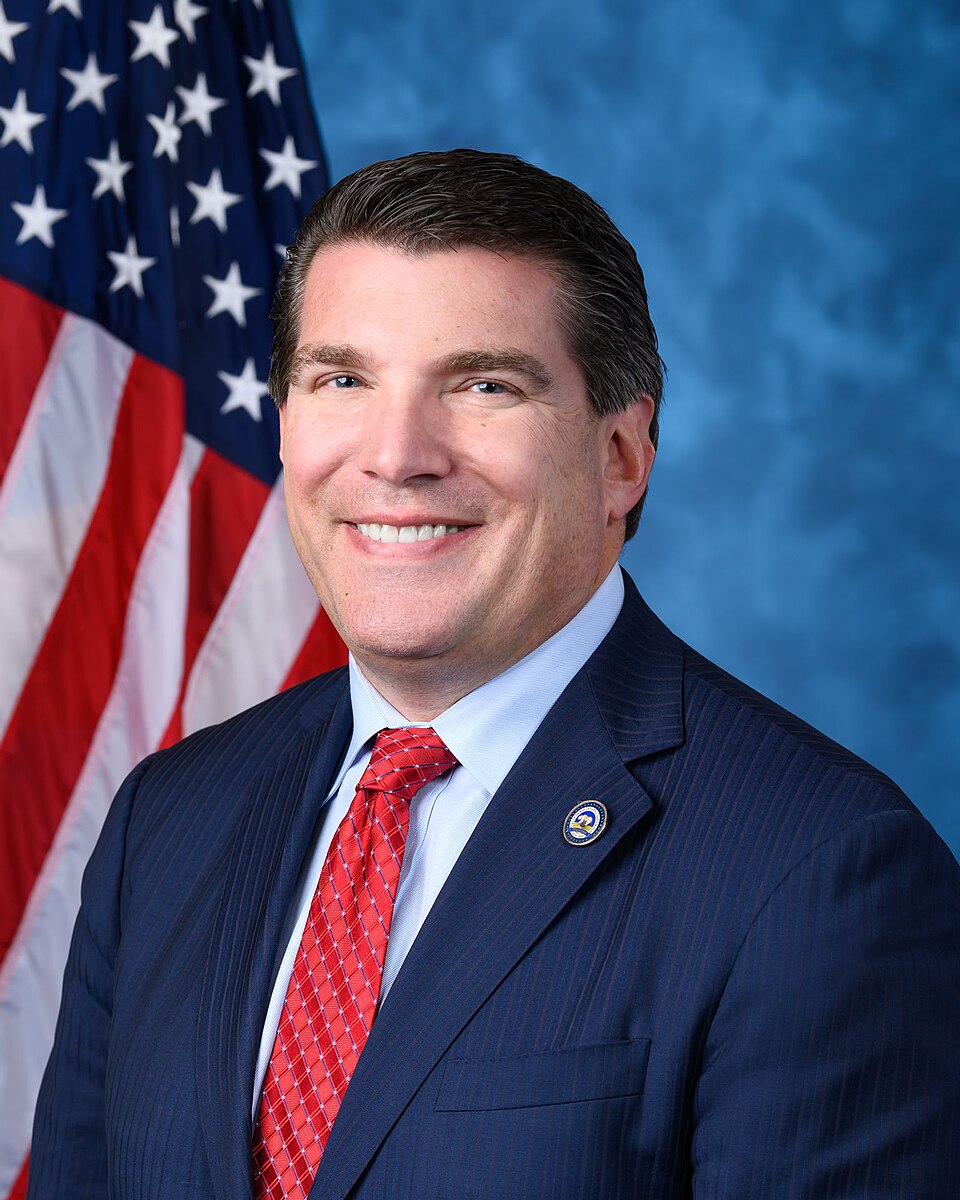
Title: United States Representative, (R-CA)
Industry Affiliation: Farsight Studios
- Obernolte founded Farsight Studios in 1988. The firm produces small-budget video games, many based on professional leagues for recreational sports like cornhole, bowling, and pickleball. In 2013, he stepped away from day-to-day operations to focus on working in the California State Assembly.
Congressional Actions
- Obernolte is one of the leading House Republicans on AI policy. In February 2024, Speaker Mike Johnson appointed Obernolte one of the chairs of the House’s bipartisan AI taskforce–a responsibility he shared with Ted Lieu (D-CA). In December, the taskforce completed its comprehensive report, which received praise from AI Progress, an AI industry advocacy group founded by firms including Amazon, Google, Meta, Microsoft, and OpenAI; the taskforce’s report also received direct praise from firms including Scale AI, Open AI, and IBM. Among other findings, the report emphasized developing AI frontier models for national security, increasing ‘AI literacy’ in schools, and studying state preemption as a future possibility.
- Reps. Lori Trahan (D-MA) and Jay Obernolte introduced a new draft of their signature AI regulation in late July 2026, now called the FRONTIER Act. They claim that the new wording should satisfy critics of the initial draft language they released the month prior. However, within a day of releasing the new wording, the tech ethics watchdog Americans for Responsible Innovation released a statement outlining major outstanding issues. One issue ARI identified was the narrow focus on legislating catastrophic risks, an approach that some actors in the AI industry, including Anthropic, have long championed. Another issue ARI identified was that the bill would allow AI companies “to perform a cost-benefit analysis on whether deployment of a high-risk model is acceptable”–a provision which is likely to undercut real government enforcement of the provisions designed to hamper AI’s unintended consequences.
- Obernolte collaborated with Lori Trahan (D-MA) to release the initial draft language of “The Great American Artificial Intelligence Act” in early June 2026. At the time, the bill’s provisions to preempt state AI regulations and enforcement drew criticism from watchdog groups and organized labor.
- Obernolte also introduced a June 2026 bill called the AI Security and Innovation Act to “ensure continued United States leadership” in AI research and development. The act would allow the Secretary of Commerce to establish a “Center for AI Security and Innovation.” The act would appropriate $20 million per year between 2027 and 2032, to measure the risks of AI models, support exchange of information between “non-governmental entities and Federal departments” and to “ensure continued leadership” of American AI.
- If the bill were passed on its planned timeline, implementation would be left to Howard Lutnick, former head of the investment bank Cantor Fitzgerald. Lutnick famously said in a CNBC interview that young workers should prepare to work in factories to build consumer tech for big tech: “This is the new model, where you work in these [factory] plants for the rest of your life, and your kids work here, and your grandkids work here.”
Revolver/Government Experience
- On June 2, 2026, Obernolte received the most votes in an open primary for California’s 23rd District. According to Tech Influence Watch, he received $259,682 from American Mission, the Republican-focused branch of Leading the Future, a super PAC funded by OpenAI president Greg Brockman and Andreessen Horowitz. Obernolte also received $32,134 in individual contributions from employees at Andreessen Horowitz, Google, Palantir, Microsoft, and Meta.
- Since 2020, Obernolte has been a member of the House. Obernolte serves on the House committees on energy & commerce, science, space, & technology, and budget. In April 2026, Obernolte was also tapped to serve as head of the Republican Policy Committee (RPC).
- The RPC is an advisory committee that plays a major role in determining Republican legislative priorities. As chair, Obernolte is the fourth ranking House Republican and now poised to help set priorities on conservative AI legislation. His leadership in the RPC and AI policy more broadly is heightened by his academic background in computer science and past as a coder.
- According to the Orange County Register, Obernolte considers himself an “optimist” about the disruptions that AI will bring to the labor force and worker productivity. In the past, he’s used this optimism to support light-touch regulation and state preemption. In one May 2025 hearing of the House E&C Committee’s subcommittee on commerce, manufacturing, and trade, Obernolte argued that state-level regulations would stop startups that could become “the next Open AI or the next Google.” Of the same state-level regulations, Amba Kak, president of the AI policy organization AI Now noted that “This is not a sprawling morass of industry-burdening regulation. It truly is the bare minimum.” For instance, she pointed to regulations targeting “revenge porn” and the use of AI by insurance companies.
- Within the House E&C Committee, Obernolte cosponsored the Office of Fusion Act of 2025 introduced by Rep. Donald Beyer (D-VA). The act would establish federal support for private ventures in fusion energy, a speculative technology that the AI industry sees as a necessary component of powering future data center demand. OpenAI CEO Sam Altman, for example, has investments in multiple private fusion companies like Helion and Oklo. Bob Mumgaard, CEO of another private fusion leader Commonwealth Fusion Systems is a member of Trump’s science council.
- The fusion sector promises to make real progress on a scientific problem that’s stumped physicists for generations, thus bringing immense amounts of clean energy to the grid through new tech. However, as the physicist-turned-journalist Adam Becker wrote in Fortune, “there’s danger that the hollow promise of near-term fusion will be floated as a panacea, used as an excuse to ignore faster avenues to decarbonization and to use even more energy right now.” In short, Obernolte’s support for the fusion sector may end up enriching a small group of tech VCs and private firms promising unrealistic timelines while crowding out green energy.
- Obernolte worked in local government in the city of Big Bear Lake as both city councilman and mayor, making the jump to assemblyman for California’s 33rd State Assembly district in 2014; he served in that role until 2020.
Trump Admin Ties
- Obernolte tweeted approvingly of the Administration’s January 2025 directive to remove barriers to American leadership in AI. This White House directive resulted in the creation of David Sacks and Michael Kratsios’ AI Action Plan, a document which recommended slashing “red tape and onerous regulation” to promote rapid AI development and adoption.