
How Attacks on the Civil Service Destroyed Federal Capacity and Harmed Communities
For a PDF version of the original report, click here. This page will continue to be updated as we add new agency breakdowns. Last updated March 4, 2026.
Executive Summary
From the minute President Donald Trump stepped into the White House on January 20, 2025, the Trump administration has aggressively pursued its goal of stripping the federal government to its bare bones.
Under the banner of the so-called “Department of Government Efficiency” (DOGE), Elon Musk and Russell Vought have eagerly shred political, professional, and legal precedent in their effort to dismantle the essential functions of the federal government—and most importantly, democracy at large.
DOGE agents—a cohort of unelected, unqualified, and unaccountable goons recruited from Elon Musk and Peter Thiel’s orbit—have been given unfettered access to the internal machinery of federal agencies. From seizing control of the nation’s payment system at the Treasury Department to orchestrating mass purges of the experts who ensure our food is safe, these actors bypassed traditional oversight to strip agencies of their ability to serve the American public.
DOGE: From Meme to Government Erosion Machine serves as a recounting of DOGE’s first year. We outline DOGE’s operational takeover and systemic demolition of the federal government. We hope this effort to record the scale of DOGE’s destruction engenders much needed accountability for all who enacted and cheered the initiative’s irrational actions.
The audit offers a comprehensive picture of what happens when federal capacity is erased by:
- Probing DOGE’s origin story. From thought leaders like Marc Andreessen and Peter Thiel, to foot soldiers like Gavin Kliger and Edward Coristine, we map out key figures within the DOGE machine;
- Detailing the material costs of DOGE’s infiltration across the administrative state, covering everything from reduced regulatory action to increased death tolls from anemic responses to crises; and
- Examining the emerging threat posed by the transfer of power to DOGE’s new leader, Office of Management and Budget Director Russell Vought.
Introduction
President Donald Trump’s creation of the Department of Government Efficiency (DOGE) marked a radical restructuring of the federal government and an unprecedented transfer of power to an unelected private citizen in Elon Musk. Even as DOGE fell out of the daily headlines following Musk’s exit, the guiding principles of the agency lived on through Russell Vought, Director of the Office of Management and Budget, who took up the mantle of decimating federal capacity on behalf of billionaire interests.
Pitched as a solution to our purported bureaucratic malaise, the Trump administration initially advertised the initiative as a vehicle to bring more accountability and transparency to federal spending. Instead, DOGE became a central hub for dismantling core public services and accelerating agency attrition, while consolidating power through tech-aligned privatization efforts. DOGE functioned less as an efficiency project and more as an instrument of institutional erosion, one whose effects are evident across the federal government.
This audit explores how DOGE operated, who enabled it, and what the consequences were.
We’ve compiled documentation and created an interactive map to help the public, journalists, and oversight bodies understand what happened—and what’s still at stake.
Timeline of DOGE’s Formation
- March 2024: Musk traveled to Florida as Trump tried to convince wealthy Republican donors to finance his presidential bid. Musk had indicated he was “leaning away from Joe Biden.”
- May 2024: Musk helped create the pro-Trump America PAC.
- July 2024: Musk “fully endorsed” Trump.
- August 2024: During an online conversation with Trump, Musk raised the idea of a government efficiency commission.
- Days later, Trump publicly floated bringing Musk into his administration; Musk confirmed his willingness to serve on X while also teasing the name “Department of Government Efficiency.”
- October 2024: Musk joined Trump on the campaign trail, having already donated $75 million to the campaign. A week before the 2024 election, Musk pledged that he would use DOGE to cut federal spending by $2 trillion.
- Musk pledged to give away $1 million a day, between October 20 and November 5, to people signing the pro-Trump America PAC petition supporting the First and Second Amendments. Registration to the PAC was a prerequisite for eligibility, raising concerns about the legality of paying people to register to vote.
- November 2024: Trump announced Musk as the co-lead of DOGE. Ultimately, Musk spent at least $250 million in direct efforts to help secure Trump’s election victory.
- Additionally, analyses of X during the 2024 election found that content from Musk and pro-Trump conservative accounts was systematically boosted, suggesting that the platform’s algorithm may have been manipulated to advantage Trump.
- Post 2024 Election: Reporting started to chronicle Musk’s growing influence at the White House. During the presidential transition period, Musk started sending DOGE personnel into federal agencies.
Key Players at DOGE
Shortly after Trump’s return to office, Elon Musk and former Republican presidential candidate Vivek Ramaswamy were tapped to lead DOGE. Musk and Ramaswamy, with the help of venture capitalist Marc Andreessen and other allies, spent the lame duck period recruiting lackeys to join the new agency.
At the start of the administration, the character of DOGE personnel became clear. Many were young professionals from tech companies backed by Peter Thiel or Elon Musk. Others had online footprints filled with racist or misogynistic remarks. One had founded a telehealth startup that went bankrupt after raising millions of dollars and faced litigation from a former business partner.
This section will catalog the most important players at DOGE, from the leaders directing DOGE’s attacks to the inexperienced agents carrying them out.
These summaries, in conjunction with the personnel map, serve as a repository of the actions taken by DOGE affiliates and their ties to Elon Musk.
Leadership and Higher Ups
- Elon Musk: The man behind the Department of Government Efficiency. Musk became Trump’s top donor during the 2024 presidential campaign, shelling out at least $250 million in financial support. His reward: free rein to form and staff DOGE to pursue concurrent missions of cutting out government “waste, fraud, and abuse” by drastically minimizing the size and role of the federal government. Musk has had frequent run-ins with federal regulators throughout his career, and used his power at DOGE to gut some of those same agencies, which we warned would happen in November 2024.
- Legal experts warned that Musk’s actions amounted to an illegal power grab, triggering a constitutional crisis between Congress and the executive branch. Almost as soon as DOGE moved to fire federal employees or slash programs, lawsuits followed to halt or reverse those actions.
- In protest against Musk’s government purge, objectors demonstrated outside of Tesla dealerships and called for boycotts.
- Peter Thiel: Though he is not directly connected to DOGE, Thiel’s influence can be felt within DOGE and across the broader Trump administration. Thiel and Musk have had a long and deep professional relationship starting with their time together at PayPal, and a number of staffers at DOGE are either Thiel employees, current or former, or beneficiaries of a Thiel-fellowship. Thiel’s libertarian ideology aligns with DOGE’s mission of effectively reducing the size and capacity of government.
- Marc Andreessen: Andreessen is a Trump donor and ally, and one half of Andreessen-Horowitz (a16z), the Silicon Valley venture capital firm with heavy investments in several of Musk’s companies. As early as December 2024, billionaire Andreessen became DOGE’s “unpaid intern,” working to interview and recruit candidates. Andreessen has pushed for AI use in government, while a16z is heavily invested in AI companies marketed for government use.
- a16z has invested heavily in cryptocurrency firms that have either broken the law or been involved in controversies. This includes the likes of Anchorage Digital, who failed to comply with anti-money laundering mandates from DHS, and Coinbase, which faced SEC charges for operating as an unregistered securities exchange.
- The crypto industry poured tens of millions of dollars into electing friendly politicians, and donated at least $26 million to Trump in the first half of 2025.
- a16z has invested heavily in cryptocurrency firms that have either broken the law or been involved in controversies. This includes the likes of Anchorage Digital, who failed to comply with anti-money laundering mandates from DHS, and Coinbase, which faced SEC charges for operating as an unregistered securities exchange.
- Scott Kupor: The current head of the Office of Personnel Management (OPM), Kupor was a long-time Marc Andreessen collaborator and managing partner at Andreessen-Horowitz.
- As head of OPM, Kupor has openly worked with DOGE to cut the size of the federal workforce and reform the federal hiring process.
- Amy Gleason: Named the administrator of DOGE after weeks of confusion from the White House on who was leading the agency. She previously held the position of Senior Advisor at the US Digital Service, the agency that ultimately morphed into DOGE.
- Russell Vought: Director of the Office of Management and Budget (OMB), chief architect of Project 2025, and the de-facto leader of DOGE after Musk left government. Vought is also the acting director for the Consumer Financial Protection Bureau (CFPB) and the US Agency for International Aid (USAID), two agencies significantly gutted by DOGE.
- Vought is ideologically motivated to reduce the scale and impact of government and worked closely with Musk, making him a natural successor.
- October 2024: Vought told a private audience he wanted “bureaucrats to be traumatically affected” by their time in government. He went on to say, “When they wake up in the morning, we want them to not want to go to work, because they are increasingly viewed as the villains. We want their funding to be shut down … We want to put them in trauma.”
- Vought is ideologically motivated to reduce the scale and impact of government and worked closely with Musk, making him a natural successor.
- Steve Davis: Musk’s long-time right-hand man, who became the day-to-day leader of DOGE. He helped construct DOGE after Trump’s 2024 election win, and was in charge of interviewing DOGE recruits. Davis is involved in several Musk-companies, helping Musk secure government contracts key to his wealth. He also managed Musk’s 2024 Super PAC, which played a key role in electing Donald Trump.
- Brad Smith: One of Steve Davis’ closest colleagues within DOGE, Smith operated across federal health agencies. Smith was an investor who founded and sold several healthcare companies. He also served in the first Trump administration as the director of the Center for Medicare and Medicaid Innovation, helping manage the federal government’s response to the COVID-19 pandemic.
- Chris Young: Director and treasurer of Musk’s pro-Trump America PAC before joining DOGE as a “senior advisor” at the CFPB, where he was given full access to sensitive records. As he worked to dismantle the CFPB, Young may have earned up to $1 million simultaneously working as a political advisor to Musk.
- Anthony Armstrong: Installed as a senior advisor at OPM, Armstrong viewed OPM as a test case for DOGE’s government-wide goal of reducing “the footprint of the federal workforce.” Before joining DOGE, Armstrong was an investment banker at Morgan Stanley, where he worked on Musk’s deal to buy Twitter.
- Tom Krause: As Fiscal Assistant Secretary of the Treasury, Krause was appointed to what was previously the highest career staffer position at the department. Described as a Musk-ally, Krause was responsible for overseeing the federal government’s financial infrastructure and requested access to Treasury payment systems despite lacking clearance. Krause was CEO of Cloud Software Group, a Silicon Valley tech company that was subjected to major hacks after he made deep staffing cuts to save costs.
- Antonio Gracias: Chief of DOGE’s immigration task force who was on stage with Musk as he spread misinformation about Social Security during a town hall in Wisconsin. Gracias, who worked in DOGE while simultaneously serving as CEO of Valor Equity Partners, was a long time Musk associate and investor. Gracias left DOGE shortly after an AFL-CIO report reported on by the Revolving Door Project in the American Prospect raised due diligence questions about his management of public employees’ pension funds.
Notable Staff
- Thomas Shedd: A former Tesla engineer who first joined DOGE as the director of the Technology Transformation Service (TTS), the branch of the GSA that oversees the government’s IT infrastructure. While at the TTS, it was reported in April that Shedd still maintained employment ties to Tesla, despite stating that he left the company in January in his financial disclosure for the GSA.
- Edward Coristine: A former intern at Musk’s Neuralink and one of DOGE’s youngest staffers at 19-years old. At DOGE, Coristine was deployed to sit atop numerous federal agencies, where he was granted seemingly unfettered access to classified information and data systems. His high-level access created security concerns due to his alleged history of leaking proprietary information, his potential ties to cybercriminal communities, and his overall lack of professional experience. Coristine is infamously linked with his online username “Big Balls” in addition to his racist, misogynistic, and violent digital footprint.
- Gavin Kliger: A former senior software engineer at Databricks, an Andreessen Horowitz backed company; Kliger was reportedly still an employee at the company during his DOGE tenure. Described as a “top staffer,” Kliger was reportedly the first DOGE member to meet with IRS officials a day before the IRS had discussed laying off 9,000 employees. Kliger also burrowed inside the CFPB, allegedly managing the April reduction in force that attempted to cut agency staff by 90%. Kliger’s social media featured retweets from known white supremacists and misogynists, and he has publicly defended alleged sex criminals.
- Luke Farritor: Farritor is tied to both Musk and Peter Thiel; he interned for both SpaceX and Starlink, and was a Thiel fellow during his time at DOGE, receiving $100,000 for the fellowship. With DOGE, Farritor helped to illegally gut the CFPB, helped dismantle USAID at the State Department, and was reportedly given access to the Department of Energy’s IT system over the objection of the department’s general counsel.
- Amanda Scales: A former employee at xAI, Musk’s artificial intelligence company that developed the problematic AI chatbot Grok. Scales joined DOGE to work as Chief of Staff at the Office of Personnel Management, where she became the point of contact for DOGE’s purge of federal employees. Scales became one of the few individuals at OPM with the authority to approve exemptions to the administration’s mass firings and hiring freeze.
- Brian Bjelde: One of the first employees at SpaceX, Bjelde worked there for 21 years. Described as a “Musk insider,” Bjelde was appointed as a senior advisor at OPM and credited with the directive to cut agency staff by 70%. He also attempted to gain access to federal databases holding sensitive information about federal employees, including Social Security numbers.
- Bjelde was named in a civil lawsuit against SpaceX alleging leadership promoted a culture of sexual harassment. The employees that filed the lawsuit were fired by SpaceX and the NLRB sued on their behalf; the suit is still ongoing.
- Marko Elez: Former SpaceX and Starlink employee turned DOGE staffer that was temporarily granted read/write access to Treasury payment systems. Elez resigned from DOGE after the Wall Street Journal discovered social media posts espousing anti-Indian racism and eugenics. Elez was later rehired by DOGE with support from Elon Musk and Vice President Vance.
- Akash Bobba: Former intern at Meta and Palantir that was deployed to the Office of Personnel Management, the GSA, and the Department of Education. Bobba was granted administrator access to the Department of Education and GSA IT systems.
- Jeremy Lewin: Former lawyer and investment banker who was deployed to USAID. Lewin was installed as head of USAID and sent a memo informing staff and Congress that USAID would eliminate nearly all staff.
- Justin Fulcher: Founder of telehealth startup RingMD that went bankrupt after raising $10 million from investors. Fulcher was sued by his former business partner for $500,000 for a cash advance, unpaid consulting fees, and interest.
- Michael Grimes: Former investment banker who had advised Elon Musk on his purchase of Twitter before serving as a senior official at the Department of Commerce.
- Nikhil Rajpal: Former Twitter employee pre-Musk who worked on a Tesla redesign. Rajpal was granted edit access to all NOAA sites.
- Bryton Shang: Part of an administration publicity stunt at the Bureau of Reclamation during January’s wildfires in California before joining the NOAA as a senior advisor.
- Michael Mirski: Granted read-only access to HUD’s confidential Enforcement Management System (HEMS), which contained the unredacted personal data of hundreds of thousands of housing discrimination victims.
- Christopher Sweet: Agent deployed to HUD who was the primary developer of SweetRex Deregulation AI Plan Builder, an artificial intelligence tool designed to identify regulations that aren’t statutorily required and expedite the process of eliminating regulations.
For more on DOGE personnel and the billionaires behind it, see our profiles of DOGE Agents and Oligarchs in Trump World.
We have designed an interactive map that shows the network of Musk affiliates involved in dismantling the federal government and their connection to his private companies:
Agencies Targeted By DOGE
On January 20, 2025, President Trump issued an executive order to officially rename the United States Digital Service (USDS) as the United States DOGE Service and establish the US DOGE Service Temporary Organization within the agency.
The executive order quickly led to a host of lawsuits challenging its legality under the Federal Advisory Committee Act of 1972 and the appointments clause of the Constitution.
Despite its questionable legality, DOGE and its agents moved quickly. In the weeks following the executive order, DOGE agents—many of whom were college-aged and most of whom had no government experience—appeared at dozens of federal agencies demanding access to data systems with sensitive information and advising senior leadership on grants and programs to axe and people to fire.
It was a chaotic period. DOGE often claimed, through its government website or its account on the Musk-owned X, to be saving taxpayers billions of dollars through cancelled grants or contracts. The actual federal disbursements undergirding these purported savings—not to mention the potential illegality of the cancellations of congressional appropriations—were often not cited, contained duplicates, or were already partially or substantially disbursed. One month after Trump’s inauguration, an analysis by CBS News found that DOGE’s “wall of receipts” drastically overestimated savings.
The federal workforce was equally thrown into chaos. Within the first few weeks of DOGE’s creation, hundreds of thousands of federal employees received a “Fork in the Road” email from the Office of Personnel Management urging them to accept a deferred resignation. The offer would allow federal employees to resign from their jobs but continue receiving pay and benefits through September. Some employees did not know if it was legitimate. Others, including air traffic controllers at the FAA, received the email—and in some instances indicated they wished to accept—only to later be told they did not qualify for the offer.
Each federal agency that DOGE visited experienced a version of these attacks; tens of thousands of employees were either forced into resignation or fired, while billions of government awards and contracts were unilaterally cancelled.
This section will break down DOGE’s activity at individual agencies in narrative order with timelines of the incursions, DOGE’s impact on workforce capacity, and the materials harms DOGE’s cuts generated.
This should not be considered a comprehensive accounting of every DOGE action, but it serves as a summary of DOGE’s activities across a swath of agencies and the negative consequences that have flowed from these haphazard, far-reaching cuts.
Office of Personnel Management (OPM)
For a PDF version of this agency breakdown, click here.
Timeline of Attacks
- January 20, 2025: Amanda Scales, a former employee of Musk’s xAI, was appointed as Chief of Staff at OPM.
- January 21, 2025: OPM issued a memo to the heads of executive branch departments and agencies directing them to close all offices dedicated to Diversity, Equity and Inclusion and place all such employees on administrative leave.
- January 22, 2025: DOGE Agent Greg Hogan was installed as Chief Information Officer of OPM. Hogan previously worked at a semi-autonomous driving technology startup backed by Andreessen Horowitz.
- January 28, 2025: OPM sent out a government-wide “Fork in the Road” email offering deferred resignations. The government-wide email system was managed by DOGE Agent Riccardo Biasini, a former employee of several Musk-owned companies.
- February 6, 2025: DOGE agents gained access to OPM’s vast records of personally identifiable information of millions of federal employees.
- February 13, 2025: As agencies across the government began mass termination efforts against probationary employees, OPM reportedly suggested to the Energy Department that they cite “performance reasons” as the reason for termination, even when employees had demonstrably strong records during the probationary period. OPM also terminated its own probationary employees.
- February 18, 2025: CNN reported that OPM terminated members of its communications staff, privacy team, and employees processing Freedom of Information Act requests.
- February 22, 2025: OPM sent a government-wide email demanding employees respond with 5 bullet points detailing what they accomplished in the past week. Musk said that failure to respond would be considered a resignation. The email sparked confusion across the government since it was sent over the weekend and some departments told their staff not to respond.
- February 24, 2025: OPM clarified that responding to the email was not mandatory, but Musk contradicted the agency, saying that failure to respond would result in termination.
- February 26, 2025: In a joint memo with the Office of Management and Budget, OPM directed executive branch agencies to submit reduction in force plans (RIF)by March 13, 2025.
- Reduction in force actions are the process through which agencies layoff, demote, or furlough federal employees.
- February 28, 2025: OPM sent a second “What did you do last week?” email to federal employees.
- November 21, 2025: Government Executive reported on a draft OPM rule that would remove protections for federal employees during reduction in force processes.
- November 23, 2025: OPM Director Scott Kupor said the “principles of DOGE remain alive and well” and will be institutionalized by OPM.
Impacts on Capacity
DOGE gutted key OPM offices that served to protect the privacy of the personal information of federal employees. DOGE also fired people within OPM’s FOIA office, further slowing an already sclerotic system for the public to gain insight to the inner workings of the administration.
Material Harms
While the biggest direct harm was to the safety and privacy of federal employees, the material harms emanating from DOGE cuts at any agency can be traced back to the Office of Personnel Management. OPM served as a central hub for DOGE efforts to degrade the quality of life for federal employees, issuing emails and memos that created confusion throughout the federal workforce and subjected them to excessive scrutiny over their work. OPM’s deferred resignation program alone led to the loss of hundreds of thousands of federal employees, causing the public sector to lose an untold amount of institutional knowledge and capacity to deliver services to the American people.
The stress and confusion DOGE imposed on federal workers could not have been beneficial to their performance professionally, even as it is to the credit of the federal workforce that there are not widespread stories of failure amidst the intentional affliction of (in Russell Vought’s words) “trauma” upon them.
Notable Names
Ousted Leadership
- Erica Roach: Former Chief Financial Officer at OPM who resigned after being told to develop plans to cut 70% of her staff.
- Melvin Brown: Former Deputy Chief Information Officer at OPM who briefly served as CIO before being replaced by DOGE Agent Greg Hogan. Brown then served as a Deputy Executive Director before leaving the agency in March.
DOGE Agents
- Greg Hogan
- Amanda Scales
- Riccardo Biasini
- Noah Peters
- Anthony Armstrong
- Stephen Duarte
- Christina Hanna
- Bryanne-Michelle Mlodzianowski
- Mike Gonzalez
- Yat Choi
- Andrew Vilcsak
- Jamie Sullivan
United States Agency for International Development (USAID)
For a PDF version of this agency breakdown, click here.
Timeline of Attacks
- January 27, 2025: Following Trump’s executive order freezing all foreign aid, over 50 USAID staff members, including senior officials, were placed on administrative leave. The administration claimed the staffers were trying to circumvent the freeze.
- January 30, 2025: Nicholas Gottlieb, a top USAID official, was placed on administrative leave after attempting to reverse the firings of senior staff.
- January 31, 2025: Acting administrator of USAID Jason Gray ordered staff to give DOGE agents Luke Farritor and Gavin Kliger access to the agency’s IT systems.
- February 1, 2025: USAID’s website was shut down.
- February 2, 2025: CNN reported that DOGE agents had gained access to USAID security systems and personnel files. John Voorhees and Brian McGill, USAID’s Director and Deputy Director of Security respectively, were placed on administrative leave after attempting to prevent DOGE agents from accessing classified material. DOGE also accessed USAID’s financial management system and shut it down.
- February 3, 2025: USAID staff were told via email that the agency headquarters would be closed and staff should work remotely.
- February 4, 2025: USAID employees received an email notifying them that “direct hire personnel” would be placed on administrative leave, with the exception of “mission-critical” staff.
- February 6, 2025: Wired reported that DOGE was cutting USAID staff from over 10,000 people to under 300.
- February 6, 2025: The Associated Press reported that DOGE’s incursion at the Treasury Department was carried out in order to access the payment system and stop disbursements to USAID.
- February 27, 2025: Over 4,000 USAID workers were placed on administrative leave while another 1,600 were terminated. Staff at USAID headquarters were given 15 minute windows to come in and clear their desks.
- March 10, 2025: Secretary of State Marco Rubio announced that USAID had eliminated 83% of its programs and thanked DOGE for its help. The remaining programs were to be administered by the State Department.
- March 12, 2025: Leadership at USAID ordered employees to shred and burn the agency’s classified and personnel records.
- March 19, 2025: Pete Marocco, the acting deputy administrator of USAID, informed employees that he was leaving the agency and handing over authority to DOGE Agent Jeremy Lewin.
- March 28, 2025: Lewin sent a memo titled “USAID’s Final Mission,” informing employees and Congress that USAID would eliminate all positions not required by law, with employees being terminated on July 1 or September 2, 2025. Only around 15 positions remained.
Material Harms
For more information on USAID’s impact and the humanitarian cost of DOGE’s cuts, see this study published in The Lancet and the documentary Rovina’s Choice.
DOGE’s dismantling of USAID will likely have the most devastating and far-reaching harms of any of the DOGE attacks. The gutting of foreign aid has destabilized humanitarian efforts in every region of the globe, which will lead to increased death rates as funding dries up for nutrition and food aid, and prevention of diseases like HIV and malaria, among other programs. A model from Dr. Brooke Nichols of Boston University’s School of Public Health estimated that USAID cuts caused over 700,000 excess deaths and rising as of January 2026.
Examples of the impacts of eliminating USAID’s lifesaving programs include:
- DOGE cut $1.3 billion for emergency food assistance and nutrition programs for children administered by the World Food Programme in Middle East and African countries. ProPublica reported that US embassy officials noted increases in “criminality, sexual violence, and instances of human trafficking” in Malawi refugee camps and violent protests at food distribution centers in Kenya. The New York Times reported on the severe malnutrition and starvation of children in war-torn areas of Sudan as 300 soup kitchens were forced to close.
- Four contracts to contain an Ebola outbreak in Uganda were discontinued, leaving just six USAID contractors to manage the crisis. In late February, after the cuts, a 4- year-old boy died from the disease.
- Reuters reported on 60,000 metric tonnes of food rations, which could feed 3.5 million people for a month, that were at risk of becoming unusable due to DOGE cuts to distribution programs and contracts with warehouses that store the food.
- DOGE cut off USAID funding for World Relief, an organization that helped treat a cholera outbreak in South Sudan that had infected 36,000 and killed 600 in the first three months of 2025. World Relief clinics in the country had saved 500 lives.
Impacts on Capacity
DOGE’s attack on USAID effectively dismantled the agency, abruptly ending funding for thousands of humanitarian efforts, which forced staff across the globe to abandon their posts and return to the United States. The vast majority of US foreign aid programs were eliminated and nearly all staff were terminated, with the small percentage of remaining contracts transferred to the State Department.
Notable Names
Ousted Leadership
- Matt Hopson: USAID chief of staff that was appointed by President Trump resigned after security staff tried to block DOGE agents from accessing classified USAID material.
DOGE Agents
- Jeremy Lewin
- Luke Farritor
- Edward Coristine
- Gavin Kliger
General Services Administration (GSA)
For a PDF version of this agency breakdown, click here.
Timeline of Attacks
- January 28, 2025: GSA employees received the deferred resignation offers from the Office of Personnel Management.
- January 29, 2025: GSA leadership sent an email to regional managers telling them to begin the termination of 7,500 federal leases. The effort was reportedly led by Nicole Hollander, a former Twitter/X employee.
- January 31, 2025: DOGE agents took over GSA headquarters, accessing GSA IT infrastructure and monitoring software to surveil GSA employees.
- February 6, 2025: DOGE was in the process of developing a chatbot named GSAi to analyze the agency’s contract and procurement data.
- February 8, 2025: Washington Post reported that the cancellations of leases was “intended to depress workforce morale and increase attrition” according to people with knowledge of internal conversations at GSA.
- February 12, 2025: DOGE terminated dozens of workers at the GSA’s Technology Transformation Services office. 50-70 members of the US Digital Corps, a two year fellowship program, were also terminated.
- February 12, 2025: According to NPR, GSA staffers were told to expect the agency to cut its budget and staff in half and closely surveil the employees that remained at the agency.
- February 20, 2025: DOGE put a spending limit of $1 on all credit cards for GSA employees and contractors.
- March 2, 2025: DOGE dismantled the GSA’s 18F office, which was responsible for building and updating government websites, including the IRS’ Direct File service. In all, around 200 employees resigned or were fired from the US Digital Service.
- March 5, 2025: The GSA published a list of 320 federal properties to be sold, claiming they were “not core to government operations.” The agency initially published a list of over 440 buildings, including the headquarters of the FBI, Department of Labor, and Department of Housing and Urban Development.
- March 7, 2025: DOGE launched its GSAi chatbot. The rollout memo warned employees not to type “federal nonpublic information” or personally identifiable information into the bot.
- September 24, 2025: GSA was compelled by reality to issue reinstatement offers to hundreds of GSA employees who had lost their jobs due to DOGE. According to the Associated Press, “the administration [had] slashed GSA’s headquarters staff by 79%, its portfolio managers by 65% and facilities managers by 35%.”
- November 25, 2025: A DOGE spokesperson said it is working with the GSA to implement “responsible AI governmentwide.”
Impacts on Capacity
Internal communications show that DOGE’s lease cancellations were intended to make the lives of federal employees more difficult, and therefore increase the number of voluntary resignations. Due to office closures, staff could be reassigned to posts in different states, but would not be informed of the change until after the deadline for acceptance of deferred resignation offers. Furthermore, DOGE’s use of artificial intelligence in government offices was intended to replace the jobs of federal employees.
The widespread firings and resignations were seemingly deemed excessive by the administration, as they moved to rehire hundreds of employees in September. A former official talking to the Associated Press described the agency as a “broken and understaffed” husk, which could not “carry out basic functions” after DOGE’s rampage.
Material Harms
DOGE’s efforts at GSA to terminate vast amounts of federal leases seemingly contradicted the administration’s other stated goal of forcing federal employees to end work from home arrangements. In practice, the combination of these policies meant that employees across the government still needed to show up to work in person, but now had longer commutes to lower quality offices.
The campaign at GSA was part of a larger agenda to replace large swaths of the federal workforce with artificial intelligence. Furthermore, the use of surveillance technology, including a “keylogger” software that monitors everything an employee types, created immense security risks for GSA staffers working on sensitive projects.
Far from increasing efficiency, DOGE’s actions at GSA dismantled successful offices and may have led to unnecessary expenses. The limitation of credit card spending, for example, meant that federal employees could not avoid paying state sales tax on hotels and car rentals, which government credit cards are exempted from. The dismantling of 18F meant the government lost its ability to use in-house experts to develop and roll out technology like Direct File, which was enormously popular and would have saved taxpayers millions of dollars each year.
Notable Names
Ousted Leadership
- Steven Reilly: Former engineering lead for notify.gov, part of the Technology Transformation Services, resigned after DOGE Agent Thomas Shedd requested access to notify.gov’s systems, which included the phone numbers and other personally identifiable data of the public. Reilly said granting access would allow DOGE to “download and store…without anybody else receiving a notification.”
DOGE Agents
- Marshall Wood
- Jeremy Lewin
- Akash Bobba
- Ashley Boizelle
- Emily Bryant
- Brian Michael Burroughs
- Nate Cavanaugh
- Allison Childs
- Edward Coristine
- Steve Davis
- Stephen Ehikian
- Bee Elvy
- Justin Fox
- Nicholas Gallagher
- Derek Geissler
- Nicole Hollander
- Rajasekar Jegannathan
- Gautier Killian
- Boris E. Kizenko
- David Malcher
- Allan Mangaser
- Jonathan Mendelson
- Donald Park
- Matthew Parkhurst-Session
- Kyle Schutt
- Riley Sennott
- Ryan Shea
- Thomas Shedd
- Ethan Shaotran
- Alexander Simonpour
- Jack Stein
- Christopher Sweet
- Alexander Tullman
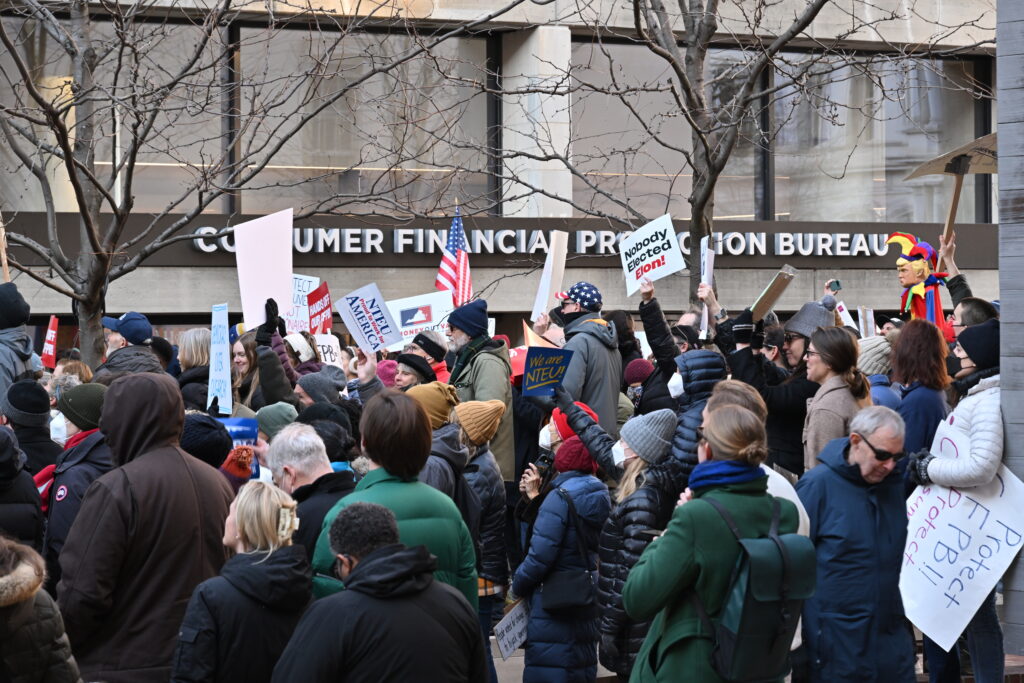
Consumer Financial Protection Bureau (CFPB)
For a PDF version of this agency breakdown, click here.
Timeline of Attacks
- February 1-3, 2025: Trump fired then-CFPB Director Rohit Chopra, replacing him with Treasury Secretary Scott Bessent.
- February 8, 2025: Russell Vought was made acting CFPB Director.
- February 9, 2025: Vought formally notified the Federal Reserve that the Bureau would decline its legally mandated quarterly funding transfer.
- February 10, 2025: Vought directed CFPB employees to “not come into the office” or “perform any work tasks” and paused all investigations.
- February 12, 2024: Around 73 probationary CFPB staffers were terminated.
- February 13, 2025: Approximately 100 career staff were laid off.
- February 14, 2025: A federal judge temporarily blocked Vought from terminating more employees following a lawsuit by the National Treasury Employees Union.
- March 15, 2025: At the CFPB’s own request, a federal court vacated the rule capping credit card late fees at $8. Major issuers announced plans to revert to fees of $30-$41. Consumer advocates estimated the move would extract an additional $10 billion annually from consumers.
- April 17, 2025: The CFPB issued layoff notices to around 1,400 employees after a federal appeals court allowed the reduction in force efforts to move forward. Simultaneously, the administration locked a majority of the CFPB’s workforce out of their offices and revoked their IT credentials.
- April 18, 2025: A federal judge again ordered the CFPB to halt terminations, stating the agency was “thumbing their nose” at her court.
- August 15, 2025: The DC Circuit Court of Appeals allowed the mass layoffs to move forward, though a NTEU request for an en banc hearing has held up implementation.
- December 30, 2025: A federal judge rejected CFPB’s attempt, under Vought’s leadership, to declare the Bureau’s funding mechanism illegal.
- January 9, 2026: Vought complied with the ruling and requested $145 million from the Federal Reserve to fund the CFPB.
Impacts on Capacity
The biggest cuts to CFPB personnel occurred within its enforcement and supervision divisions. For a more detailed accounting of DOGE’s actions across financial agencies, see Revolving Door Project’s Cuts to Corporate Enforcement Capacity tracker.
DOGE employed personnel with direct conflicts of interest with the CFPB’s regulatory authority. Gavin Kliger, a 25-year-old DOGE software engineer, was given a key role in managing CFPB system access despite owning over $365,000 in stock of companies like Apple and Tesla—firms with significant interests in the digital payment systems the CFPB was slated to regulate.
The targeted reductions in force (RIFs) caused a catastrophic brain drain, with the most significant losses among senior examiners and attorneys specializing in complex financial instruments and fair lending analytics. The RIFs also reduced the digital services team, the Office of Fair Lending and Equal Opportunity, and the Office of Civil Rights to one employee each, effectively dismantling them. With the vast majority of its staff subjected to layoffs, the CFPB will be unable to perform any of its key oversight functions.
Material Harms
As a result of DOGE’s raid on the CFPB and the subsequent dismantling of key market oversight functions, consumers now face direct financial harm and openly predatory behavior from corporations.
The most immediate impact was the explicit blocking of financial restitution for consumers victimized by corporate malfeasance. The revocation of the credit card late fee rule alone represented a transfer of approximately $10 billion annually from American households to major financial institutions. Furthermore, the CFPB under Vought dismissed a $60 million order against Toyota Motor Credit, waiving roughly $48 million in consumer redress. Former CFPB Director Eric Halperin said the CFPB now “wants to actively reward lawbreakers.”
The paralysis of the CFPB degraded the fundamental integrity of the consumer financial marketplace. The CFPB’s consumer complaint database became a black hole, as around 70,000 complaints went unaddressed in the week after Vought’s stop-work order. This, in turn, created an immense backlog of complaints that required a manual review, including around 75 complaints regarding imminent foreclosures. This void not only harmed the people in need of rapid assistance, but signaled to bad actors that predatory practices were less likely to be detected or punished.
Since Vought took over, the Bureau has only filed one enforcement action. At the same time, Vought unilaterally ended or voided scores of enforcement cases and actions. One beneficiary of such canceled actions was Navy Federal Credit Union, who had been on the hook for $80 million in refunds after illegally charging overdraft fees.
Given the absence of police on the banking beat, it seems inevitable that many people will be taken advantage of by amoral financial services companies.
Notable Names
Ousted Leadership
- Rohit Chopra: Senate-confirmed CFPB Director who was systematically sidelined before being terminated in February. Operational control of the Bureau was transferred to Russell Vought as Acting Director, who immediately began implementing the DOGE-aligned plan to dismantle the agency’s core functions.
- Lorelei Salas: Supervision director of the CFPB who resigned citing Vought’s stop-work directive, saying, “I do not believe it is appropriate, nor lawful, to stop all supervisory activities and examinations.”
- Eric Halperin: CFPB enforcement director who resigned after Vought’s directives made it so he could not “effectively serve” in his role to protect consumers.
- Gabriel O’Malley: CFPB Deputy enforcement director for policy and strategy who resigned after enforcement staff were placed on administrative leave, saying the Bureau’s work was “marked by silence and uncertainty.”
- Mark McArdle: CFPB assistant director for mortgage markets who resigned shortly after Vought’s takeover.
- Michael Salemi: Principal deputy enforcement director of CFPB who resigned in December 2025. Salemi told CFPB staff he saw “no path to an effective future enforcement program at the Bureau.”
DOGE Agents
- Russell Vought
- Gavin Kliger
Department of Health and Human Services (HHS)
For a PDF version of this agency breakdown, click here.
Timeline of Attacks
- February 5, 2025: DOGE agents gained access to the payment and contracting systems of HHS’ Centers for Medicare and Medicaid Services (CMS).
- February 14, 2025: DOGE agent Rachel Riley met with the heads of CMS.
- February 14, 2025: DOGE Agent and former Palantir employee Clark Minor was installed as chief information officer at HHS.
- February 15, 2025: 3,600 probationary employees were terminated at HHS. Most of the firings were at the Centers for Disease Control and Prevention (CDC), which lost around 1,300 employees, and the National Institutes of Health (NIH), which lost between 1,000 and 1,200 employees.
- February 21, 2025: The Substance Abuse and Mental Health Services Administration, a subagency of HHS, lost 10% of its staff to DOGE cuts. Some of the terminated staff were working on a mental health crisis hotline.
- March 10, 2025: Nearly all HHS employees received deferred resignation offers with a $25,000 incentive.
- March 26, 2025: HHS announced it was cutting $11.4 billion of funding for state and local health departments.
- March 27, 2025: HHS announced it was aiming to reduce its workforce by 20,000 employees and had achieved half of that goal through deferred resignations and early retirements.
- April 1, 2025: HHS announced that it would be laying off 10,000 employees in accordance with DOGE efforts. The cuts included 2,400 positions at the CDC, 3,500 positions at the Food and Drug Administration, and 1,200 at the National Institutes of Health.
- April 2, 2025: DOGE ordered HHS to reduce contract spending by 35%.
- April 3, 2025: Health Secretary Robert F. Kennedy Jr. said that 20% of DOGE cuts at HHS are going to be “mistakes” and employees will need to be reinstated.
- April 17, 2025: DOGE rolled out a “Defend the Spend” program at HHS that put a hold on funding in some subagencies, requiring grant awardees to justify each disbursement and receive approval from political appointees.
- April 22, 2025: Wired reported that DOGE had gained access to a total of 19 sensitive systems at HHS, including those that handle Medicaid payments to states.
- May 2, 2025: The FDA rehired FOIA workers that had been terminated during April’s DOGE cuts.
- May 2, 2025: The National Institute for Occupational Safety and Health moved to terminate over 900 employees, including those working on mine safety and workplace respiratory hazards. Around 328 of these firings were reversed a few weeks later after pressure from unions and representatives.
- June 16, 2025: HHS reinstated approximately 800 CDC employees who had been terminated in April.
- June 24, 2025: Secretary Kennedy told Congress that HHS has rehired a total 1,250 employees who had been terminated in DOGE layoffs.
- July 16, 2025: A DOGE review of CDC grants delayed $140 million of funding for fentanyl overdose response efforts.
Impacts on Capacity
Under the dual threats of DOGE and Health Secretary RFK Jr.’s “Make America Healthy Again” agenda, HHS lost roughly 25% of its workforce due to terminations and deferred resignations. The cuts affected a host of critical programs which the department manages in service of its expansive mission and authority.
HHS let go of the team that administers the National Survey on Drug Use and Health, which has collected data on drug use and mental health since 1971, serving as a critical resource for research and policy. The Low-Income Home Energy Assistance Program was virtually eliminated, with all full time staff terminated.
In April, cuts at the CDC initially included over 200 workers at the National Institute of Occupational Safety and Health (NIOSH) in Morgantown, West Virginia. As a result of firings, the union said hundreds of lab animals would be euthanized. In May, around 900 employees at NIOSH were slated to be terminated, including those working on tracking cancer in firefighters and combating black lung in coal miners. After pushback, 328 employees were rehired.
At CMS, the agency lost employees who worked on initiatives to improve care for beneficiaries, staffers who oversaw the Affordable Care Act, and staffers working on insurance fraud, among others.
At the FDA, DOGE cut staff responsible for overseeing the regulation of prescription drugs and medical devices, as well as support staff at offices that conducted inspections of food processing and drug manufacturing plants. This included 20 people at the office of neurological and physical medicine devices, which was responsible for oversight of Elon Musk’s brain chip company Neuralink. 140 members of the agency’s Center for Veterinary Medicine were also fired.
In all, the consolidation or elimination of HHS divisions reduced the number of subagencies in the department from 28 to 15 and resulted in the loss of a quarter of its staff.
Material Harms
In addition to the massive layoffs and resignations at HHS, the dramatic reduction of grants will negatively impact health efforts across the country.
Some major DOGE cuts included:
- $226 million for the Minnesota Department of Health, a quarter of its budget. The funds were used in vaccination clinics and health programs, among other initiatives.
- Funds for “immunizations, health disparities, community health workers, and epidemiology programs” administered by the Kansas Department of Health and Environment, said by DOGE to total $49 million.
- Approximately $10 million for the Louisiana Department of Health for mental health, substance abuse, and crisis services. While DOGE’s website claimed to have saved $55 million by cutting grants to the Louisiana Health Department, the department’s Deputy Secretary said cuts were closer to $10 million.
- A $4 million CDC grant for HIV prevention in Tennessee.
The cancelled grants had immediate impacts—some vaccination clinics were forced to close right away—but the decimation of funding will also inevitably lead to lower vaccination rates for various diseases, and, in turn, lead to more preventable disease and death.
The safety of our food and drug systems has also been put at risk. Even prior to losing over 3,000 employees, the FDA inspection regime was woefully inadequate: in 2024, the Government Accountability Office found a 16% vacancy rate for FDA investigators, leading to fewer inspections than in 2019. While investigators themselves were exempted from cuts, terminating the support staff that handle travel and logistics for investigators will only slow the pace of inspections and investigations, diminishing the government’s ability to guarantee sanitary food processing and safe medical devices. Current FDA investigators speaking with NPR detailed how travel reimbursements were slowed and booking travel arrangements made more difficult due to the loss of staff. Speaking about the firings at the FDA, the president of the American Veterinary Medical Association warned that oversight of food safety and animal-borne diseases would become limited by personnel cuts.
At the CDC, experts warned that cuts at the agency will harm disease research, prevention, and communication. The cuts were far ranging across the agency, hitting research into hepatitis, sexually transmitted diseases, tuberculosis, gun violence, and domestic violence. It will be hard to directly trace the relationship between these cuts and any spikes in these issues, but one thing is clear: the government’s ability to understand and combat these problems has been decimated by DOGE.
Notable Names
Resignations
- Susan Monarez: Director of the CDC who was ousted in August 2025 after less than one month on the job after refusing to sign on to “unscientific, reckless directives,” according to her attorneys.
- Dr. Debra Houry: Deputy director of the CDC who resigned in response to the termination of Director Monarez.
- Dr. Daniel Jernigan: Head of the CDC’s National Center for Emerging Zoonotic Infectious Diseases who resigned in response to the termination of Director Monarez, saying it was clear that the administration was not interested in an “evidence-based approach.”
- Dr. Demetre Daskalakis: Head of the CDC’s National Center for Immunization and Respiratory Diseases who resigned in response to Monarez’s termination, citing Secretary Kennedy’s anti-vaccine rhetoric and the administration’s “efforts to erase transgender populations” in his resignation letter.
- Jen Layden: Director of the Office of Public Health Data at the CDC who resigned after budget cuts made it “challenging” for her office to do its job.
- Peter Marks: Top vaccine official at the FDA who resigned in protest of Secretary Kennedy’s anti-vaccine views and misinformation.
- Michael Rogers: FDA’s associate commissioner for inspections and investigations who resigned in May 2025 after 34 years with the agency.
DOGE Agents
- Luke Farritor
- Marko Elez
- Edward Coristine
- Rachel Riley
- Aram Moghaddassi
- Zachary Terrell
- Kyle Schutt
- Clark Minor
Department of Veterans Affairs (VA)
For a PDF version of this agency breakdown, click here.
Timeline of Attacks
- February 5, 2025: The VA’s press secretary confirmed to Military.com that a DOGE agent was present at the department, claiming that the employee would improve efficiency, but “not have access to veterans’ or VA beneficiaries data.” The employee was later confirmed by Bloomberg to be Justin Fulcher.
- February 13, 2025: The VA announced it was terminating over 1,000 employees.
- February 25, 2025: DOGE announced the cancellation of 875 VA contracts amounting to nearly $2 billion. The contracts funded medical services, cancer programs, recruited doctors, and provided burial services according to a Washington Post analysis of VA documents. VA Secretary Douglas Collins celebrated the cuts, tweeting “No more paying consultants to do things like make Power Point slides and write meeting minutes!”
- February 25, 2025: The VA announced that another 1,400 probationary employees had been terminated.
- March 4, 2025: A leaked memo obtained by Government Executive revealed that the administration planned to cut VA staff by 83,000 employees by the end of the year. Secretary Collins later confirmed that he intended to cut the workforce by 72,000 employees.
- April 4, 2025: Wired reported that, in late March, DOGE Agent Sahil Lavingia was attempting to insert coding changes into the VA’s government website. Lavingia was reportedly using AI to write code for the department’s systems.
- May 20, 2025: 14,000 VA employees applied to accept DOGE’s deferred resignation program. The agency initially approved resignations of crisis hotline staff before later walking back that decision.
- June 6, 2025: DOGE agents built an artificial intelligence tool to identify VA contracts that it considered non-essential and labeled them “Munchable.” ProPublica found that the tool used the label on 2,000 contracts and regularly produced false information about the size of the contracts. VA employees attempting to retain a given contract had to justify doing so in 255 characters or fewer and often only had a few hours to do so.
Impacts on Capacity
The massive DOGE cuts at the VA were intended to bring the department back to 2019 levels, reversing a massive hiring surge undertaken by the Biden Administration to prepare for expanded veteran health care coverage under the 2022 PACT Act.
Personnel responsible for mental health support for veterans were included in the first first two rounds of cuts. According to Rolling Stone, the VA lost PTSD specialists, crisis hot line staffers, and a suicide prevention counselor. DOGE also ended support contracts for the National Center for PTSD. Not only were these services for veterans eliminated, but a large majority of the canceled contracts supported veteran-owned businesses.
Material Harms
The extensive DOGE cuts to VA staffing and contracts reverberated in communities throughout the country as VA operated clinics were gutted. For example, 14 employees were fired at the Boise VA Medical Center in Idaho in February 2025, with potentially 300 more terminations coming through Secretary Collins’ reduction in force plan. Local workers and representatives said the cuts would “devastate” the ability to provide adequate care.
The administration claimed patient care would not be affected by cuts, but VA employees told a different story. Speaking anonymously with NBC News, VA employees expressed concern that the cancelled contracts will impact patient safety, as the cuts included contracts for sterilization of hospitals and equipment and maintaining safe air quality in VA facilities.
Mental health care was also on the chopping block. DOGE cuts initially included probationary employees at the VA’s crisis hotline before public outrage forced a reversal. This chaos, in conjunction with the increased stress among veterans caused by DOGE, overwhelmed remaining staff, as call volume increased to 80,000 calls per month in the first three months of 2025. Furthermore, the cuts targeted other call centers that help veterans access care. The National Call Center for Homeless Veterans, for example, lost 30% of its staff.
To make matters worse, the return-to-office mandates risked the confidentiality of patients speaking to VA therapists, as telehealth meetings could be overheard by other staff. The American Psychological Association criticized the mandate, stating it “could compromise access to care and confidentiality standards.”
By June of 2025, DOGE had cancelled about 600 VA contracts. While it’s unclear how many of these were part of the 2,000 contracts flagged by the AI tool Munchable, ProPublica identified two dozen contracts from the DOGE list that had been cancelled. Per ProPublica reporting, among the contracts were “a gene sequencing device used to develop better cancer treatments” and a “blood sample analysis in support of a VA research project.”
Notable Names
DOGE Agents
- Justin Fulcher
- Cary Volpert
- Christopher Roussos
- David Malchers
- Sahil Lavingia
Social Security Administration (SSA)
For a PDF version of this agency breakdown, see here.
Timeline of Attacks
- February 5, 2025: Michael Russo was installed as chief information officer at the SSA. Russo previously served as the Chief Technology Officer for the payment processing firm Shift4, which held equity in Elon Musk’s SpaceX and provided services for Musk’s StarLink.
- February 5, 2025: DOGE was granted read-only access to the Treasury Department’s payments systems, which is responsible for disbursing Social Security checks and contains sensitive personal information, including social security numbers.
- February 14, 2025: The SSA’s Office of Hearing Operations in White Plains, New York was part of a DOGE list of leases marked for termination or nonrenewal. The office closed at the end of its lease in May.
- February 16, 2025: Musk and the White House spread misinformation about Social Security, claiming “tens of millions of deceased people” were receiving Social Security payments.
- February 18, 2025: Leland Dudek replaced Michelle King as acting SSA commissioner when King stepped down after attempting to block DOGE’s access to sensitive personal information. Dudek was previously placed on administrative leave for circumventing agency leadership to give information to DOGE. As commissioner, Dudek swiftly announced that DOGE would be given read-only access to DOGE’s sensitive systems.
- February 19, 2025: DOGE claimed to have saved $232 million at the SSA, largely through cancelling “IT development efforts.” The Intercept later reported the true “savings” was only $560,000.
- February 21, 2025: The Office of Analytics Review and Oversight was dissolved, with its operations being absorbed into other offices.
- February 24, 2025: DOGE announced that 10 Social Security Offices across the country will be closed.
- February 25, 2025: Dudek announced the closure of the Office of Transformation and the Office of Civil Rights and Equal Opportunity. Approximately 190 employees were placed on administrative leave as a result of the closures.
- February 28, 2025: The SSA announced it would be cutting staffing levels by 7,000 employees, reducing total employment to around 50,000.
- February 28, 2025: DOGE cancelled IT contracts with Leidos Holdings and IT Concepts. Dudek also announced he was terminating 200 employees and 200 contractors.
- March 6, 2025: The Washington Post reported that Dudek admitted DOGE was responsible for the cuts he had implemented at the agency.
- March 9, 2025: DOGE instituted a $1 spending limit on government credit cards. At the SSA, this led to offices “running out of paper, pens and printer toner.”
- March 10, 2025: Bloomberg reported that Musk had installed venture capitalists Antonio Gracias and Scott Coulter as DOGE representatives at the SSA.
- March 12, 2025: The Washington Post reported on DOGE plans to end phone services for the SSA. Shortly after the report, DOGE amended its plans to end the ability for SSA recipients to change their banking information by phone, rather than ending phone service altogether. By mid-April, DOGE had completely scrapped the plans amid widespread backlash and increased wait times in person and over the phone.
- March 19, 2025: The Associated Press obtained an internal planning document that showed DOGE planned to close a total of 47 SSA offices.
- March 20, 2025: A federal judge temporarily blocked DOGE’s access to the sensitive personal information housed in the SSA’s systems.
- March 28, 2025: DOGE began plans to migrate the SSA’s computer systems to a different programming language.
- April 4, 2025: DOGE informed the SSA that the agency must propose “more extensive” reduction in for plans beyond the 7,000 employees they cut.
- April 4, 2025: SSA data analyzed by the Washington Post revealed that 2,500 employees at field offices were leaving the agency after accepting DOGE’s buyout offer.
- April 10, 2025: The SSA effectively canceled thousands of Social Security numbers legally obtained by immigrants by moving them to its database of dead people, removing their ability to receive benefits or work with legal documentation.
- June 6, 2025: After a months-long court battle, the Supreme Court ruled that DOGE can access sensitive social security data.
- July 9, 2025: The SSA reassigned approximately 1,000 field office staff to handle calls to the agency’s phone line.
- August 26, 2025: A whistleblower at the SSA revealed that DOGE had uploaded Social Security data to the cloud in violation of a court order, putting sensitive data at immense risk.
- January 20, 2026: The Department of Justice accused two DOGE members of conspiring with groups seeking to overturn election results. The scheme allegedly hinged on the DOGE agents’ access to Social Security data, which could be used to match state voter rolls. The individuals were referred for violations of the Hatch Act.
Impacts on Capacity
Shortly after DOGE-enthusiast Leland Dudek was installed as acting commissioner, SSA began eliminating parts of the agency. Within his first week, Dudek dismantled the Office of Analytics Review and Oversight (OARA), Office of Transformation, and the Office of Civil Rights and Equal Opportunity.
Prior to its dissolution, OARA was responsible for “overseeing fraud detection and prevention efforts and addressing recommendations from external monitoring authorities.” The Office of Transformation, which was created in 2023 to implement agency-wide improvements to modernize signature requirements and electronic document uploads, had 50 employees placed on administrative leave. The Office of Civil Rights and Equal Opportunity was responsible for “investigating civil rights complaints, preventing harassment and ensuring accommodations for people with disabilities.” The office had 150 employees placed on administrative leave, with the majority believed to be headed for termination.
In addition to terminating SSA employees, DOGE also ended agreements with outside contractors Leidos Holdings Inc and IT Concepts, which were responsible for IT improvements. Dudek said he planned to eliminate contractors and full time employees at a 1:1 ratio.
In February, the agency announced its plans to reduce the workforce by 7,000 people. It’s unclear exactly where these cuts were instituted, but the near 12% staffing cut has had far reaching effects on the agency’s ability to serve beneficiaries. Field offices alone lost 2,500 employees to buyouts, with offices in Missouri, Nevada, and Minnesota losing 50% or more of their workforces.
Material Harms
Within a few weeks of DOGE’s presence at the SSA, their objectives became pretty clear: eliminate physical office locations, terminate a significant chunk of employees, and replace these services with AI or call systems. The first target of this plan was the White Plains, New York hearing office. As a result of its closure, which was finalized at the end of May 2025, beneficiaries in the area were forced to travel anywhere from 24 to 135 miles to reach the next closest office. The office, which heard appeals for people that were denied Social Security Disability Insurance or Supplemental Security Income, had some 2,000 pending cases when its closure was announced.
DOGE eventually listed nearly 50 offices for lease termination or nonrenewal, though leadership denied that field offices were closing, saying “only underutilized hearing office space has been closed and [sic] without permanently closing field offices.” It’s unclear how many of these proposed closures went through, but service was undoubtedly impacted. 119,000 people across the country visit the SSA’s 1,200 offices each day. Slowdown of service at these offices have deadly consequences. In 2023, 30,000 beneficiaries died while waiting for the SSA to issue determinations on their disability payments. Cuts to personnel and the number of hearing locations will only lengthen this process.
While the administration eventually backed off most detrimental plans to end phone services, and then withdrew its narrowed plans to end the ability of beneficiaries to change banking information over the phone, DOGE’s cuts still significantly hampered customer service efforts. The chaos with which DOGE announced planned cuts to services and offices led to a flood of phone calls to the agency’s hotlines. But due to the loss of personnel, the wait times were between 120 and 180 minutes. Inevitably, scores of people must have hung up before getting any assistance. It wasn’t just the phone lines either. Despite the supposed technological prowess of DOGE’s agents, the agency’s website repeatedly crashed and issued inaccurate error messages to users regarding their payments. Eventually, the agency stopped reporting its wait times and other performance metrics.
Under DOGE’s watch, the SSA also became a tool of the administration in political fights. In Maine, Acting Commissioner Dudek imposed a requirement that parents would need to register their children at physical SSA offices, rather than at the hospital. The move came amid Maine governor Janet Mills’ feud over Trump’s threats to pull federal education funding if the state didn’t ban transgender women from competing in women’s sports. A week after announcing the rule, Dudek revoked his action, saying it imposed an “undue burden” on Maine’s population.
The SSA was also a tool in the administration’s war on immigrants, with thousands of immigrants losing their legally obtained social security numbers after being added to the agency’s Death Master File, effectively barring them from employment and benefits. According to Wired, DOGE also pooled data from the SSA with the Department of Homeland Security and other agencies to create a database that could track and surveil immigrants, making the agency complicit in the violent ICE and Border Patrol incursions into cities across the country.
Notable Names
Ousted Leadership
- Michelle King: Former acting commissioner of the SSA who resigned from her position after disputes with DOGE over access to sensitive information. King was a career civil servant who had worked at the SSA since 1994.
- Tiffany Flick: SSA chief of staff who resigned after Leland Dudek was made acting commissioner.
- Charles Borges: Chief data officer of the SSA who resigned involuntarily after filing a whistleblower complaint regarding DOGE’s potential violation of federal statutes in its handling of sensitive information.
DOGE Agents
- Akash Bobba
- Scott Coulter
- Marko Elez
- Luke Farritor
- Antonio Gracias
- Gautier Cole Killian
- Jon Koval
- Nikhil Rajpal
- Payton Rehling
- Ethan Shaotran
Department of Education
For a PDF version of this agency breakdown, click here.
Timeline of Attacks
- February 3, 2025: At least 55 employees at the Education Department were placed on administrative leave, in alignment with the administration’s directive to eliminate DEI offices across the government. According to the American Federation of Government Employees, the action included civil rights attorneys focused on discrimination and antisemitism.
- February 3, 2025: The Washington Post reported that approximately 20 DOGE agents were present at the Department of Education. The agents had gained access to sensitive data systems which contained personal and financial information about students in the federal student aid program.
- February 5, 2025: Top officials at the Education Department told employees that DOGE’s deferred resignation offer could later be unilaterally cancelled by the Education Secretary, leaving employees who accepted the offer with no legal recourse.
- February 6, 2025: DOGE reportedly began feeding sensitive information, including personally identifiable information about grantees, from the Education Department into a Microsoft AI software program. DOGE intended to use AI to determine where to cut funding and staff from the department.
- February 7, 2025: Congressional Democrats were denied access to the Education Department during their attempt to meet with Acting Secretary Denise Carter.
- February 8, 2025: DOGE agents, including Akash Bobba and Ethan Shaotran, were given administrator email accounts for the Education Department.
- February 10, 2025: DOGE initiated $881 million in cuts to Education Department grants and contracts. The cuts included 170 contracts from the Institute of Education Sciences and grants for diversity, equity and inclusion efforts.
- February 17, 2025: DOGE canceled another $369 million in contracts and grants after prompting from far right activist Christopher Rufo. These cuts included grants for Equity Assistance Centers and contracts with Regional Educational Laboratories.
- March 11, 2025: The Education Department planned to terminate roughly half of its workforce as part of DOGE’s cuts, totaling over 1,300 workers. The cuts were in addition to 600 accepted deferred resignation offers.
- March 20, 2025: President Trump signed an executive order directing the dismantling of the Education Department.
Impacts on Capacity
By cutting contracts from the Institute of Education Sciences, including to Regional Educational Laboratories, the Department of Education lost hundreds of millions of dollars worth of research capabilities to study ways to improve the education system. Furthermore, Equity Assistance Centers are instrumental to addressing long standing educational inequalities and implementing desegregation, “ensuring that all students have equitable access to learning opportunities, regardless of their child’s race, sex, national origin, or religion.”
The administration took particular aim at the Office for Civil Rights (OCR) where 240 employees were terminated in March. Operating as a watchdog, OCR is responsible for ensuring schools that receive federal funding uphold antidiscrimination laws. In fact, one of their many responsibilities is to ensure schools are not segregated.
Staffing at the Office of Federal Student Aid was also drastically reduced, with the FSA losing over 725 employees to resignations and terminations. These employees were responsible for oversight of student loan companies, as well as IT specialists that managed the FSA program.
Material Harms
DOGE’s incursion at the Education Department risked the security of sensitive data of millions of students in the federal student loan program. Not only did DOGE agents themselves gain access to this information, they fed sensitive data into an artificial intelligence program, leaving it vulnerable to cyberattacks.
The DOGE cuts to grants and research contracts undermined efforts to improve education across the country, as the Institute of Education Sciences funded research on student performance, analysis of educational improvement programs, and best training practices, among other efforts. While Trump and DOGE claimed the Education Department must be dismantled due to alleged poor performance, they targeted the very offices whose sole purpose was to determine how to improve education programs and practices.
Amid the administration’s efforts to purge any and all DEI programs, research and programs helping children with disabilities were also eliminated. DOGE cancelled a contract with the American Institutes for Research (AIR) that studied the “effectiveness of transition supports for youth with disabilities served under the Individuals with Disabilities Education Act.”
DOGE hits to the Office of Civil Rights will negatively impact women, students of color, and LGBTQIA+ students. As the single governing body that administers protections for students of protected classes under Title IX, DOGE cuts severely crippled the guardrails that ensured nondiscrimination.
Cuts to Federal Student Aid hamstring the office’s ability to competently oversee student loan disbursements, threatening Americans’ access to higher education while also leaving students more vulnerable to scams. One of the largest cuts to the pivotal office targeted staff who ensure that for-profit colleges and universities are kept in check.
For more information on the harmful effects of dismantling the Education Department, see here.
Notable Names
DOGE Agents
- Akash Bobba
- Ethan Shaotran
- Brooks Morgan
- Alexandra Beynon
- Adam Ramada
- Jehn Balajadia
Treasury Department
For a PDF version of this agency breakdown, click here.
Timeline of Attacks
For a more detailed timeline of attacks on Treasury payment systems and suspended federal spending, see here.
- January 20, 2025: President Trump issued an executive order halting disbursement of foreign aid.
- January 24, 2025: Treasury Chief of Staff Dan Katz emailed senior officials directing them to grant DOGE access to payment systems in order to freeze US Agency for International Development (USAID) payments. Acting Treasury Secretary David Lebryk declined, stating “I don’t believe we have the legal authority to stop an authorized payment certified by an agency.”
- January 25, 2025: DOGE Agent Tom Krause responded to Lebryk insisting that DOGE be granted access, stating “I think this deserves serious consideration as well. I believe we can all feel more comfortable that we hold payment at least to review the underlying payment requests from U.S.A.I.D. now so that we can be given time to consult State.”
- January 31, 2025: Treasury Secretary Scott Bessent authorized Krause and his team to access the payment systems.
- February 4, 2025: The Treasury wrote a letter to Congress claiming that Krause and his team would have “read-only access,” and the review was not “resulting in the suspension or rejection of any payment instructions submitted to Treasury by other federal agencies across the government.”
- February 4, 2025: DOGE agent Marco Elez had administrator-level privileges at Treasury, which include “the ability not just to read but to write code on two of the most sensitive systems in the U.S. government: the Payment Automation Manager and Secure Payment System at the Bureau of the Fiscal Service (BFS).”
- February 11, 2025: In an affidavit, Krause said that he is “responsible, among other duties, for reducing and eliminating improper and fraudulent payments; waste, fraud, and abuse; and improving the accuracy of financial reporting.” According to Krause, his work included “ensuring that the Treasury DOGE Team was leveraging its unique technological expertise to help operationalize the president’s policy priorities for the early days of the administration, including by helping identify payments that may be improper under his new executive orders.”
- March 13, 2025: A federal judge ruled that thousands of terminated federal employees should be reinstated, including those at the Treasury Department.
- May 28, 2025: A federal judge ended restrictions that prevented DOGE staffers from accessing the Treasury’s sensitive data systems. The ruling modified a preliminary injunction, stating that DOGE staffers who have undergone proper training and vetting could be given access to the sensitive information.
- December 16, 2025: Treasury CIO and DOGE staffer Sam Corcos approved $1.5 million for ChatGPT licenses and issued coding tests to evaluate hundreds of IRS IT staff’s “technical proficiency.”
Impacts on Capacity
In addition to cuts to the IRS, the Treasury Department instituted cuts to the Bureau of Fiscal Service (BFS), with a union representative estimating that layoffs would eliminate up to 25% of its 3,300 employees. The layoffs would result in “outsourcing the work at the bureau’s Servicing of Savings Bonds, Debt Cross-Servicing Program and Paper Check Printing and Ancillary Services offices.”
Material Harms
As a result of DOGE’s raid on the Treasury, DOGE agents were able to access people’s sensitive personal information, including social security numbers, bank account information, and more. In one instance, DOGE staffer Marko Elez violated Treasury data security practices when he emailed a spreadsheet containing personally identifiable information to officials in a different agency. Granting access to Treasury payment systems also opened the door for DOGE to arbitrarily impound congressionally appropriated funds.
The staffing cuts at BFS could have severe ramifications for Parkersburg, West Virginia where BFS employs 2,200 people. A Republican state legislator representing parts of Parkersburg said that BFS cuts would “devastate” the city’s economy.
Notable Names
Ousted Leadership
- David Lebryk: After refusing to give in to DOGE’s request to take over the Treasury’s payment system, Acting Deputy Secretary of the Treasury David Lebryk was forced out of the government. Lebryk first joined the Treasury Department as a civil servant in 1989.
DOGE Agents
- Tom Krause
- Marko Elez
- Linda Whitridge
- Samuel Corcos
- Todd Newman
- Ryan Wunderly
- Aram Moghaddass
Internal Revenue Service (IRS)
For a PDF version of this agency breakdown, click here.
Timeline of Attacks
- February 11, 2025: The administration issued the “Workforce Optimization Initiative,” mandating a “1-to-4” hiring ratio and requiring the IRS to develop a reduction in force (RIF) plan.
- February 13, 2025: DOGE operative Gavin Kliger, a 25-year-old software engineer, entered IRS headquarters and was given access to the agency’s Integrated Data Retrieval System (IDRS).
- February 17, 2025: DOGE staffers reached an agreement to gain limited “read-only” access to anonymized taxpayer data within the IRS.
- March 13, 2025: Acting Chief Counsel William Paul was removed and demoted after clashing with DOGE over the sharing of sensitive taxpayer data. He was replaced by Andrew De Mello.
- July 18, 2025: The Treasury Inspector General for Tax Administration revealed a dramatic shrinking of the IRS workforce from roughly 103,000 staffers in January 2025 to 77,428 as of May 2025.
Impacts on Capacity
The 25% reduction in the IRS’s total workforce has rendered the agency a “zombie” of itself at best, and a “feast for wealthy tax evaders” at worst. By ousting nearly a third of the agency’s auditing workforce—especially those focused on auditing the ultra wealthy—DOGE has effectively granted corporate criminals a reprieve from paying taxes.
The DOGE-induced degradation of the IRS’s operational capacity is likely to be especially noticeable during the 2026 tax season. To maintain current levels of service for the upcoming filing season, the IRS would have needed to hire over 11,000 customer service employees, a task rendered impossible by the DOGE-mandated cuts.The implementation of Trump’s One Big Beautiful Bill Act would require the IRS to update forms and programming systems at the same time its technical and support staff are being purged.
Material Harms
The realignment of the IRS under DOGE has led to the weaponization of taxpayer data and financial losses caused by misinformation.
DOGE leaders floated the idea of a “DOGE Dividend”—a payment of up to $5,000 to be distributed to taxpayers from the “savings” generated by government cuts. The “DOGE Dividend” has yet to materialize, but it has created an opening for scammers to take advantage of the confusion and prey on the public.
What’s more concerning however, is the way DOGE has sought to weaponize taxpayer data. Historically, the IRS has guarded taxpayer information to ensure that all residents, regardless of immigration status, feel safe participating in the voluntary tax system. But on April 7, 2025, the IRS agreed to share names, addresses, and tax data for individuals under final orders of removal or under criminal investigation for immigration violations. By August 2025, the IRS had disclosed tens of thousands of records to ICE, despite warnings from internal legal counsel that the deal likely violated federal privacy laws. The use of IRS data to target specific populations sets a dangerous precedent for using the tax system as a tool of political or administrative retribution against any group of citizens.
Devastating the auditing capacity of the IRS did benefit some groups, however: private equity and venture capital firms. Under the Biden administration, the IRS began auditing firms in these massive industries to uncover the various tactics they were using to avoid billions in taxes. It was working. With DOGE cuts, however, audits have dropped by “80 or 90 percent,” potentially leaving billions upon billions of dollars of tax dollars in the pockets of private corporate behemoths.
The loss of these audits is indicative of DOGE’s project at the IRS: decimate the ability of the government to investigate tax cheats while normal people lose valuable tools like DirectFile.
Notable Names
Ousted Leadership
- Melanie Krause: Chief Operating Officer and Acting Commissioner who resigned in May in protest of IRS’ data-sharing agreement with ICE.
- Traci Di Martini: Head of human resources at IRS was ousted in March 2025 for informing employees that firings within the agency were authorized by the DOGE-controlled Office of Personnel Management.
DOGE Agents
- Gavin Kliger
- Samuel Corcos
Department of Agriculture
For a PDF version of this agency breakdown, click here.
Timeline of Attacks
- February 13, 2025: Secretary Brooke Rollins was sworn into office. She welcomed the integration of DOGE into the USDA and immediately initiated mass layoffs across the agency.
- February 18, 2025: The USDA admitted to accidentally firing several employees tasked with managing the federal response to the H5N1 avian flu outbreak.
- February 20, 2025: The USDA initiated widespread layoffs, including “many hundreds of staff at critical scientific subagencies” and 2,000 Forest Service employees.
- March 12, 2025: The USDA eliminated two critical food safety advisory committees: the National Advisory Committee on Microbiological Criteria for Foods and the National Advisory Committee on Meat and Poultry Inspection.
- March 13, 2025: The USDA canceled $1 billion in funding for programs that assisted local schools and food banks in sourcing products from their own communities.
- March 14, 2025: Investigative reporting revealed that hundreds of USDA sites were listed on DOGE’s “Wall of Receipts,” signaling they were targeted for termination.
- April 10, 2025: 12,000 USDA employees accepted resignation offers; notably, 10% of these departures occurred within the Animal and Plant Health Inspection Service (APHIS).
- May 1, 2025: New regulations required DOGE approval for over one-third of USDA farm-loan dollars—totaling at least $1.7 billion.
- May 4, 2025: Total resignations at the USDA reached 15,000, or 15% of the total staff. This included 555 departures from the Food Safety and Inspection Service (FSIS).
- June 11, 2025: The USDA Forest Service Chief stated that the agency had lost 4,200 employees to paid leave and 600 employees to early retirements.
- August 13, 2025: The USDA terminated union contracts for over 8,000 employees within the Animal and Plant Health Inspection Service and the Food Safety and Inspection Service.
- September 30, 2025: Approximately 1,200 employees from the Agricultural Research Service (ARS) resigned after accepting DOGE buyouts.
Impacts on Capacity
DOGE’s assault on USDA has effectively eliminated the agency’s capacity to maintain national food security and rural infrastructure. The removal of technical staff responsible for irrigation engineering, invasive disease mitigation, and rural housing assistance has created a backlog of critical projects that experts indicate may remain stalled indefinitely. As the remaining workforce faces unmanageable caseloads, the collapse of these support systems threatens the viability of America’s food supply.
The mass firing of federal avian flu response personnel leaves America’s poultry supply defenseless against an emerging public health threat. And while USDA later scrambled to rehire these essential experts, the initial purge occurred at a moment of heightened vulnerability.
Material Harms
DOGE’s attacks on USDA is an attack on America’s physical health. The loss of hundreds of inspectors at entry points increases the probability of a catastrophic invasive species breach. Additionally, this bottlenecking of the national supply chain raises concerns of a port-to-table failure, as perishable food imports rot in transit due to processing delays.
In addition to supply chain issues, the USDA canceled direct food assistance programs to the tune of over $1 billion. In March, the agency announced they were scrapping $660 million for the Local Food for Schools Cooperative Agreement Program. The program helped schools and child care facilities provide better nutrition for their students by working with local producers to buy fresh food. Affected communities called the cuts “devastating” and a “slap in the face.” Without these funds, schools are forced to buy from national corporations and often cannot afford fresh, healthy food for children. The agency cuts also targeted the Local Food Purchase Assistance Cooperative Agreement Program, which supported food banks.
At the Forest Service, the dramatic cuts to probationary employees forced firefighters to take on the duties of support staff. The agency simultaneously stated it did not have “enough capacity to meet the needs of the continuing wildfire crisis.” While USDA leadership publicly claimed to be ready for wildfire season, remaining firefighters speaking with reporters said employees were “worried” and described the loss of institutional knowledge as “crippling.”
Rural communities that helped elect Trump to office are suffering the most from DOGE-controlled USDA. Agency cuts have stopped the flow of rural development funds to isolated communities. As a result, programs that helped transport families to medical appointments or repaired homes for the elderly were “forced to stop community outreach.”
USDA’s dereliction of duty has also harmed the public’s financial health. DOGE’s assault on avian flu response personnel has already been linked to rising egg prices, a trend that stands to impact grocery costs more generally.
Notable Names
DOGE Agents
- Gavin Kliger
- Joshua Fox
Department of Commerce
For a PDF version of this agency breakdown, click here.
Timeline of Attacks
- February 4, 2025: DOGE staffers entered the Department of Commerce. DOGE was granted access to the National Oceanic and Atmospheric Administration’s (NOAA) computer systems.
- February 20, 2025: DOGE implemented a $1 spending cap on government-issued credit cards that federal employees use to cover travel and other work-related expenses.
- February 22, 2025: At the direction of Elon Musk, employees across the government received an email from the Office of Personnel Management directing them to give 5 bullet points of their accomplishments from the past week. According to Musk, failure to respond would “be taken as a resignation.” Though workers at many agencies were informed they could ignore the directive, Department of Commerce employees were told to comply.
- February 27, 2025: DOGE laid off 880 NOAA employees, representing over 5% of its workforce. More than 100 of the fired employees worked in the National Weather Service (NWS).
- February 28, 2025: Approximately 500 NOAA employees accepted DOGE’s deferred resignation offer. Nearly 200 of the resignations were employees at NWS.
- March 3, 2025: 73 workers at the National Institute for Science and Technology (NIST), a Commerce subagency, were terminated.
- March 4, 2025: NIST’s AI Safety Institute signed a deal with Elon Musk’s artificial intelligence company xAI.
- March 10, 2025: NOAA submitted plans to fire 1,029 employees. The plan was in response to a memo from the Office of Management and Budget and Office of Personnel Management directing agencies to submit reduction in force plans. Employees had until April 17 to decide whether to take early retirements or buyouts. NOAA approved more than 1,000 exit requests from eligible workers, including roughly 300 from NWS.
- March 13, 2025: A federal judge ruled that thousands of terminated federal employees should be reinstated, including those at the Department of Commerce.
- April 9, 2025: A Fourth Circuit Court of Appeals panel reversed the lower court’s ruling, saying the court lacked jurisdiction to reinstate terminated workers.
Impacts on Capacity
The vast majority of the cuts at the Department of Commerce occurred at NOAA, where more than 2,300 workers were pushed out. The agency lost roughly 10% of its staff before the start of tornado season and nearly 20% before the start of hurricane season.
The National Weather Service (NWS), a critical subagency of NOAA that is responsible for collecting the data used for weather forecasting, lost about 600 employees. Approximately 6% of the agency’s workforce was missing at the start of tornado season and around 13% were gone before the start of hurricane season.
By March 20, NWS had suspended weather balloon launches or reduced the frequency of launches in 11 different locations, worsening forecasting and modeling capabilities. On April 17, NWS announced the suspension of additional weather balloon launches. In late May, The Washington Post reported that in the wake of DOGE cuts “up to 30 [weather balloon] launches have been missed each day, representing around 17 percent of total daily launches.”
The legislative director of the NWS employees union said that as of mid-May, 52 of 122 weather forecast offices had staff vacancy rates over 20%. In addition, 35 offices were missing meteorologists-in-charge, also known as chief meteorologists.
Eight NWS forecast offices were forced to cease overnight operations in the spring.
The administration implicitly admitted the cuts had gone too far—in June, the NWS announced it was looking to hire 126 people in order to “stabilize” its operations. In August, NOAA was reportedly looking to hire 450 critical positions. As of December, just 80 previously ousted NWS workers had accepted offers to return.
At the National Institute for Science and Technology, DOGE terminated 42 employees working on administering the CHIPS and Science Act.
Material Harms
The NWS cuts caused so much alarm that five former agency directors penned an open letter about the potential consequences, stating, “Our worst nightmare is that weather forecast offices will be so understaffed that there will be needless loss of life.”
Wired reported in early March that “the DOGE-mandated credit card freeze is delaying shipments of critical supplies, stalling travel, and stopping employees from doing their jobs.” NOAA scientists, for example, “aren’t able to order equipment used to repair ships and radars.”
Fired NOAA employees warned that due to staffing shortages, the agency would struggle to keep its fleet of “hurricane hunter” aircraft flying 24/7, jeopardizing forecast accuracy.
Weather balloons collect upper atmospheric data that is essential to accurate forecasting. Forecast quality was degraded as a result of DOGE cuts, including during the tornadoes and hail storms that hit the Midwest in mid-April.
Ahead of the July floods that killed more than 130 people in Texas, local NWS offices were missing key officials, which may have undermined swift coordination between forecasters and local emergency managers. The agency’s San Angelo office, which covers many of the hardest-hit areas, was missing a senior hydrologist, staff forecaster, and a meteorologist-in-charge. The latter position, also known as a chief meteorologist, is “the critical linchpin in the operation of our weather forecast offices,” former NOAA administrator Rick Spinrad told CNN. “They ensure the forecasters have all they need to be most effective, and they are the direct link to NWS HQ for safe and timely communications during weather events.” Spinrad lamented that “not having a permanent MIC in place is like having a substitute pilot on the airplane.”
Before the Alaska Native village of Kipnuk was inundated by catastrophic floods in October, reductions in weather balloon launches likely degraded forecasts and cuts to public radio stations probably impeded the distribution of warnings.
DOGE also terminated a $8.2 million Department of Commerce grant that was intended to expand rural broadband in Kansas. According to the Kansas Health Institute, 12% of Kansas households do not have broadband, including 30% of households with income under $20,000.
Notable Names
Ousted Leadership
- Jeff Dillen: NOAA deputy general counsel who was placed on administrative leave, ostensibly for “performance issues.”
- Stephen Volz: Assistant administrator for NOAA’s Satellite and Information Service who was placed on administrative leave. Volz previously led an investigation into two Trump NOAA officials and found they violated NOAA’s “scientific integrity policy.”
DOGE Agents
- Michael Grimes
- Nikhil Rajpal
- Bryton Shang
Department of Homeland Security (DHS)
For a PDF version of this agency breakdown, click here.
Timeline of Attacks
- February 5, 2025: The Department of Homeland Security offered a “deferred resignation” to Cybersecurity and Infrastructure Security Agency (CISA) employees. Under this agreement, 174 employees resigned.
- February 5, 2025: DOGE staffers gained access to computer systems of the Federal Emergency Management Agency (FEMA), a DHS subagency, including sensitive databases containing the personally identifiable information of tens of thousands of disaster victims.
- February 10, 2025: Elon Musk’s inaccurate claims on X about FEMA spending on undocumented immigrants disrupted the flow of agency funds. Then-Acting FEMA Administrator Cameron Hamilton gave DOGE “full system access to our financial management system.” In late February, FEMA imposed a “manual review” of all grants, resulting in a freeze on more than $100 billion in payments.
- February 14, 2025: DOGE fired an estimated 130 CISA employees.
- February 18, 2025: CISA staff members specifically focused on disinformation and foreign influence operations were placed on administrative leave.
- February 19, 2025: DOGE agent Edward Coristine was embedded at DHS and began targeting the Countering Weapons of Mass Destruction (CWMD) Office’s bio-detection program and CISA’s Cybersecurity Advisory Division.
- February 25, 2025: DOGE began closing DHS agencies across the country.
- February 2025: The Trump administration fired more than 200 “probationary” FEMA workers. Over 800 FEMA employees accepted a deferred resignation offer. A dozen senior leaders were among the 1,000-plus who were laid off or left FEMA.
- March 8, 2025: In-person disaster response and emergency management training at the National Fire Academy was abruptly halted and suspended as part of a DOGE “efficiency review” of government operations.
- March 19, 2025: House oversight Democrats requested a GAO review of DOGE’s layoffs, embedded staff, and contract terminations at DHS.
- April 4, 2025: Reports indicated broader reductions at CISA could impact ~1,300 staff and contractors.
- April 4, 2025: FEMA eliminated the Building Resilient Infrastructure and Communities (BRIC) grant program and rescinded more than $3 billion in funding for climate adaptation and hazard mitigation projects that had been approved but not completed.
- April 2025: Roughly 1,000 additional FEMA employees, including many senior officials, sought early retirements or accepted buyouts amid DOGE-inflicted chaos.
- June 3, 2025: Axios reported that roughly 1,000 employees had left CISA through reductions in force or resignations.
- October 11, 2025: DHS issued a reduction in force notice to 54 employees.
Impacts on Capacity
The staff levels at CISA were severely diminished by DOGE cuts, with nearly one third of the workforce leaving via terminations or resignations. The Cybersecurity Division, which serves to “fortify the nation’s cyber defenses against immediate threats and vulnerabilities,” was hit particularly hard, losing close to 200 of its 1,100 employees.
The forced departure of roughly up to 33% of FEMA’s permanent full-time staff by May 1—including senior executives and critical coordinating officers—decimated the agency’s operational capacity and undermined training and planning. At the start of the 2025 hurricane season on June 1, FEMA had almost 800 fewer disaster workers available than the year prior and roughly half as many staff trained to respond to disasters as in May 2024. All of FEMA’s most senior leadership positions were filled by DHS personnel with little to no disaster management expertise.
The elimination of the Building Resilient Infrastructure and Communities grant program and the halt to climate adaptation and hazard mitigation work destroyed FEMA’s ability to fund projects that reduce future disaster risk. The removal of equity and climate considerations from mitigation planning guides increased the likelihood that low-income and vulnerable communities would be overlooked.
Material Harms
For more on the administration’s mishandling of natural disasters, see our Disaster Policy Tracker.
The systematic dismantling of FEMA directly led to catastrophic failures in disaster response. During the deadly Central Texas floods in July 2025:
- Call center worker contracts were allowed to lapse, leaving thousands of calls for assistance unanswered.
- DHS Secretary Kristi Noem waited over 72 hours to authorize the deployment of Urban Search and Rescue Teams.
- Requests for critical aerial imagery to aid rescue operations were stalled awaiting political sign-off.
- The acting FEMA administrator was unreachable for over 24 hours and did not visit the disaster zone for nine days.
Since March 2025, DHS has made the allocation of funding—including the Emergency Management Performance Grant program used to train and pay state and local emergency management staff—contingent on cooperation with Trump’s crackdown on immigrants. This and Noem’s requirement for political approval of all contracts over $100,000 paralyzed the agency’s ability to disburse congressionally appropriated funds, impeding preparedness and delaying recovery for communities across the country. An analysis found that proposed changes to federal assistance thresholds would have disqualified 71% of major disasters declared from 2008-2024, depriving state and local governments of $41 billion in aid.
Notable Names
Ousted Leadership
- MaryAnn Tierney: Acting deputy administrator cited the Trump administration’s attacks on FEMA in her May resignation letter.
- Jeremy Greenberg: The Director of the National Response Coordination Center, FEMA’s “24-hour war room,” resigned on June 11, one day after Trump announced plans to phase out the agency.
- Ken Pagurek: FEMA search and rescue chief resigned in the wake of Noem’s delayed response to the Texas flooding disaster.
DOGE Agents
- Edward Coristine
- Kyle Schutt
Securities and Exchange Commission (SEC)
For a PDF version of this agency breakdown, click here.
Timeline of Attacks
- February 17, 2025: DOGE’s SEC X account account asked users to “DM this account with insights on finding and fixing waste, fraud and abuse relating to the Securities and Exchange Commission.”
- February 24, 2025: The SEC told 10 of its regional directors that their jobs would be eliminated as part of DOGE cuts.
- March 3, 2025: The GSA announced plans to terminate the agency’s regional offices in Los Angeles and Philadelphia.
- March 21, 2025: More than 600 SEC employees, accounting for 12% of the total staff, accepted resignation offers. Sources told Reuters that resignations included over a dozen senior staff and 150 employees in the Division of Enforcement.
- March 28, 2025: The SEC began to bring in DOGE agents and told staff to “cooperate with their request.”
- April 2, 2025: Bloomberg reported that Eliezer Mishory, previously the chief regulatory officer at the prediction market Kalshi, was leading DOGE at the SEC.
- April 15, 2025: Mishory requested read and write access to SEC agency data, including “staff emails, personnel data, contracts, and payments systems.”
- May 6, 2025: SEC chair Paul Atkins said the agency had lost 15% of its staff. Atkins claimed all of the staff exits were from retirements and deferred resignations.
- May 21, 2025: Atkins claimed DOGE had saved the agency $90 million. A FedScoop analysis of public DOGE data, however, found DOGE had cut more than 40 contracts totaling $18.9 million.
- May 30, 2025: The SEC’s FY2026 budget request asked for funding for 4,100 positions, down from the roughly 5,000 employees the agency had at the start of the administration.
- June 9, 2025: The SEC submitted reduction in force plans to the Office of Management and Budget, saying voluntary separations satisfied reduction mandates. The submission revealed the agency had 4,300 staffers remaining.
- August 26, 2025: The SEC walked back DOGE’s Los Angeles and Philadelphia lease cancellations, renewing the leases until 2029 and 2035, respectively.
- October 30, 2025: Reuters reported that Mishory, DOGE’s lone remaining agent at the SEC, had finished his work and would be leaving.
Impacts on Capacity
The initial round of resignations in March 2025 was most felt within the Division of Enforcement, which lost around 150 employees. By May, a Reuters analysis of staff departures found the Office of the General Counsel had lost 19.5% of staff and the regional offices in Chicago, San Francisco, and Denver had each lost over 16% of their staff.
The SEC aimed to cement these personnel losses in FY2026. The agency requested 4,100 full time employees, down from over 5,000 the previous year. The SEC also lost around 300 of its 2,000 contractors.
Material Harms
Between the mass DOGE-induced resignations and the administration’s dedication to letting corporate criminals walk free, SEC enforcement cases have plummeted under Atkins’ leadership. According to analysis by Paul Weiss, the agency only initiated 313 new enforcement actions in FY2025, a 27% decline compared to the previous fiscal year and the fewest in 10 years. As a result, the agency brought in $808 million from settlements, a 45% reduction from the previous year, which really reflects DOGE’s lack of imagination. Like we’ve long argued, corporate enforcement easily pays for itself. It also protects investors from a host of corporate shenanigans.
After the agency set records for civil penalties in 2022, SEC enforcement chair Gurbir Grewal stated, “We don’t expect to break these records and set new ones each year because we expect behaviors to change. We expect compliance.” In other words, strong enforcement disincentivizes lawbreaking. Lax enforcement , on the other hand, sends a message that companies can break the law with impunity. In the unlikely case they face penalties, companies will count those minimal fees as the cost of doing business and continue unabated. As a result, the pocketbooks of regular Americans will suffer as they fall victim to financial fraud or manipulation.
In addition to diminished enforcement efforts, the agency has also dropped a slew of high profile cases that began during the Biden administration. A New York Times analysis found the SEC moved to “pause litigation, lessen penalties or outright dismiss” 60% of inherited cases against crypto companies. Of the 14 cases that were dismissed, paused, or settled favorably, at least 8 of the companies under investigation had ties to Trump.
Among the firms who had their cases dropped were Gemini, a crypto exchange founded by Trump allies and donors Tyler and Cameron Winklevoss, and Binance, a crypto exchange that heavily invested in and boosted Trump’s crypto venture World Liberty Financial and its USD1 stablecoin. Gemini had been accused of the unregistered offer and sale of crypto securities, resulting in hundreds of thousands of customers having $900 million of their assets frozen when its Gemini Earn program collapsed. Binance, which previously paid $4 billion in a plea deal for money laundering violations, was accused of misleading investors and commingling funds, among other charges. Binance’s CEO Changpeng Zhao, who had pleaded guilty to money laundering after his exchange was used to fund terrorist groups, was also given a pardon by Trump.
Notable Names
Ousted Leadership
- Erica Williams: Former chair of the Public Company Accounting Oversight (PCAOB), which is overseen by the SEC, resigned in July at the request of Atkins.
DOGE Agents
- Eliezer Mishory
- Jonathan Mendelson
Department of Energy
For a PDF version of this agency breakdown, click here.
Timeline of Attacks
- February 5, 2025: Energy Secretary Chris Wright granted DOGE agent Luke Farritor access to the Department of Energy’s IT system against the advice of the agency’s general counsel, who said Farritor was “not cleared to be in DOE.” Farritor previously worked as a SpaceX intern.
- February 7, 2025: DOE leadership appointed former SpaceX engineer Ryan Riedel as Chief Information Officer.
- February 13, 2025: The Department of Energy initiated plans to lay off approximately 2,000 probationary employees.
- February 14, 2025: Officials at the National Nuclear Security Administration (NNSA), a sub-agency of DOE responsible for overseeing US nuclear weapons, rescinded the terminations of hundreds of employees. Nearly all of the 300 terminated employees had their firings reversed. NBC News reported that NNSA had difficulty reaching some of the terminated employees, as the agency did not have their personal contact information.
- March 31, 2025: Secretary Wright reopened the deferred resignation program, giving employees a second opportunity to take the offer after the initial deadline passed. The new deadline was set for April 8, 2025, but Wright later extended the deadline to April 11, 2025.
- April 4, 2025: The Energy Department identified over 8,500 positions as nonessential workers that could be targeted for another round of reductions in force, representing nearly 50% of DOE staff.
- April 22, 2025: Over 3,500 employees accepted the deferred resignation offers.
Impacts on Capacity
The NNSA staff cuts led to a severe loss of institutional knowledge. This includes the 27 engineers and five scientists, among others, that were involved in nuclear modernization efforts, and an arms control expert.
At the DOE’s Loan Programs Office (LPO), which provides loans for domestic energy projects often focusing on technological advancements deemed too risky for traditional banks, around 60% of its staff accepted resignation offers. Billions of dollars in loans originating from the office were also frozen.
Another casualty, the Office of Clean Energy Demonstrations (OCED), which helps kickstart new energy and decarbonization projects, lost 77% of its staff to deferred resignations. OCED’s cancelled awards included up to $500 million for a lower-carbon steel production in Ohio and up to $500 million for an aluminum smelter run by carbon-free electricity. The administration later terminated billions of dollars in awards originating from the office and, in November 2025, announced the closure of the entire office.
Material Harms
Former officials with the NNSA said the cuts would reduce the agency’s ability to oversee the contractors working with the agency, opening the door for fraud or wasteful spending of taxpayer dollars.
At LPO, frozen loans forced companies to change their business plans. Planned battery plants in Arizona and Georgia were scrapped after loans to the respective companies were frozen. In conjunction with the widespread cancellation of other awards from DOE offices, DOGE’s cuts will have untold negative impacts on the future of clean energy and decarbonization in this country.
The closure of OCED alone could result in the loss of over 290,000 jobs, $22.9 billion in wages, and $65.9 billion in economic output, according to an economic impact analysis by the Center for Climate and Energy Solutions.
The loss of federal support has and will lead to the cancellation of clean energy projects, forcing entities to either scrap plans altogether or revert to dirtier forms of energy production. Still, the impact reverberates beyond federally-backed projects. Innovative technologies reliant upon federal research and investment to become commercially viable were a key focus of DOE’s efforts. Without federal backing, clean energy efforts that rely on technological advancement and require heavy initial investments will likely flounder as the private sector shies away.
Notable Names
DOGE Agents
- Luke Farritor
- Ryan Riedel
- Adam Ramada
Federal Aviation Administration (FAA)
For a PDF version of this agency breakdown, click here.
Timeline of Attacks
- January 28, 2025: FAA employees, including air traffic controllers, received deferred resignation offers. After the deadly crash at Reagan National Airport, the Office of Personnel Management said air traffic controllers were not eligible to take the offer.
- February 5, 2025: Musk and DOGE said they would “make rapid safety upgrades to the air traffic control system.”
- February 14, 2025: DOGE fired approximately 400 probationary FAA employees, including aviation safety assistants, nautical aviation specialists, and maintenance mechanics.
- March 5, 2025: Musk’s company SpaceX began deploying Starlink terminals to airports across the country. The terminals were deployed shortly after reporting revealed that the FAA was considering canceling a contract with Verizon to upgrade the national airspace system and awarding it to SpaceX instead.
- March 7, 2025: During a cabinet meeting, Transportation Secretary Sean Duffy accused Musk and DOGE of attempting to fire air traffic controllers. Musk denied the allegation but “insisted that people hired under diversity, equity and inclusion programs were working in control towers.”
- April 25, 2025: DOGE staffers at the FAA directed employees to sign non-disclosure agreements regarding “Project Lift,” a plan to upgrade the FAA’s communications network.
- May 15, 2025: 2,700 FAA employees reportedly signed up for the deferred resignation program, though a portion of them may be deemed ineligible.
Impacts on Capacity
While the administration claims that no “critical” staff were let go as part of DOGE’s incursion, the 400 dismissed employees were still involved in maintaining aviation safety. For example, DOGE terminated nautical aviation specialists that were responsible for updating maps used by pilots and mechanics that repaired air traffic control facilities.
DOGE cuts and resignation offers came while the FAA was already dealing with severe understaffing of both air traffic controllers and support staff.
Material Harms
Investigations into aviation disasters can often take months or years to determine all the causes of a given accident. While there is no indication that DOGE resignations and cuts have directly caused the extensive flight delays or aviation disasters throughout the year, experts and FAA employee union leaders have warned that the cuts make it harder to do “safety oversight.”
For more on Trump administration actions regarding air safety, see our Aviation Disaster Tracker.
Notable Names
Ousted Leadership
- Michael Whitaker: FAA administrator who resigned upon Trump’s inauguration after a months-long pressure campaign from Elon Musk. Musk called for his resignation in 2024 after the agency proposed $633,009 in fines for SpaceX due to the company’s alleged failure to follow license requirements during two rocket launches.
DOGE Agents
- Elon Musk
- Brady Glantz
- Thomas Kiernan
- Ted Malaska
- Sam Smeal
Environmental Protection Agency (EPA)
For a PDF version of this agency breakdown, click here.
Timeline of Attacks
- January 28, 2025: EPA employees received Elon Musk’s “Fork in the Road” email offering deferred resignations.
- January 29, 2025: More than 1,100 EPA employees received an emailed notice that they could be terminated immediately due to their probationary status.
- February 4, 2025: DOGE agent Gautier Cole Killian was listed on the EPA’s directory as a “Federal Detailee.”
- February 5, 2025: EPA Administrator Lee Zeldin’s public calendar listed a meeting with DOGE staffers.
- February 6, 2025: The EPA placed 168 employees on leave at the Office of Environmental Justice. The office was focused on the disproportionate impact of pollution on minority, low-income, and rural communities.
- February 6, 2025: Congressional Democrats were denied entry to the EPA headquarters while trying to meet with the DOGE staffers at the agency.
- February 12, 2025: DOGE agents were granted read-only access to the EPA’s Acquisition System. The system houses information regarding the agency’s spending, including sensitive personal information such as employee names, ID numbers, and the tax IDs of government contractors.
- February 14, 2025: Hundreds of EPA employees were informed via email that they were being fired. Just five days later, the EPA then emailed a portion of the terminated employees to inform them that the firing had been rescinded. The EPA told Business Insider that a total of 388 probationary employees were terminated.
- February 26, 2025: During a cabinet meeting, President Trump lauded a plan from Administrator Zeldin to cut 65% of the EPA’s staff. The White House later corrected his comments to claim Zeldin’s plan would cut 65% of EPA spending, not staff.
- March 5, 2025: DOGE announced the cancellation of seven leases for EPA offices across the country.
- March 7, 2025: The EPA issued guidance mandating that any spending originating from the agency greater than $50,000 must be approved by DOGE staff at the agency.
- March 12, 2025: The EPA eliminated a host of offices focused on diversity efforts and environmental justice, including the Office of Environmental Justice and External Civil Rights, the Environmental Justice Division, and the Office of Inclusive Excellence. 171 staffers were placed on administrative leave as a result.
- March 14, 2025: DOGE added three more EPA offices to its list of cancelled leases.
- July 18, 2025: The EPA announced it was eliminating the Office of Research and Development, which analyzed a range of environmental hazards and pollutants to undergird EPA’s decision making. The agency also announced plans to reduce staff level by 3,700 employees.
- November 14, 2025: 2,620 employees accepted the EPA’s deferred resignation offer.
Impacts on Capacity
DOGE’s early focus at the EPA targeted offices working on addressing the disproportionate impacts that pollution and environmental disasters have on low income and minority communities. The Office of Environmental Justice and External Civil Rights, Environmental Justice Divisions within regional offices, and the Office of Inclusive Excellence were all completely eliminated.
Furthermore, the Office of Research and Development was shut down, decimating the agency’s scientific research capacity. The EPA said it would replace the Office of Research and Development with the Office of Applied Science and Environmental Solutions, but the agency plans also put over 1,100 scientists at risk of layoffs. In all, the agency staff levels were reduced by over 6,000 employees between reduction in force efforts and deferred resignations.
Material Harms
Grant cancellations from DOGE and Administrator Zeldin affected so many communities and environmental efforts across the country that it is impossible to name them all here. By late April, the agency had already identified nearly 800 grants for cancellation. They canceled $2 million in grants that would have funded water testing kits and filters, among other efforts, in the Pittsburgh area; $20 million for improved water quality and removal of pollutants from local watersheds in Brunswick County North Carolina; $250 million to fund solar energy infrastructure in Texas. The list goes on and on.
As a result, the country will not be able to transition to clean energy in the near future. Communities will be needlessly subjected to increased amounts of polluted air and water and must contend with the poor health outcomes that will inevitably follow.
FedScoop also spoke with scientists across the country about work that has now ceased due to canceled grants, including $1.5 million at Texas A&M to develop new ways to quickly assess the environmental lifecycles of chemicals and $2.5 million at Texas Tech to study the impact of chemicals from fireworks on drinking water, among others. For more on the harm caused by DOGE’s efforts at EPA, see these resources from the National Resources Defense Council detailing the $29 billion in frozen or cancelled EPA grants.
The Revolving Door Project has also maintained a tracker of environmental harms caused by Trump administration actions.
Notable Names
DOGE Agents
- Gautier Cole Killian
- Kathryn Loving
- Erica Jehling
National Labor Relations Board (NLRB)
For a PDF version of this breakdown, click here.
Timeline of Attacks
- February 20, 2025: DOGE listed a lease cancellation for an NLRB office in Buffalo, New York on its “Wall of Receipts.” The General Services Administration (GSA) later said the lease was not being cancelled. DOGE went on to list cancellations in Puerto Rico, Los Angeles, Kansas, and Alabama and told GSA to “close virtually all NLRB buildings with leases that could be immediately terminated without incurring a penalty,” according to Politico.
- March 3, 2025: DOGE agents arrived at the NLRB and attempted to access the agency’s internal systems.
- April 15, 2025: A whistleblower accused DOGE agents of taking and exporting data from the agency, including potentially sensitive information. The agents were also accused of taking steps to cover their digital footprint and delete records of their access.
- April 16, 2025: NLRB Director of Administration Lasharn Hamilton told staff that DOGE would have agents stationed at the agency for “several months.”
- April 21, 2025: Bloomberg reported that the DOGE agents at the NLRB had been a part of DOGE efforts to dismantle the US Institute of Peace, the US African Development Foundation, and the National Endowment for the Humanities.
- April 29, 2025: The Office of Management and Budget told the NLRB it had not laid off enough employees, telling the agency that it “cannot fully exempt itself from further staff reductions.”
- June 17, 2025: The GSA informed the NLRB that it would not be pursuing the lease cancellations previously announced by DOGE.
Impacts on Capacity
While the NLRB avoided the DOGE-directed employee terminations and office closures that afflicted other agencies, the labor board still experienced significant employee losses. Over 150 employees left the agency over the first year of the administration, representing a 10% decrease. According to Bloomberg Law, the agency lost six attorneys responding to lawsuits challenging the Board’s constitutionality, and 13 of 25 regional offices have vacancies in senior positions.
This brain drain compounded long-standing capacity issues at the agency, where inflation-adjusted funding has significantly decreased since 2014. In 2026, the agency was appropriated $294 million, nine million above its own request. This pales in comparison to the 2014 budget, which would be $376 million in today’s dollars. Furthermore, the Board budgeted for just 1,152 full-time equivalents, over 500 fewer than in 2014. According to a Bloomberg Law analysis, the agency is understaffed by 23% for the current caseload, with some offices at less than 70% of the needed staff.
Material Harms
Due to the now worsened capacity crisis, the agency has a significant caseload backlog without the personnel to alleviate the issue. This means fewer and slower investigations, slower processing of union petitions and elections, and slower adjudication of unfair labor practices (ULP). Now, the backload, which stood at 500 cases in October 2025, will likely grow.
Rather than address these issues by increasing its capacity, Trump’s NLRB is simply changing the rules to prevent more cases from reaching their desks. In December, then-acting General Counsel William Cowen issued a memorandum enacting stricter procedures for having the NLRB review a ULP. Under the new guidelines, ULP charges will be considered pending for 14 days. In that period, filers must present the NLRB with:
- “A chronological outline or timeline of the relevant sequence of events and exchanges (verbal and in person communications) related to the charge allegations. Include the names and titles of any involved Union and/or Employer representatives;
- Relevant documentation related to the allegations in the charge as well as supporting communications and documents such as letters, e-mails, text messages, phone records, etc.; and
- A list of the witnesses you intend to present, their contact information (e-mail and phone) and a brief summary of each witness’s testimony.”
This presents an enormous burden for employees trying to document and prevent employer abuses. Failing to meet these requirements “may result in dismissal of the charge for lack of cooperation.” Even if the filer is able to comply with the Board’s new guidelines, their charges may not receive timely attention: ULPs will not be assigned to an investigator “until there is a Board Agent who has sufficient capacity to allow them to timely investigate the charge.” Given the self-induced capacity constraints, the potential for delay is immense. In the meantime, employees can be subjected to retaliation, threats, and other ULPs with virtual impunity.
Notable Names
Ousted Leadership
- Jennifer Abruzzo: Former NLRB General Counsel terminated by Trump.
- Gwynne Wilcox: Former NLRB Board member terminated by Trump.
DOGE Agents
- Nate Cavanaugh
- Justin Fox
Department of Labor (DOL)
For a PDF version of this agency breakdown, click here.
Timeline of Attacks
- February 5, 2025: A group of unions, including the American Federation of Government Employees, filed a lawsuit to block DOGE from accessing the Department of Labor’s data systems. The complaint alleged that Department of Labor leadership told employees to grant access to any systems DOGE asked for without pushback.
- February 7, 2025: A federal judge declined to block DOGE’s access, ruling that the plaintiffs did not establish standing.
- February 25, 2025: A memo from the Department of Labor’s Office of Federal Contract Compliance Programs (OFFCP) stated that the office will reduce staff from 479 to 50 workers.
- March 10, 2025: DOGE announced the termination of at least 29 leases for US Mine Safety and Health Administration (MSHA) offices, and 11 leases for Occupational Safety and Health Administration offices. The administration later reversed the MSHA closures in May.
- March 29, 2025: A court filing in AFL-CIO v. Department of Labor revealed that DOGE agent Marko Elez was given read-only access to Department of Labor databases.
- April 2, 2025: DOGE announced it would be shutting down 87 Department of Labor offices and terminating 96 contracts for “trainings, software, and other services.”
- April 17, 2025: Department of Labor Chief Intelligence Office Thomas Shedd reportedly aimed to reduce the workforce of DOL’s Office of the CIO by 30%. While not officially a DOGE member, Shedd was working in government while on a leave of absence from Tesla.
- May 2, 2025: DOGE implemented a new “Defend the Spend” requirement for grant officers and grantees to provide an explanation every time funds are allocated.
- May 3, 2025: DOL lost about 20% of its workforce to DOGE’s deferred resignation program according to sources inside the agency.
Impacts on Capacity
The dramatic cuts to the Office of Federal Contract Compliance Programs (OFFCP), which served as a watchdog over the hiring and compliance practices of companies that contract with the government, kneecapped its operations. Audits into discrimination claims were halted and the office shifted its focus to solely monitoring for discrimination against disabled workers and veterans. Among the terminated employees were “labor economists and statisticians, who were charged with conducting systemic statistical analyses.”
Material Harms
In closing Labor Department offices, DOGE left communities without a federal presence to oversee their rights to safe workplaces and wage protections. Louisiana, for example, lost its only Occupational Safety and Health Administration (OSHA) office, which was particularly important given the state does not have its own workplace safety agency. Louisiana was ranked as the sixth most dangerous state in terms of workplace fatalities.
DOGE cancelled nearly 100 Department of Labor contracts, many of which were grants originating from the Bureau of International Labor Affairs. The grants sought to improve labor conditions and prevent exploitative labor practices that both hurt the workers in other countries and undercut the competitiveness of US companies. Furthermore, the added “Defend the Spend” requirement on other grants could slow down the disbursement of funds that go to job training and apprenticeship programs.
Notable Names
Ousted Leadership
- Sydney Rose: The Department of Labor’s Chief Human Capital Officer, who had worked in the government for over 40 years, accepted DOGE’s deferred resignation offer.
- Troy Finnegan: The Department of Labor’s assistant secretary for administration and management resigned less than a month after his appointment. The resignation came just days before the administration’s deadline to submit plans for mass layoffs.
DOGE Agents
- Sam Beyda
- Derek Geissler
- Miles Collins
Department of Housing and Urban Development (HUD)
For a PDF version of this agency breakdown, click here.
Timeline of Attacks
- February 7, 2025: The New York Times reported that Elon Musk’s DOGE aides had “descended upon” HUD.
- February 13, 2025: Secretary of Housing Scott Turner tweeted a video claiming that the DOGE task force at HUD “identified $260 million in savings.”
- February 14, 2025: Antonio Gaines, president of the American Federation of Government Workers told Politico that DOGE cuts at the agency could reduce staff levels by 50%, with the offices of Policy Development and Research, Community Planning and Development, and Fair Housing and Equal Opportunity potentially seeing a 75% staff reduction.
- February 14, 2025: DOGE posted screenshots of unredacted HUD contracts that had sensitive tax information of two companies.
- February 19, 2025: The administration reportedly recommended terminating over 40% of staff at HUD’s Office of Housing, the largest subsection of the Federal Housing Administration, which provided mortgage insurance for nearly 500,000 first time home-buyers in FY 2024.
- February 23, 2025: A leaked memo detailed plans to cut overall HUD staff from 8,300 to 4,000 employees. The Office of Community Planning and Development would lose 84% of employees, the Office of Public and Indian Housing would lose 50% of employees, and the Office of Fair Housing and Equal Opportunity would be cut by 77%.
- February 23, 2025: The leaked memo revealed roughly 600 employees, including senior officials, accepted the deferred resignation offer.
- February 26, 2025: DOGE agent Michael Mirski gained access to the HUD Enforcement Management System (HEMS), which “contains medical records, financial files, documents that may list Social Security numbers and other private information.”
- February 28, 2025: At DOGE’s direction, HUD began terminating grants to organizations that help process complaints of housing discrimination under the Fair Housing Act. Roughly half of the 162 grants were slated for cancellation.
- March 7, 2025: HUD froze $60 million in funding for affordable housing through community development nonprofits.
- March 12, 2025: HUD froze a $1 billion program that helped maintain and improve affordable housing units.
- March 19, 2025: HUD began reductions in force of 150 employees to effectively close its Office of Field Policy and Management.
- April 16, 2025: Approximately 2,300 HUD employees accepted the deferred resignation offer.
- April 17, 2025: HUD initiated plans to sell off its headquarters in DC.
- June 5, 2025: Bloomberg reported that HUD’s Office of General Counsel had lost 39% of its staff, including large swaths of its managing attorneys.
- August 14, 2025: Wired reported that DOGE agents at HUD had developed an AI tool called SweetRex Deregulation AI Plan Builder to expedite the process of identifying and eliminating regulations DOGE deems unnecessary.
- October 10, 2025: HUD issued reductions in force for over 400 employees, 114 of whom were in the Office of Fair Housing and Equal Opportunity. HUD also lost employees at its Office of Public and Indian Housing, Office of Housing, and Office of Community Planning and Development.
Impacts on Capacity
The vast majority of the planned cuts at HUD targeted the very teams that administer its most critical programs. The proposed 84% cut to the Office of Community Planning and Development would render it incapable of overseeing the distribution of $4.5 billion in annual grants that fund homeless shelters and services.
DOGE’s contract review explicitly targeted expertise related to equity. HUD’s political leadership canceled $4 million in contracts related to DEI, signaling a deliberate shift in the agency’s human capital away from civil rights enforcement.
The most significant reduction in force was in the Office of Fair Housing and Equal Opportunity, a clear sign of the administration’s disinterest in protecting rights in the housing space. HUD employees fear a “regression to the 1960s or ’70s,” where landlords are able to violate rights and the public is unable to “hold private-sector landlords accountable for these things.”
While HUD did not lose as many employees as was floated at the start of the administration, the department still lost over 3,000 employees through deferred resignations and reductions in force.
Material Harms
The DOGE-led infiltration of HUD resulted in the active dismantling of civil rights enforcement and the withdrawal of critical support for the nation’s most vulnerable populations. DOGE’s Office of General Counsel lost nearly 40% of its total workforce, including “50% of the managing attorneys in its Chicago, San Francisco and Seattle offices; 75% of its managers in Boston; and all of its managers in Denver.” Even if the agency’s leadership decided to begin pursuing enforcement actions on behalf of victimized people, the main office tasked with doing so is now severely understaffed.
The most immediate material harm was the deliberate defanging of federal fair housing law. DOGE directed the elimination of around half of the 162 grants for organizations that process complaints under the Fair Housing Act, 75% of which are processed by these nonprofits.
The termination of the Green and Resilient Retrofit Program had immediate, catastrophic effects. For the Smith Tower Apartments in Vancouver, Washington—a building housing low-income seniors—the revocation of a $10 million GRRP award meant the cancellation of critical upgrades, including a new roof and the building’s first-ever sprinkler system. A 72-year-old resident described the situation as “terrifying.” This same scenario will be seen across the country as the $1 billion in funding dries up.
Notable Names
DOGE Agents
- Christopher Sweet
- Scott Langmack
- Michael Mirski
United States Postal Service (USPS)
For a PDF version of this agency breakdown, click here.
Timeline of Attacks
- December 2024: President-elect Donald Trump hinted at his intention to privatize the U.S. Postal Service.
- February 19, 2025: Postmaster General Louis DeJoy asked the Postal Service Board of Governors to begin a search for his successor.
- February 24, 2025: President Trump publicly floated the idea of a Commerce Department takeover of the USPS, which could remove USPS’s independence.
- March 5, 2025: While speaking at a Morgan Stanley technology conference, Elon Musk said the Postal Service should be privatized “as much as possible.”
- March 18, 2025: DeJoy agreed to a cost-cutting deal, allowing DOGE representatives to infiltrate the agency to root out “further inefficiencies.”
- March 24, 2025: Louis DeJoy officially resigned and appointed Deputy Postmaster General Doug Tulino as the interim leader.
- March – May 2025: Tulino initiated a series of high-level meetings between interim USPS leadership and DOGE operatives Alex Simonpour and Ethan Shaotran to discuss ethics, pricing strategy, and exigent price increases. The meetings later expanded to include DOGE chief attorney James Burnham and James Sherk, a White House official involved in reduction in force efforts.
- July 17, 2025: David Steiner began his tenure as the new Postmaster General.
Impacts on Capacity
Under a formal agreement signed with the Department of Government Efficiency (DOGE) and the General Services Administration (GSA), Postmaster General Louis DeJoy committed to a drastic downsizing of the postal workforce. The agreement outlined a 30-day window to remove 10,000 employees from the postal workforce via an early retirement program. By August, the Postal Service’s third quarter financial report showed nearly 10,500 employees had taken the early retirement offer.
Material Harms
DOGE joined Postal Service leadership in implementing plans that threatened the postal service’s universal service obligation and 6-day delivery standard, which will likely result in delayed or lost mail—including time-sensitive medication, legal documents, ballots and benefit checks. Rural, indigenous, and remote areas that rely on USPS for “last-mile delivery” are at especially high risk of being cut off from services. Should Musk get his wish of privatization, these issues will only be further exacerbated.
According to a USPS internal review published in May 2025, its delivery time for first-class letters had been 5% slower in the two preceding years. While not directly attributable to DOGE, the poor performance is likely due to Dejoy’s past cost-cutting measures, a mantle DOGE happily took up.
Notable Names
Ousted Leadership
- Louis Dejoy: Postmaster General who stepped down shortly after signing an agreement with DOGE to allow the agency to find “further efficiencies” at USPS.
DOGE Agents
- Alex Simonpour
- James Burnham
- Ethan Shaotran
United States Institute of Peace (USIP)
For a PDF version of this agency breakdown, click here.
Timeline of Attacks
- February 19, 2025: President Donald Trump issued an executive order calling for the elimination of the “unnecessary” U.S. Institute of Peace.
- February 24, 2025: USIP leadership met virtually with DOGE representatives and explained that USIP was an independent, congressionally-established nonprofit corporation, not an executive branch agency.
- March 14, 2025: Trump abruptly fired all 10 Senate-confirmed voting members of USIP’s Board of Directors. This left Defense Secretary Pete Hegseth, Secretary of State Marco Rubio and National Defense University President Peter Garvin as the only remaining board members. A separate, coordinated DOGE attempt to gain physical access to USIP’s headquarters failed.
- March 14, 2025: The three remaining board members signed a resolution to remove USIP’s acting president.
- March 16, 2025: DOGE, with the assistance of FBI agents and employees from USIP’s security contractor Inter-Con, gained unlawful entry to the USIP headquarters. DC Metropolitan Police assisted DOGE in securing control of the building.
- March 17, 2025: Remaining Trump-aligned board members appoint Kenneth Jackson as acting president.
- March 19, 2025: DOGE gained access to USIP’s internal computer systems.
- March 21-28, 2025: DOGE initiated mass terminations, first issuing notices to six senior staffers, followed by “virtually all” of USIP’s remaining employees days later.
- March 25-29, 2025: DOGE Representative Nate Cavanaugh was given authority over USIP and instructed the transfer of all its assets, including its headquarters building, to the General Services Administration (GSA) for free. The Office of Management and Budget (OMB) Director Russell Vought signed off on the transfer.
- May 22, 2025: Following a federal judge’s ruling that the takeover was “unlawful,” USIP temporarily regained control of its headquarters.
- June 27, 2025: A federal appeals court stayed the lower court’s ruling, returning control to DOGE.
Impacts on Capacity
DOGE’s assault resulted in the functional elimination of an independent, quasi-governmental peacebuilding institution. The agency has suffered a near-total dissolution, with between 200-300 employees laid off on two separate occasions. DOGE’s physical occupation and neglect of USIP’s headquarters caused hundreds of thousands of dollars in damages, leaving the facility in disarray and “littered with drugs and cockroaches.”
Material Harms
The neutralization of USIP caused immediate and severe setbacks to U.S. foreign policy and global stability. Critical, on-the-ground efforts to mediate conflicts and reduce violence were abruptly terminated. This included ending community violence prevention programs in Latin America and halting conflict mediation services in active war zones such as in the Middle East and Africa. The elimination of the agency’s $55 million annual budget—a cost equivalent to what the military spends on three helicopters—effectively destroyed what a former U.S. Central Command chief called the “Marine Corps or special forces for foreign affairs and peace-building,” creating a significant strategic void.
Notable Names
Ousted Leadership
- George Moose: USIP acting president who was removed from his position via a resolution signed by Secretary of State Marco Rubio, Defense Secretary Pete Hegseth, and Vice Admiral Peter Garvin during DOGE’s chaotic infiltration and takeover of the institute.
DOGE Agents
- Chris Young
- Kenneth Jackson
- Nate Cavanaugh
Federal Bureau of Investigation (FBI)
For a PDF version of this agency breakdown, click here.
Timeline of Attacks
- January 29, 2025: A person “affiliated with Elon Musk’s SpaceX” was brought in to advise FBI Director Kash Patel.
- February 3, 2025: Through DOGE’s incursion at the Small Business Administration, DOGE agent Edward Coristine was granted access to the National Finance Center (NFC). The NFC handles human resources and payroll for the FBI, among other agencies, and its systems include the “Social Security numbers, banking information, addresses, and dates of birth for federal employees.”
- February 6, 2025: Justin Monroe, a former senior director for security at SpaceX, was working as an adviser at the FBI.
- April 18, 2025: Former Tesla employee Tarak Makecha was serving as a senior advisor to the FBI’s executive assistant director for human resources.
- June 17, 2025: The Justice Department’s downsizing plans outlined the elimination of 1,500 FBI positions, including 700 vacant agent jobs.
- October 1, 2025: About 800 FBI agents, roughly 40% of whom were special agents, officially left the agency through accepted deferred resignation offers.
Impacts on Capacity
In addition to the administration’s ideological and retaliatory purges at the FBI, DOGE’s deferred resignation program was directly responsible for the retirement of hundreds of agents. The FBI also used resources to conduct a federal investigation into Tesla Takedown protests that originated in opposition to Elon Musk’s DOGE involvement.
Material Harms
As with many DOGE incursions, one of the main concerns is the unfettered access to sensitive personal information of federal employees. This is of particular concern regarding Coristine, as his network servicing company DiamondCDN previously provided infrastructure services to a cybercrime gang that targeted an FBI agent who was investigating them.
Notable Names
DOGE Agents
- Tarak Makecha
- Edward Coristine
- Justin Monroe
The Long Tail of DOGE
The Trump-Musk Fallout
After months of DOGE cutting federal grants and terminating federal workers at will, Elon Musk announced in late May 2025 that he was leaving the agency. Just days later, the political alliance between Donald Trump and Musk reached its breaking point over Trump’s One Big Beautiful Bill Act (OBBBA). Musk and Tesla complained on X that it was “very unfair” that electric vehicle subsidies were being eliminated while oil and gas subsidies remained. Though Musk denied the EV tax credits were his main point of opposition, the policy threatened Tesla’s bottom line.
On June 3, in a thinly veiled reminder of his heavy electoral spending in 2024, Musk argued that electeds who supported the “pork-filled” legislation ought to be ousted by voters in the next election. He labeled the then-bill a “disgusting abomination” and urged Congress to “Kill the Bill.” Trump responded days later during a press conference in the Oval Office, expressing “disappointment” in Musk, and suggesting that the billionaire’s outbursts were fueled by the removal of electric vehicle subsidies.
Trump further claimed that he would have won Pennsylvania without Musk’s help, an assertion Musk immediately refuted. Musk accused Trump of “ingratitude,” argued that Republican electoral success was largely dependent on his support, and stated that Trump was in the Epstein files. That was largely the end of Musk’s direct DOGE involvement.
Despite the shakeup, Musk never fully removed himself from Trump World. Within a week, the billionaire deleted his post implicating Trump in the Epstein Files. And by August, Musk had seemingly abandoned plans to start his own party in an effort to appease Vice President JD Vance. Any residual ill-will between the president and Musk has not stopped him from financially backing the GOP heading into the 2026 midterm elections.
The Shift: Enter “Vampire Vought”
After Musk’s exit, DOGE, filled with his lackeys, remained a feature in the federal government. In fact, the guiding principles of DOGE—traumatizing federal workers, decimating government capacity, and slashing funding for people and places in need—were rejuvenated, albeit with a new, more effective and more discreet standard bearer. Russell Vought, Director of the Office of Management and Budget, began firming up DOGE’s legacy behind the scenes, using the power of his office to embed DOGE personnel in federal agencies as full time staff and institutionalize funding cuts through illegal use of the Impoundment Control Act.
Vought’s effectiveness stems from the immense structural power of the OMB. As director of the agency, Vought can review and reshape federal budget proposals according to his own ideological priorities, even if the agency leaders disagree. A supposed hyper-originalist and self-described Christian Nationalist, Vought has used this leverage to reshape the federal government from the top down.
As our Chris Lewis wrote ahead of the 2024 election, Vought has acted as a “reverse Robin Hood.” As OMB Director during Trump’s first term, Vought moved to eliminate the Low-Income Home Energy Assistance Program, slashed nutrition assistance, and pushed to throw 90,000 children off the Head Start program. During his time at the Heritage Foundation, he led the pressure campaign to repeal the Affordable Care Act. As head of the Republican Study Committee, he authored a “highly unbalanced” budget that prioritized tax cuts for the wealthy. His career goal of dismantling the welfare state has been turbocharged in the era of DOGE.
The Institutionalization of DOGE
Before his return to government, Vought was explicit about his goals for the next Trump administration—put civil servants “in trauma.” DOGE, with its chaotic terminations and forced resignations of federal workers, did just that. It’s no wonder that Vought said in July that he was looking to make DOGE’s legacy “permanent” by using “OMB institutional expertise.”
Vought has taken several steps to do so, starting with withholding funding seemingly through rescissions and impoundment. In July, the OMB conducted “an ongoing programmatic review” of $6 billion in funding for a host of Department of Education programs, including teacher training, English as a Second Language classes, and more.
Though ultimately released several weeks later after immense pressure, including from some Republicans, the showdown was indicative of Vought’s mindset: if congressionally-appropriated funding does not align with his priorities, he will try to hold it up by any means necessary. As a case in point, in early January 2026, OMB froze funding for $10 billion in funds for child care and low-income families in retaliation against blue states.
Vought also gleefully executed the personnel cuts that began with DOGE, directing widespread reductions in force in October 2025 at the start of the government shutdown. He personally took to X to announce the action, which cut around 4,200 employees across several agencies.
Proof of Concept: Sucking the Life out of the CFPB
The CFPB was a prime example of Vought’s vision of dismantling federal agencies that do not serve his interest. On February 7, 2025, shortly after being made acting director of the Bureau, Vought issued a stop-work order that explicitly covered all supervision, examination, and enforcement activities. This order effectively halted the work of over 1,700 employees, many of whom were simultaneously grappling with the physical closure of the agency’s headquarters at Vought’s request. Vought also issued reductions in force notices for approximately 1,500 CFPB employees, attempting to completely defang the agency’s oversight capabilities, though the layoffs are still being debated in court.
In conjunction with these attacks on personnel, Vought attempted to manufacture a funding crisis to zero-out CFPB’s budget. In November 2025, Vought secured a legal opinion from the Department of Justice’s Office of Legal Counsel (OLC) that redefined the term “combined earnings” in the statute to mean net profits. Because the Federal Reserve had been incurring operating losses due to the interest rate environment, the OLC concluded that there were no “earnings” available for the CFPB to draw upon. Vought utilized this opinion to justify his refusal to request funding for Fiscal Year 2026, in an attempt to burn through the bureau’s remaining cash. Though again ultimately unsuccessful—a court ruled against Vought’s argument and he subsequently requested a budget—the confrontation was yet another example of Vought testing the limits of the law to upend the agency.
In the midst of the ongoing legal battles, Vought ensured the CFPB would no longer serve as a financial watchdog. Under his direction, the Bureau abandoned cases against Zelle, Capital One, and dozens of other corporate crooks, preventing consumers from receiving billions in restitution. Many of these cases have been dismissed “with prejudice,” meaning they cannot be pursued again.
The CFPB saga serves as a template of things to come with Vought at the helm of the DOGE mission.
Conclusion
One year after its inception, the story of DOGE is one of extensive degradation of the federal government and harm to communities across the country. This audit should serve as a reminder of this harm and the cutthroat nature with which DOGE personnel carried it out. DOGE proved that the widespread decimation of government capacity has real, detrimental consequences for the American people. That should not be forgotten.
Some of the harmful effects of DOGE are already evident; many are still hidden; most will not take full effect until the dangers we would have ordinarily expected our government to mitigate or prevent fully emerge. Nevertheless, we hope this interim examination serves as a resource for policymakers, organizations, and journalists that aim to engrain these capriciously villainous acts into the public consciousness. Society cannot begin to heal itself until DOGE personnel are held accountable for their roles in the destruction of our government.
Acknowledgements
The authors would like to thank Revolving Door Project Executive Director Jeff Hauser, and Assistant Director Timi Iwayemi, who provided guidance and expertise that greatly contributed to this paper. The authors would also like to thank Kenny Stancil, Hannah Story Brown, and Andrea Beaty for their edits and contributions.
Cover Photo Attribution: Wikipedia Commons, G. Edward Johnson, 2/10/25

Related Articles
April 14, 2026
Map: Trump Has Often Delayed or Denied Disaster Aid
April 10, 2026
DOGE’s Ransacking of SSA Has Left Us All to Float in a Data Security Vacuum
April 3, 2026
Corruption Calendar Weeks 62-63: Enforcement Has Left The Building
April 2, 2026