
The repeal of the endangerment finding is a final nail in the coffin for a debilitated EPA.
This newsletter was originally published on our Substack. Read and subscribe here.
The Environmental Protection Agency (EPA) and its underlying authorities have long been a top target of Trump’s deregulatory agenda as the administration and its industry supporters endeavor to return the country to an era of rampant smog and choking air pollution.
During the first year of his second presidency, Trump and EPA administrator Lee Zeldin have jettisoned billions of dollars in clean energy investments while propping up the corpse of the coal industry to power data centers. They have delayed implementation of stricter standards for methane emissions by oil and gas companies leasing federal lands, weakened limits on Perfluoroalkyl and Polyfluoroalkyl Substances (PFAS) in our drinking water, and rolled back basic tailpipe emissions and fuel economy standards for automobiles.
The list goes on and on and on (as we’ve documented in our Environmental Policy Tracker). But last week, the administration dropped the biggest hammer to date—repealing the EPA’s endangerment finding.
The endangerment finding was a landmark determination from the EPA in 2009 that greenhouse gases—carbon dioxide, methane, and others—constituted an inarguable threat to public health. The ruling undergirded fifteen plus years of the agency’s rulemaking efforts to protect both people and planet from these dangerous, and potentially deadly, emissions.
From the start, the finding drew the ire of the oil and gas industry, which would prefer no guardrails exist at all that might inhibit their poisonous pursuit of profit, as well as the sycophantic conservative activists that equate climate regulation with communism.
Industry trade groups also spent decades arguing against greenhouse gas regulation, though, as our friends at Heated pointed out, the American Petroleum Institute lately displayed some misgivings of such broadscale deregulatory activities, likely out of fear that repeal at the federal level could leave oil companies liable for climate damages in state courts.
It’s not just oil and gas trade groups that have urged the administration to move forward with the endangerment finding’s repeal, however, while still demanding protections from legal liability for their actions. In August, the Chamber of Commerce, self-described as the “world’s largest business association,” submitted a public comment in support of the EPA’s proposed repeal of the finding. The Chamber claimed that the affected regulations were “enormously costly and ultimately unachievable,” while urging the administration to engage in even more rulemaking efforts to prevent states from regulating greenhouse gases or “enact[ing] or enforc[ing] statutes that seek to impose liability for the effects of global climate change.”
Though the Chamber is not singularly an oil and gas advocacy group, it routinely acts in Big Oil’s best interest, and has an arm that functions as a lobbyist for some of the biggest players in the oil industry. While the Chamber does not publicize its membership list, previous reporting has identified oil behemoths like Chevron, Marathon, and ConocoPhillips as part of the organization. The Chamber’s Global Energy Institute, which filed their public comment on the endangerment finding’s repeal, has as a matter of course opposed environmental regulation, deriding everything from coal regulations to subsidies for renewables according to DeSmog.
But the Chamber’s supporter base goes far beyond the oil industry and classic climate denialists. Reporting from the New York Times in 2010 revealed Chamber donors included Goldman Sachs, Prudential Financial, investment firm Edward Jones, and insurance company American International Group (AIG). The Conservative Transparency project also reported contributions from insurance giant Aetna, Microsoft, Intel, and eBay. Current Chamber board members include senior executives from FedEx, Meta, Deloitte, Hilton, State Farm, Comcast, and Pfizer, among many others.
Though the opaqueness of the Chamber will prevent the vast majority of corporations from answering for funding the Trump administration’s latest attack on basic environmental protections, it’s another example of the country’s biggest corporations not only turning a blind eye to Trump’s radicalism, but actively endorsing it.
Our critics have claimed that Corporate America and Big Business writ large has been reluctant to criticize Trump only because Democrats became too hostile to it over the course of the Biden administration and ultimately completely alienated the business community as a whole.
The Chamber’s willingness to support the most radical climate denialism of the Trump administration—not to mention its longstanding opposition to other environmental regulations—calls this version of events into question. If the blue chip companies that make up the Chambers’ membership are willing to cosign the gutting of EPA authority to boost the profits of their friends in the oil and gas industries at the expense of the public’s health, did they ever really have the best interest of the American people at heart? Not likely.
It’s worth noting that the EPA was already floundering before this latest death knell. As we described in our DOGE report last month, the agency lost over 6,000 employees through terminations and deferred resignations. Entire offices, focused on everything from environmental justice to scientific research, were shuttered. Hundreds of EPA grants (to the tune of hundreds of millions of dollars) were unilaterally cancelled by DOGE. As a result, communities are now going without funding for water testing, carbon reduction efforts, solar infrastructure, and more.
While DOGE was busy abandoning proactive efforts to address climate catastrophe, the EPA and its DOJ counterparts were letting polluters walk free. A recent report from the Public Employees for Environmental Responsibility (PEER) analyzed the severe drop off in civil enforcement of EPA authority that has emerged from the past year. According to PEER, the Department of Justice lodged just one consent decree regarding Clean Air Act violations in the year following Trump’s inauguration. Over the same period, just four consent decrees were lodged for Clean Water Act violations. It’s a dramatic enforcement cliff even compared to the first Trump administration when the EPA settled 26 and 15 cases, respectively.
The repeal of the endangerment finding is merely icing on the whole rotting cake.
The near-total lack of enforcement has been a boon for polluters’ pocketbooks. An EarthJustice analysis in December found the second Trump administration had imposed just $15.1 million in civil environmental penalties compared to $1.88 billion enacted in 2024. It’s unlikely that the rate or severity of enforcement will improve any time soon, and it’s still possible that this administration could stoop even lower in the years it has left to govern. And we can only make educated guesses about how much amoral businesses can save in foregone investments in environmental safety that would have been rational if law enforcement were a viable threat.
The DOJ Environment and Natural Resources Division has lost at least 140 of the 400 attorneys it employed at the start of 2025. The EPA, for its part, lost over 200 staffers working on enforcement. Meanwhile, the regulatory rollbacks will mean more pollution and related health issues—yet another example of how eroding enforcement agencies in the name of efficiency actually results in greater costs for Americans.
In April 2024, Trump hosted oil industry big wigs at Mar-a-Lago. He asked for $1 billion in campaign contributions in exchange for rolling back Biden’s environmental regulations. While the industry didn’t quite fulfill its end of the quid pro quo—though $250 million is nothing to scoff at—Trump and his EPA have done their part.
A little over a year into this administration, it appears the oil and gas industry has made quite a good return on their investment, and the American public will be left to pay the price.
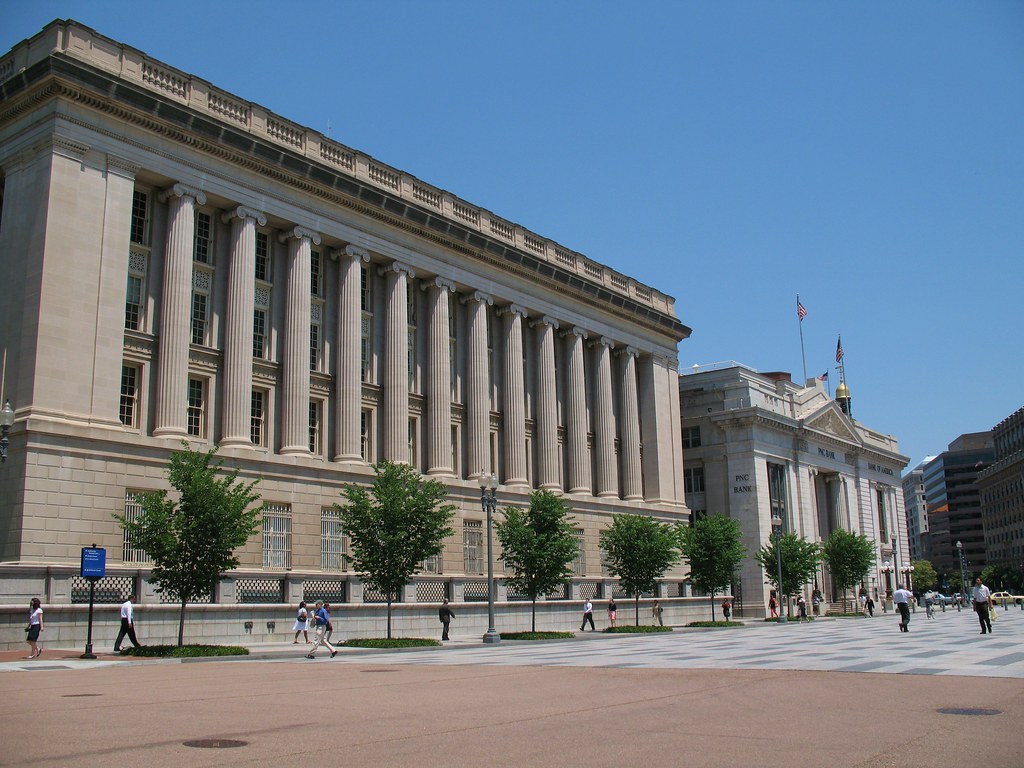
Image Credit: “US Chamber of Commerce and Old Bank” by Mr.TinDC is licensed under CC BY-NC-ND 2.0.
Related Articles
March 30, 2026
The Would-Be Pawns Sacrificing Their Own Civil Service Jobs
March 27, 2026
Map: Trump Has Often Delayed or Denied Disaster Aid
March 27, 2026
Kristi Noem's Deadly Legacy
March 24, 2026