
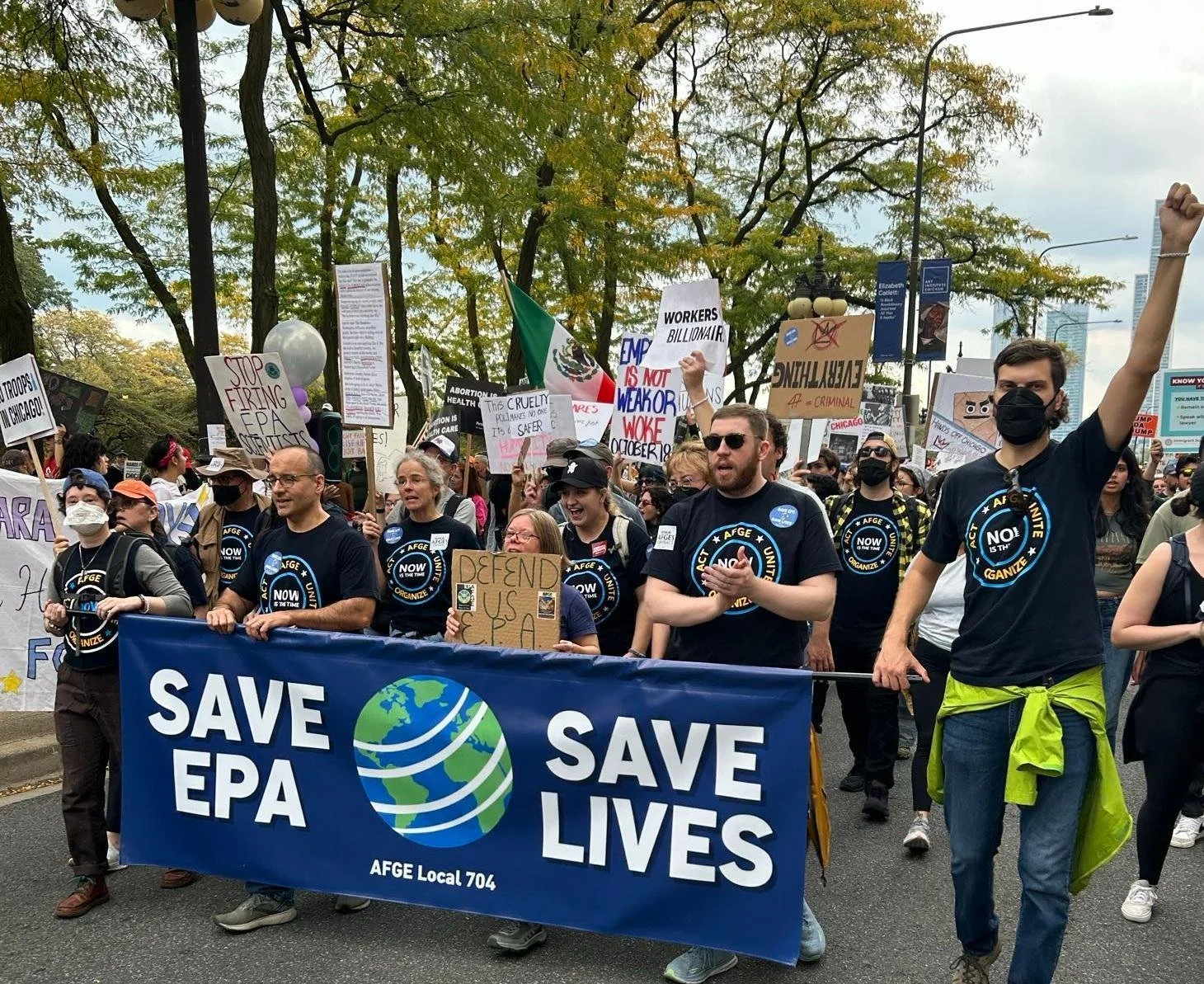
The Trump regime is dismantling the federal government’s ability to protect you. Undoing the Vought-led onslaught is a matter of life-and-death, and it would be good politics.
This newsletter was originally published on Watchdog Weekly. Read and subscribe here.
A couple of highlights before I jump in:
- My colleague Hannah Story Brown has played a huge role in exposing Supreme Court Justice Samuel Alito’s shameful fossil fuel-related conflicts of interest (see her writing on the subject here, here, and here). On Monday, Alito recused from Suncor v. Boulder, a climate deception case whose oral arguments are set to begin next week. Major kudos to Hannah and others involved!
- RDP fellow Dorothy Slater, an oncology nurse in Cancer Alley, has a gut-wrenching new piece in Dissent detailing how the current development of gas-powered AI data centers in Louisiana is poised to unleash even more suffering and death. It’s essential reading to understand the real human costs of subordinating social and environmental well-being to the interests of a handful of misanthropic tech billionaires.
Last week, a piece that I co-authored, “Unions Against Voughtism,” was published at Can We Still Govern?, an outlet run by public administration scholar Don Moynihan. I had the pleasure of working on it with Chris Dols, executive director of the Federal Unionists Network (FUN), a coalition of federal workers and allies who are organizing to resist the Trump regime’s authoritarian dismantling of the public services that sustain our society and rebuild a democratic government that works for the many, not just the wealthy.
Here’s the gist of our argument:
- Much of the work done by civil servants is aimed at reducing risks and preventing adverse outcomes.
- The Trump administration’s ongoing barrage against the government’s unsung heroes is causing harmful consequences and increasing the probability of negative impacts down the line.
- This barrage is being led by Russell Vought, a reactionary ideologue who embodies many of the right’s inhumane tendencies.
- Each moment of crisis, for example the current foodborne illness outbreak that was triggered by the White House’s shredding of our food safety net, is an argument against the right-wing vision of shrinking the government (so that it only serves the rich).
- What is in the best interests of public employees (job security, good pay and benefits, collective bargaining rights, etc.) is also in the best interests of other working people, environmental quality, and public health.
- Given their knowledge of the inner workings of government, civil servants are well-positioned to sound alarms about impending harms, connect dots between cuts and avoidable suffering, and build solidarity in the fight against the gutting of public services. To do so effectively, they’ll need the backing of their unions and broader communities.
Watchdog Weekly readers are likely familiar with what I mean by Voughtism given how much RDP has covered this multifaceted effort to selectively sabotage government capacity, but allow me to briefly recap. (I say “selectively” because the White House’s disdain for regulators and scientists coexists with its support for a vast military and a repressive secret police force.) One method is to concentrate federal spending authority in the executive branch by meddling with the disbursement of appropriated funds. Another is to cement absolute control over the federal workforce, hence all of the steps taken to purge and disempower hundreds of thousands of civil servants and increase the share of political appointees.
Why traumatize federal workers and break the civil service? To provide a safe haven for billionaires to continue ripping people off as the planet burns. What’s the point of impounding hundreds of billions of dollars? To punish Trump’s perceived enemies and coerce compliance with his agenda.
Vought has, in short order, established a pro-oligarch, anti-working class reign that exacerbates avoidable suffering and ends lives prematurely. While much of this work was initially carried out publicly by Elon Musk and his DOGE vandals, “Shadow President” Vought, the Project 2025 mastermind, has always been the driving force behind this ongoing endeavor.
I want to use this week’s newsletter to expand on two points that Chris and I didn’t have room to make in our recent essay: 1) the extent to which our future will be defined by the federal government’s ability to confront converging perils, and 2) how past political decisions led us to this dangerous conjuncture.
Put simply, a half-century of bipartisan neoliberalization has left our society ill-equipped to tackle daunting 21st century challenges, not least of which is climate change—a threat multiplier that compounds existing problems. A third point I’ll make, which flows directly from the previous ones, is that the stakes of present and upcoming policy choices couldn’t be higher. (This newsletter is solo-authored, so Chris and FUN bear no responsibility.)
Democrats should attribute worsening crises and looming ones to the Trump regime’s targeted evisceration of government capacity. Of course, a wider array of people than Trump and Vought deserve blame for increasing the likelihood of various crises. For roughly 50 years, rightward political shifts spearheaded by Republicans (“Government is the problem”) and accommodated by Democrats (“The era of big government is over”), have weakened the government’s ability to protect working people and police the elites. In a vicious spiral, elite beneficiaries have used their impunity and tax savings to bankroll ever more extremist Republicans and ostensibly moderate Democrats who won’t deviate much from the rightward-moving status quo. But all that said, Voughtism is a clear intensification of this assault on governing in the public interest, and it has landed decisive blows.
Once in power, Democrats should do the opposite: build up a pro-worker government with the explicit goal of saving lives. Fighting carcinogenic pollution and fighting oligarchy go hand-in-hand.
2028 electoral candidates would be able to distinguish themselves by demonstrating that they understand the damage wrought by Vought, and committing themselves to building a functioning federal government that supports its experts and serves the public. Of course, actually delivering will be essential. Failing to address the deteriorating material conditions, corporate consolidation, and skyrocketing inequality and unfairness that have propelled the rise of far-right revanchists the world over, Trump included, all but ensures that another fascist will take advantage of persistent economic insecurity and political dysfunction to scapegoat and/or muscle their way into office.
Competing Approaches to the Hazardous Future: Risk Maxxing or Risk Reduction?
The piece that Chris and I wrote describes the current foodborne illness outbreak as a foreseeable consequence of Vought-led attacks on the workers who uphold our food safety system. As Voughtism continues to break vital yet underappreciated government functions, repercussions worse than diarrhea will almost certainly materialize domestically. Internationally, the Trump regime’s dismantling of the U.S. Agency for International Development—which shattered malaria, tuberculosis, and HIV/AIDS prevention as well as nutrition assistance—has already killed at least 700,000 of the world’s poorest people and is predicted to kill more than 14 million by 2030.
The first quarter of the 21st century has already proven tumultuous. Turbulence is only going to increase amid the failure to curb the climate and ecological crises driven primarily by the fossil fuel industry and other profit-maximizing corporations. To date, the world has warmed by nearly 1.5°C/2.7°F, the more ambitious limit set just over a decade ago. On our current trajectory, we’re looking at roughly 2.6°C/4.7°F of warming by century’s end. The projected effects of such a scenario are calamitous.
The reality of our increasingly hazardous future demands a whole-of-government approach to comprehensive risk reduction. Unfortunately, the Trump regime is maximizing vulnerability.
To take one example, as rising temperatures create more favorable conditions for vector-borne and zoonotic disease outbreaks, Vought and other White House officials are undermining our public health infrastructure and pandemic preparedness (that’s on top of driving up future temperatures). The Trump administration last week rejected a United Nations declaration endorsing greater global health cooperation, the latest in a string of shortsighted decisions.
Moreover, as planet-heating emissions increase the frequency and severity of extreme weather events, the White House is sabotaging our disaster readiness and response capacity. A sane government would be reducing fossil fuel dependence to mitigate warming and investing in equitable adaptation to decrease vulnerability to pollution-turbocharged heatwaves and storms. The Trump regime is doing the opposite: doubling down on oil, gas, and coal; derailing clean energy; and destroying the institutions capable of helping us understand, prepare for, and confront a variety of escalating and converging threats.
We’ve already seen the lethal impacts of Voughtism manifest as degraded weather forecasts and warnings as well as delayed disaster responses and recoveries, including during the Central Texas floods that killed more than 130 people in July 2025. As I’ve argued, the Trump administration’s approach has turned the United States into a sitting duck for a major hurricane. Fortunately, that hasn’t happened yet, partly because El Niño is suppressing tropical activity in the Atlantic. But it still may, and if that happens, we’ll know who to blame. Unfortunately, the record-breaking El Niño still developing is also poised to make the Trump regime’s reckless approach to extreme heat, wildfires, and droughts even deadlier in the months ahead.
Meanwhile, faced with the prospect of more common and acute supply chain disruptions stemming from the collision of extreme weather and monopoly fragility, which will aggravate cost-of-living struggles, the Trump administration continues to turn up the carbon spew and demolish government capacity.
Even if climate change weren’t a factor, it is difficult to prevent, prepare for, and respond to things like infectious disease epidemics and weather-related disasters. Under the best circumstances, doing so requires proactive government investment and action. The climate crisis only magnifies and complicates an inherently tough situation.
Here’s a metaphor for our current plight: We have to climb Mt. Everest. Trump and Vought disallowed training; they threw our compasses, maps, coats, boots, and every other piece of equipment into a bonfire at basecamp; they said we can only bring one bottle of water (that we have to buy from someone in Trump’s inner circle). You don’t have to be a fortune-teller to see that this is going to end badly. Democrats who can articulate the stark realities we’re facing, and the substantial levels of investment and transformation needed to achieve just outcomes, are likely to stand out. Rebuilding government capacity should be at the heart of a short- and long-term agenda.
From Project 1981 to Project 2025: Drowning the Government in a Bathtub
We didn’t get here overnight. Voughtism is the zenith of the right’s longstanding antipathy toward public good-oriented government. Before there was a Project 2025, the Heritage Foundation put out Project 1981 to guide Ronald Reagan’s war on the New Deal and the Great Society. A few years later, right-wing political strategist Grover Norquist was advising Reagan on regressive tax cuts. A decade after that, Norquist was collaborating with Rep. Newt Gingrich (R-GA) on the GOP’s Contract with America, a legislative blueprint released before Republicans took control of Congress during the 1994 midterms.
Unfortunately, Bill Clinton helped legitimize the neoliberal counter-revolution during his presidency, turning cruel anti-welfare policies, corporate-managed trade agreements, privatization, and financial deregulation into bipartisan common sense. That’s why Musk routinely cited Clinton’s “reinventing government” task force as a model for DOGE. By 2001, Norquist felt comfortable enough to publicly declare his desire to shrink government “to the size where I can… drown it in the bathtub.” George W. Bush and Barack Obama continued down the same path of corporate-friendly market fundamentalism, with differences in degree, not kind.
Today, Vought is advancing Norquist’s cause. He’s being helped by the likes of Donald Devine, Reagan’s Office of Personnel Management director, who wrote the Project 2025 chapter on undermining federal workers unions and upending civil service protections. It was a massive mistake for Clinton and Obama to offer “dietized” versions of their Republican predecessors’ right-wing policy priorities. We can’t afford such a blunder today.
What we need right now is a robust government capable of meeting people’s needs through public provision, including directly building good stuff like green housing, mass transit, and clean energy as well as transmission infrastructure.
What we have instead is an enfeebled state that disregards public ownership and opts to coax capital through derisking or deregulation or, in the case of the Trump administration, that chooses to destroy life-affirming programs while strengthening the state’s repressive apparatus.
Moving Forward
Progressive transformation is not as far-fetched as it sounds. FDR’s New Deal government directly intervened to bring public power to deprived rural areas in the 1930s. There’s no good reason why similar moves can’t be made now to accelerate electrification and decarbonization. And what’s stopping a future administration, which already produces climate data, from coordinating localized risk assessments that can be used to plan land-use changes, built environment upgrades, housing retrofits, and, where necessary, managed retreat? The list goes on.
Practically speaking, one current obstacle is that, thanks to Vought, the federal government is critically understaffed. It’s foolish to expect our society to be able to prevent and minimize the scope of disasters or to marshal adequate, let alone equitable, responses to them unless the federal government goes on a major hiring spree. (And not for the people who carry guns, but for the ones who fight fires, track pathogens, deliver aid, prosecute civil rights violations, and other interventions for communities in need.) Future administrations must recruit and empower hundreds of thousands of civil servants to have any hope of reducing preventable suffering and death on an unbearably unequal and hot planet.
The imperative of reversing Voughtism gives Democrats a chance to reset the terms of political debate and, hopefully, political practice.
Follow the Revolving Door Project’s work on whatever platform works for you! You can find us on Bluesky, Twitter, Instagram, and Facebook. If you liked this piece, we’d love it if you would consider forwarding to a friend, sharing on platforms like Reddit, or otherwise helping expand our reach.
Want more? Check out some of the pieces that we have published or contributed research or thoughts to in the last week:
It’s the Economics, Stupid: A Review of Gouged and Anti-Fascist Economics
Map: Trump Has Often Delayed or Denied Disaster Aid
Data Centers and Water Explained
The Curious Left-Wing Argument Against New AI Regulations
Photo: Federal Unionists Network