
The new term begins where the last one left off: corporate pleas for elite impunity.
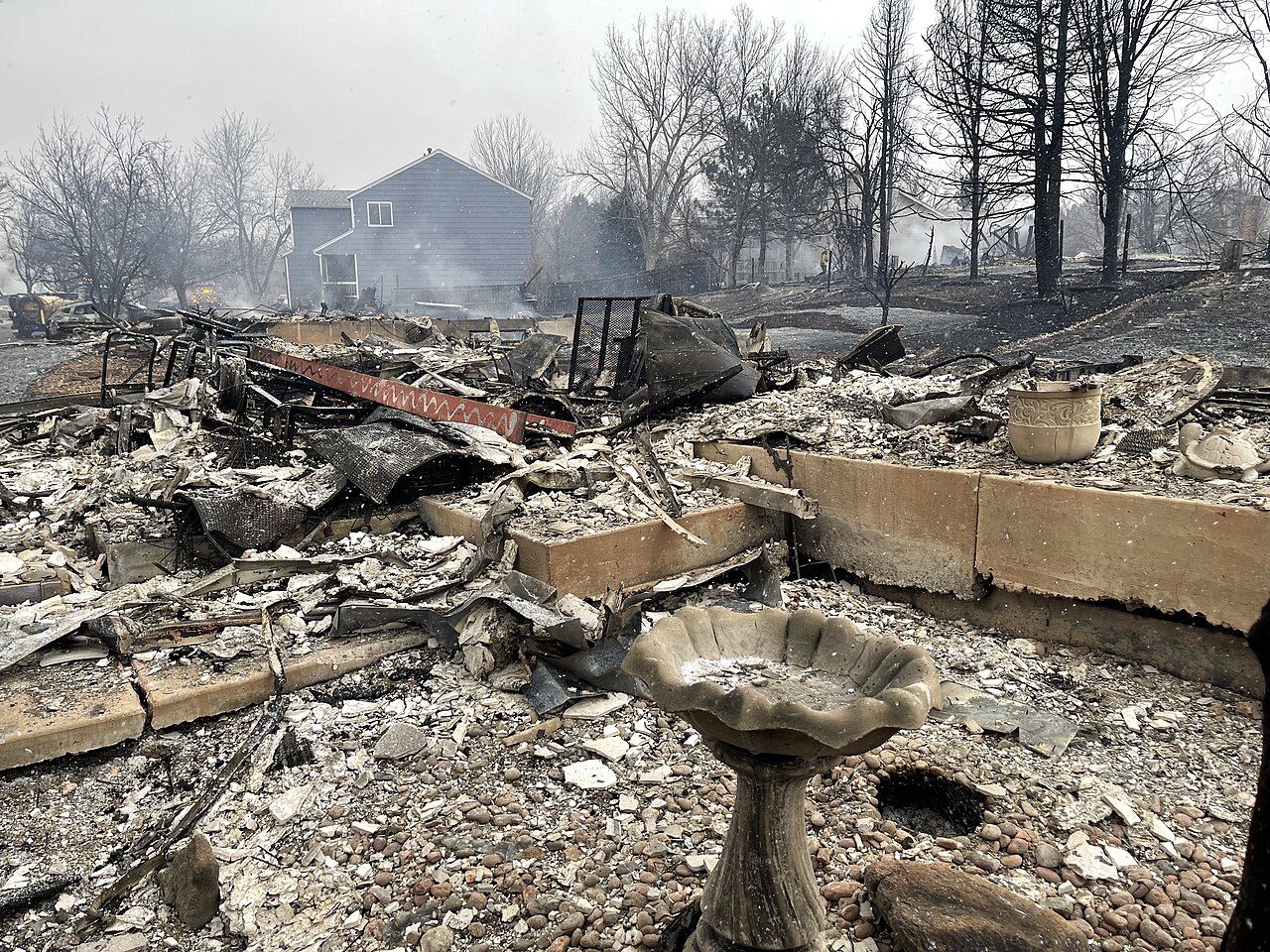
Damage from the Marshall Fire in Boulder County, Colorado in 2021. Photo licensed under the Creative Commons Attribution-Share Alike 4.0 International license.

This newsletter was originally published on our Substack. Read and subscribe here.
On Monday, the Supreme Court held oral arguments in the climate deception case Suncor v. Boulder, a case we’ve covered extensively given its outsized stakes, the oil industry’s ties to the Supreme Court bench, and the glaring conflicts of interest that have now disqualified longtime oil investor Justice Alito from participating in the case.
Boulder, Colorado is seeking compensatory damages from fossil fuel producers Suncor and Exxon for their violation of state laws. The municipal government alleges that the companies’ longstanding deceptive practices contributed to the costly damage that Boulder has faced from climate catastrophes, such as the climate change-fueled Marshall Fire in 2021 that destroyed over 1,000 homes, and caused more than $2 billion in damages. Suncor and Exxon have repeatedly petitioned the Supreme Court to intervene, hoping to kill Boulder’s case—along with dozens of other climate liability cases being brought across the country—before it goes to discovery and trial.
Painting a wild picture of “catastrophic damages,” not from runaway climate change, but from “90,000” similar lawsuits that oil companies could allegedly face if Boulder prevailed in this suit, the oil companies insist that they face immediate injury, and “the time is really now for this Court to resolve these issues.” (“Now” meaning, presumably, before the companies have to spend any more money on expensive lawyers, and while every branch of the federal government is under conservative control.)
When the Court granted the oil companies’ petition earlier this year, Alito broke with his past history of recusing from this exact case to participate in granting that petition—prompting outcry from many corners, including this one. We spearheaded a letter joined by 29 other organizations this May to the Senate Judiciary Committee, urging an investigation of Alito’s irregular recusal habits in the case, and outlining his conflicts of interest.
Alito pushed back on calls to recuse through a court spokesperson, claiming his previous recusal had been inadvertent. But then, without comment, a week before oral arguments, Alito bowed to public pressure and recused from further involvement in the case.
As I told Inside EPA, “Alito’s last-minute recusal demonstrates the power of public pushback, even up against our least accountable institutions, because he wouldn’t have recused from this case if many voices over many years hadn’t made it clear that his conflicts of interest were visible and unacceptable.”
The Wall Street Journal Editorial Board penned a lament about Alito’s recusal, calling it regrettable, and claiming that “refusing specious calls to recuse has a long, honorable tradition.” I submitted a Letter to the Editor in response, which was published Friday, pushing back on their framing:
The letter that my organization, alongside 29 others, sent to the Senate Judiciary Committee this spring urged an investigation of Justice Alito’s irregular recusal habits in this case. We argued that he should recuse for the same reason that he previously recused from this case in 2023: because he holds stock in companies involved in several of the ongoing climate deception cases that the oil company petitioners explicitly view as linked.
Justice Alito has made up to $2.9 million from his fossil-fuel interests since he joined the court, according to the Guardian. If the editorial board wants Justice Alito to decide cases in favor of the oil and gas industry, they should be lamenting his evident preference for remaining an oil and gas industry investor, not urging him to act with the impunity of a man who thinks he is above the law.
The risk of a 4-4 Supreme Court split isn’t that justice will be denied, but that a local government’s case against two corporations for violating state laws will be able to proceed in state court. That is hardly a greater loss for the integrity of American federalism than a conflicted justice casting a deciding vote.
Even a 4-4 tie would send the case back to state court to proceed to discovery and trial, meaning that if the three liberal justices vote as a block, only one conservative justice would have to be sufficiently skeptical of the oil companies’ arguments to kick the can back down the road—and keep the case alive. As Chris Geidner wrote in his summary of oral arguments, “Among the reasons why the case was undoubtedly more difficult for Suncor Energy and Exxon Mobil on Monday was the September 28 decision of Justice Sam Alito to sit out the case.”
Oral arguments did not offer a clear forecast of how the justices would vote, but skepticism was the overriding mood towards both sides. Even Kavanaugh, who was obviously sympathetic to the oil companies, appeared irritated by the broad and reaching constitutional theories of Exxon and Suncor’s lawyer Kannon Shanmugam, asking why he wasn’t making a more straightforward argument about federal preemption. (Nevertheless, his vote for the oil companies is all but guaranteed.)
Thomas spoke little but asked about whether the court has jurisdiction twice; Gorsuch noted “it’s a little complicated”; Kagan pressed hard on both parties; Jackson and Sotomayor made clear that they felt the case was prematurely taken up; Barrett appeared largely in agreement with Kavanaugh but maintained her own formulation of what state authority Congress preserved; Roberts seemed skeptical of the oil companies’ arguments but sympathetic to their fears, as I’ll get into a little bit more below. (Here’s the full transcript of oral arguments.)
Along with Chris Geidner’s latest in Law Dork, those interested in a fuller recap and analysis of oral arguments can find much of interest in write-ups from Alejandro Camacho in Legal Planet, Madiba Dennie in Slate, and Emily Sanders and Rebecca Leber in Point Source News.
Dennie concludes her excellent review: “As the federal government’s response to the climate crisis ranges from disinterest to disdainful, state and local governments have had to ask: Can’t anyone do anything about this harm? Again and again, the court’s answer has been no. Now the prospect of accountability turns on getting a single Republican justice to say yes.” (Welp, indeed.)
The track record of the Roberts Court in deciding cases in favor of industry offers little comfort. As a recent report from the Constitutional Accountability Center found, industry interests were victorious even more often than the Trump administration during last year’s Supreme Court term. Importantly, “corporate losses last term generally resulted in maintaining the status quo, whereas corporate victories aggressively reshaped the legal landscape.”
If the oil companies triumph in this case, it could have major ripples not only for the dozens of parallel climate liability cases proceeding in state courts around the country, but for the ability of cities and states to hold major corporations accountable for harmful activities with widespread impact—a pattern of harm characteristic to our globalized world.
Rachel Rothschild of the University of Michigan Law School has an excellent article in the Yale Law Journal Forum where she offers a “historical corrective” to the federal preemption argument, asserting that such a view ignores the “past forty years of cases that have relied on state tort law to address environmental and public health harms resulting from air and water pollution.” Her read of the cases that Kavanaugh dubbed a “wall of precedent” in oral arguments diverges sharply from his interpretation, and underscores the stakes of the Court curbing this avenue for relief: “how the Justices resolve the case could have broad implications for the ability of cities and states to hold out-of-state corporations liable for injuring their residents and property.”
I found her analogy to harms from the tech industry, which Boulder’s lawyers also gesture to in their response brief (“Litigation often addresses the local effects of problems amenable to international solutions—from food contamination and the fentanyl crisis to human trafficking and global internet scams”), to be particularly illuminating:
“…suits against social media companies over harms from internet use are analogous to state climate suits, as they involve similar claims like public nuisance and failure to warn along with an invisible, global medium routing the injury from the company to the plaintiff. In social media cases, this medium is the internet; in climate cases, it is the atmosphere. The atmosphere’s existence, and changes to the atmosphere, are necessary to cause the injury, but the increasing concentration of greenhouse gases in the atmosphere is no more the core source of the harm than the increasing concentration of website traffic on the internet is in suits against social media companies.”
A comment from Chief Justice Roberts, in his questioning of Justice Department lawyer Sarah Harris (who was there of course to defend the oil industry’s interests), suggested that he recognized the parallel harms of our digital age:
“I was going to say there are a lot of familiar situations where conduct outside of the state has broad effects among other states and all that, and yet we allow the state courts in a particular state to bring litigation that affects that, whether it’s a mass tort sort of thing or maybe complaints about operations of the — the Internet. I guess I’m not quite sure what makes this situation different from those, all those other ones, where we’ve allowed them to proceed in — in state court.”
Harris dismisses the salience of the analogy by mischaracterizing Boulder’s claims: “What it’s not doing is saying what Colorado is doing here: You’re banned from making that product anywhere nationwide.”
Later on, Roberts muses about what prevailing could mean for Boulder…I mean, for the poor oil companies finding themselves the target of more litigation:
“presumably, if you prevail, the next day, a municipality in every single state will file a lawsuit, they’ll probably copy your pleadings, and then there will be at least 50 — you know, different cities in one state could do it, I suppose — causes of action filed. And — and what — what do — I mean, is it — how — how do you think that will work out on the ground?”
Kavanaugh and Barrett, too, pretending they don’t understand the difference between a state law and a torts suit, fixate on the possibility that the oil companies could suffer financially from these lawsuits. You’re being “cavalier,” Kavanaugh told Boulder’s lawyer, about the possibility of a company going bankrupt…from internalizing the costs of its own operations! (It’s disturbing that the same conservative judges, who believe that 18 year olds respond to “deterrents” up to and including the death penalty, do not expect multinational corporations to have to behave responsibly lest their corporation be subject to bankruptcy.)
At no point during oral arguments did any justice mention that the costs of climate recovery are already being borne by taxpayers across the country; that the massive burden of shouldering these costs is not optional, and the question is who pays those bills; that Boulder prevailing in court along with other cities and states would mean money going to improve the resilience of those communities.
I’ll leave us with a supreme bit of snark from Justice Sotomayor about the lopsided stakes of Boulder’s actual injuries, and the oil company’s pretend ones: “I don’t know that we’ve ever talked of spending money on litigation as a constitutional injury.”
Exxon’s lawyer protested: “We are doing so involuntarily!”
Buddy, you’re not the only one.
Want more? Check out some of the pieces that we published or contributed research or thoughts to in the last week:
Make Trump Pay for Trying to Stamp Out the Postal Service
A Recusal Question Justice Alito Can’t Avoid
Map: Trump Has Often Delayed or Denied Disaster Aid
Alito’s Recusal From Climate Case: Too Little, Too Late?
Warren, Hawley Press Home and Auto Insurers on Surge in Claims Resolved Without Payment
Problems Upon Problems In Cancer Alley (Erin Brokovich)
Jayapal Introduces Legislative Framework Establishing National Charter System to Rein in AI
America’s secret ‘dark money’ takes aim at Australia’s social media ban
What’s Doug Burgum Doing With Defense Production Act Authority?
DOJ Inspector General ‘Declined Further Action’ on Todd Blanche Cryptocurrency Matter