
The National Automobile Dealers Association (NADA) has spent millions opposing emissions regulations, consumer protections, and more.
This article was originally published to Watchdog Weekly. Read it here.
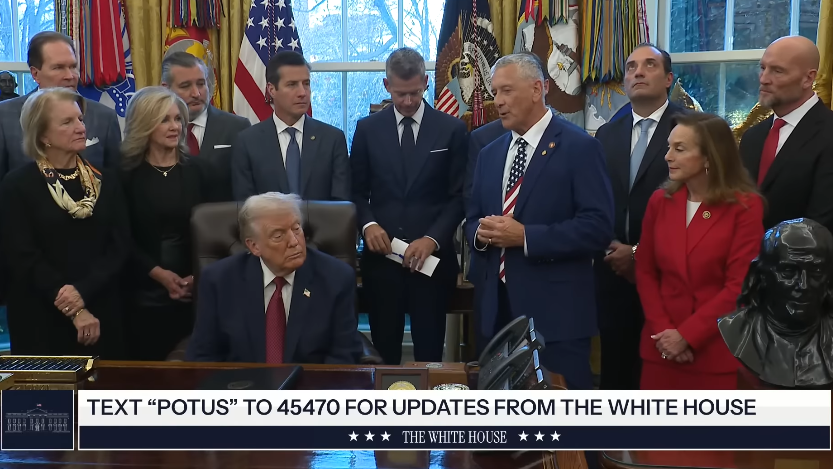
Last week, the President gathered a consortium of automobile manufacturers and politicians in the Oval Office to tout the administration’s latest efforts to roll back environmental regulations pertaining to the industry. The press conference, filled with sycophantic praising of the dear leader by industry heads and politicians alike, celebrated the National Highway Traffic Safety Administration’s (NHTSA) proposed revisions to the Corporate Average Fuel Economy, or CAFE, standards for the first time under Trump 2.0. The rules dictate the average fuel efficiency that an automaker’s fleet must achieve, usually with fines attached for noncompliance, incentivizing the industry to make cleaner cars as technology progresses.
Of course, the industry does not appreciate the government stepping in to ensure its vehicles aren’t as poisonous as they’d otherwise be. Trump, ever the ally to any polluting industry that kisses his ring, rolled back the CAFE rules to the 2022 standards after automakers lobbied for a change. It’s the latest in a string of rollbacks to vehicle standards this year, following the loosening of tailpipe emissions standards this summer, the revocation of California’s waiver to set its own stricter emissions standards, and the elimination of fines for violating CAFE standards by the OBBA. How do we know Trump did so at automakers’ behest? Well, in typical Trump fashion, he said the quiet part loud!
“Your people at Ford were coming to me all the time and they were saying, like, please […] it’s killing us.” The ask, if not an outright lie, is certainly not evidenced by any real marker. Last year, US automakers sold the most vehicles since 2019. Despite this, Trump eagerly did as he was told.
Automakers weren’t the only ones pushing for a change. Also present at the conference were execs from the National Automobile Dealers Association (NADA), a trade association that quietly spends enormous sums to stand in the way of environmentally conscious efficiency standards, right to repair, basic consumer protections, and more.
CAFE Standards
To understand how ridiculous the roll back of CAFE standards is, it’s worth a quick review of where the regulations were before Trump and industry stepped in. In 2023, the Biden administration proposed ambitious CAFE standards that required auto manufacturers’ passenger fleets to average 66.4 miles per gallon and light trucks to average 54.4 mpg by 2032. In the face of similar industry opposition, the administration softened its approach. The final rule in 2024 was significantly weaker, lowering the requirements such that automobiles would release around 200 million more metric tons of carbon dioxide compared to the initial rule. Manufacturers were relatively pleased—the Alliance for Automotive Innovation said “the administration appears to have landed on a CAFE rule that works with the other recent federal tailpipe rules,” though still questioned whether CAFE standards should even exist.
For the automakers and NADA, the watered down requirements were not enough. After the final rule was released in 2024, NADA’s Chairman said the rule was “far ahead of the market and consumer demand” and said the organization would support “measures disapproving the NHTSA CAFE rule.” They saw in Trump an opportunity to further degrade requirements. NADA, for its part, has spent nearly $5 million in lobbying through the first three quarters of 2025 alone. In quarter 3, NADA paid $1.6 million for inhouse lobbyists on issues including CAFE standards.
It’s not just money either—NADA has three former high level employees now serving in the administration. Ben Siegrist, a serial revolver who served as a NADA senior manager from 2018-2020, now serves as the Transportation Department’s Director of Public Liaison. Former NADA senior director Gregory Cote serves as a DOT principal deputy general counsel. Most concerningly, former NADA director David Bell now serves at NHTSA as its Director of the Office of Governmental, Policy, and Strategic Planning.
That type of money and influence gets you a seat at the proverbial table—or, in this case, an opportunity to speak fawningly to and about the literal sitting President. Here’s Tom Castriota, president of the National Automobile Dealers Association, stumbling through his turn to heap praise on Trump’s efforts:
Castriota, like other proponents of more lenient CAFE standards, claims that Trump’s roll back is “definitely going to save our customers money.” This is a persistent, but false, industry talking point. While CAFE standards could result in moderately higher up front costs, those sticker price increases are more than offset by savings on fuel costs. In its analysis of its 2024 rule, NHTSA estimated that consumers would save a total of $35.2 billion over the vehicles’ lifetimes. This is to say nothing of the cost of health benefits that come from decreasing pollution (beyond greenhouse gases) from oil combustion. Looking at NADA’s other lobbying priorities, it’s abundantly clear that NADA’s concern is not for consumers, but for its own poisonous bottom line.
NADA’s Anti-Consumer Priorities
In addition to their opposition to electric vehicle targets, greenhouse gas regulations, and CAFE standards, NADA is also a staunch opponent of executive and legislative interventions that protect consumers from unfair and exploitative business practices.
Take Right to repair, for instance, an issue that crops up time and again in NADA’s lobbying disclosures. Right to repair refers to the ability for consumers, in this case car owners, to access the parts or maintenance information necessary to repair their own vehicles or go to independent repair shops, rather than being forced to go through the car dealer. It’s a broadly popular policy, with large majority support from voters on both sides of the aisle. Right to repair legislation could save the average consumer hundreds of dollars a year. NADA strongly opposes it, so much so that it tops their legislative priorities list. They have spent millions of dollars just this year lobbying congress to oppose the REPAIR Act. Thus far, they’ve been very successful—neither the House nor the Senate version has made it out of committee.
It’s not their only anti-consumer priority. NADA also took aim at consumer protection efforts at the Federal Trade Commission (FTC) and Consumer Financial Protection Bureau (CFPB). In late 2023, the FTC finalized its Combating Auto Retail Scams (CARS) Rule that instituted protections for military members, who are often misled about financing terms, and banned predatory bait-and-switch tactics and junk fees. It would have saved consumers $3.2 billion and 72 million hours each year. NADA was its biggest opponent. The organization successfully sued to block the rule, winning a case before the 5th Circuit Court of Appeals after claiming the FTC failed to follow procedural rules.
Over at the CFPB, autodealers are pleading with Russell Vought to loosen federal oversight of autolenders. Under Vought’s leadership, the agency proposed to raise the threshold of how large a lender needs to be to trigger CFPB oversight. Currently, the agency oversees non-bank companies that issue 10,000 or more auto loans per year. The agency could raise that number to over 1 million loans. Per the CFPB’s own analysis, that would result in oversight of just five entities and 42% of the market.
This change would bring obvious risks to consumers, but NADA is all for it, presumably because less government intervention to protect consumers means more auto loans, however predatory they may be. Despite acknowledging that their members are largely not covered by the rule, NADA submitted a public comment urging them to consider whether financing “may function more competitively and efficiently under a reduced scope of direct CFPB supervision,” claiming that the cost of CFPB oversight is “onerous.” To the contrary, the cost to consumers will be onerous without the help of the CFPB—auto loan delinquencies have risen by 50% over the past 15 years and subprime auto loans are on the rise.
The National Automobile Dealers Association likes to brand itself as a plucky representative of small businesses looking out for the best interests of both its members and consumers. It couldn’t be further from the truth. They have long flown under the radar as a lobbying powerhouse, but NADA’s participation in last week’s press conference laid bare its growing influence. Unfortunately, given its allegiance to the administration and opposition to regulations, this spells disaster for the very consumers they claim to care about.
Follow the Revolving Door Project’s work on whatever platform works for you! You can find us on Bluesky, Twitter, Instagram, and Facebook.
Want more? Check out some of the pieces that we have published or contributed research or thoughts to in the last week:
Corruption Calendar Week 46: Whose Life is Precious?
Trump Family-Backed Companies Are Being Left Behind as Crypto Recovers
Without a landslide Trump win, states face trouble receiving aid for actual landslides