

In advance of the holiday weekend, top Democratic pollster David Shor released poll results about support for data center construction on X (nee Twitter). When asked straight up whether voters would “support or oppose new AI data centers being built in your local community,” 31 percent supported and 44 percent opposed, putting support 13 points under water. Shor’s poll followed up by asking if they would support data center construction if it resulted in a 10 percent decrease in property taxes. Unsurprisingly, this resulted in support shooting up to a net positive rating of 41 points, with 59 percent in support and just 18 percent opposed.
The only problem is that Shor seemingly just made that up figure. Beyond helping hyperscalers calibrate their sales pitches, it’s unclear what this follow-up reveals. Even our old pal Matt Yglesias seemed taken aback at the idea of such a large decline in property taxes. When Matt inquired about this, Shor pointed to an FAQ from Loudoun County, Virginia that said data centers accounted for nearly half of all property tax revenue and noted that the tax rate had fallen from 1.285 percent to 0.805 percent, a roughly 38 percent decrease in property tax rates.
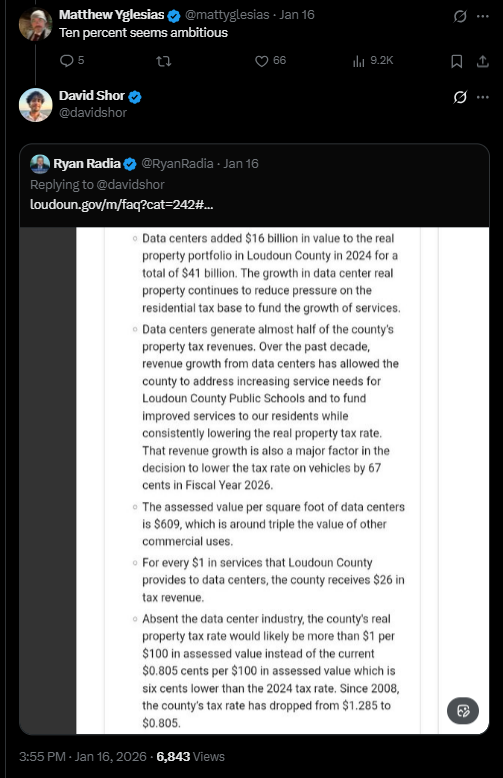
But there’s more than a few problems with that:
- Loudoun County is totally unrepresentative. That same FAQ notes the presence of “the largest concentration of data centers in the world.” The idea that it could be replicable is entirely speculative (and seems implausible).
- While the county has lowered taxes, taxpayers see countervailing price pressure from both higher electricity prices, according to Virginia’s Joint Legislative Audit & Review Commission, and potential state tax increases down the line. According to the state’s Annual Comprehensive Financial Report, and covered by Good Jobs First, Virginia lost $1.6 billion in lost taxes from what Good Jobs First’s Greg LeRoy called “virtually automatic sales and use tax exemptions.” That hole in the budget will have to be filled somehow; like many states, Virginia has balanced budget requirements, although Virginia’s requirement is that the budget be balanced only in execution, not in the form that is passed by the legislature and signed by the governor. If other taxes must go up so that property taxes go down, perhaps the question should mention that?
- The hypothetical obfuscates that the people who are already living around data centers really don’t like them. Virginia Democrats ran hard against their proliferation in 2025 and made major gains. In the 30th district, of which Loudoun County is roughly half, Democrat John McAuliff ousted the incumbent Republican following a campaign he centered on opposing data centers. Everyone hates them.
- Many municipalities and local governments looking to attract data center construction to their jurisdiction have offered tax incentives to data center firms who build there. In at least five states these tax incentives have included a reduction in property taxes. This, unsurprisingly, results in less revenue, which, in turn, results in fewer (or no) tax relief for local residents.
Image credit: “Data Center” by bandarji is licensed under CC BY 2.0.