
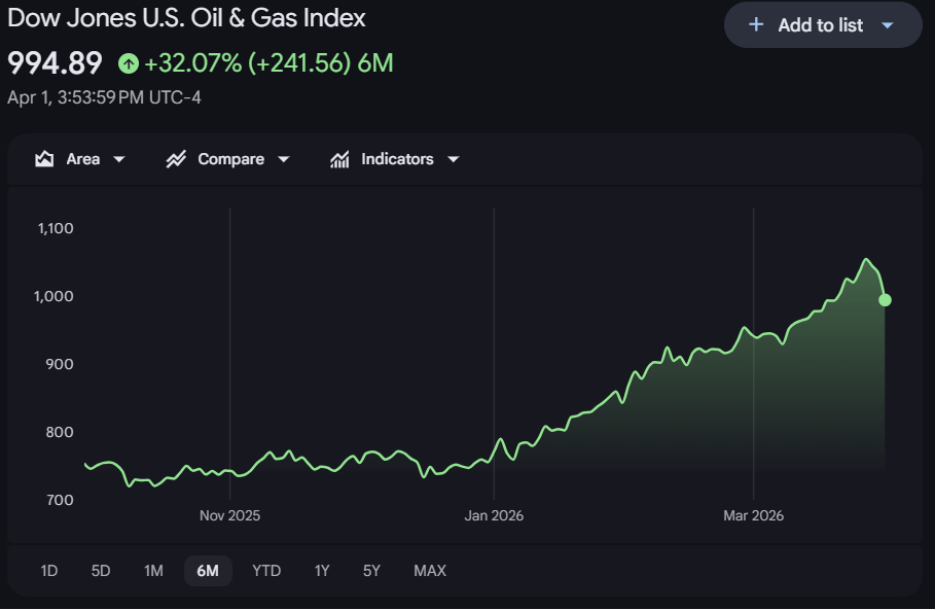
Can you blame Donald Trump for absurdly claiming that Americans will make a “lot of money” from skyrocketing oil prices? Yes, of course. It’s a fatuous assertion, but it does contain a morsel of truth. His administration is filled with the select individuals likely to profit as the prices at the pump trend upwards.
On March 13, Trump turned to social media in an attempt to write off the economic fallout of Operation Epic Fury. “The United States is the largest Oil Producer in the World, by far,” his Truth Social post read, “so when oil prices go up, we make a lot of money.” The existence of a silver lining hidden among ever-climbing gas tank fill-up costs would, presumably, reassure everyday Americans that an illegal war with Iran is in their best interest.
But it hasn’t. Because buried in that “we” is a confession about who exactly this war is for—and it isn’t the people paying 50% more than they had budgeted in order to get to work or visit family.
One doesn’t even need to walk too far down memory lane to pierce through the commander in chief’s contradictions. It was only in late-February that Trump haughtily pointed toward declining costs at the pump as a direct proof of his administration’s successes. Dubious claims of prices “below $2.30 a gallon in most states; and in some places, $1.99 a gallon,” were a key part of the “Golden Age” fantasy Trump peddled during his State of the Union address.
The national average gas price at that time was actually closer to $2.80/gallon, but that reality didn’t stop Trump from misrepresenting statistics to assert that America was “bigger, better, richer, and stronger“ under his watch.
In the seventeen days between Trump’s podium speech and his Truth Social post, that figure had soared over 50% forcing Americans to pay $3.60/gallon for the first time in four years. Predictably, gas prices have continued to surge in the weeks since and, as of writing, sit at $4.02/per gallon—the highest it’s been since 2022.
Yet Trump is calling this dramatic rise a net positive, which begs the question: positive for who?
Who is “We?”
Before the war, fossil fuel producers had low expectations for 2026. In fact, analysts projected that U.S. prices would fall below $3/per gallon as the global expansion of supply produced a surplus of crude oil in world markets.
Despite pumping nearly half a billion dollars towards Trump’s re-election—an endeavor that most notably netted them a coup in Venezuela; a resurgence in drilling operations; and a slew of regulatory write-offs—Big Oil was still bracing for a quiet year.
Then came February 28, and with it, lucrative windfalls for the oil and gas sector.
In the first two weeks of the war alone, the combined market value of “western oil super majors” increased by more than $130 billion, with ExxonMobil and Chevron hitting record stock valuations. U.S. oil companies can expect an estimated $63.4 billion boost from conflict-induced price spikes alone—a potential 140-to-one return on their $445 million dollar investment in Trump 2.0. The effort Harold Hamm and other oil executives went through to help Trump win over the corporate pollution sector is paying off.
But here’s where the story stops being about the industry and starts being about government personnel. Because the Trump administration is not merely aligned with the fossil fuel industry; it is, in meaningful respects, the embodiment of the fossil fuel industry.
RDP and Public Citizen spotlighted this overlap back in October. And after analyzing the backgrounds of over 100 staffers, we found that Trump had “made dozens of hires from the fossil fuel sector, mining conglomerates, and other polluting industries, as well as others who are well-paid to support a dirty energy agenda.” This cohort of fossil fuel insiders and renewable energy opponents included:
- 43 former fossil fuel industry employees
- 29 former corporate executives
- 14 former corporate lawyers
- 12 people tied to fossil fuel-funded right-wing think tanks
- 7 people tied primarily to Republican politics such as elected officials and staffers pushing fossil fuel interests
- 6 from utility companies or the nuclear energy industry
Similarly, watchdog reporting from the Citizens for Responsibility and Ethics (CREW) in Washington found that just seventeen White House staffers hold a reported $800,000 to $2,250,000 worth of Big Oil stocks. That is, significant investments in companies like ExxonMobil, Chevron, BP, Shell, ConocoPhillips, and Valero. From Press Secretary Karoline Leavitt and Presidential Speechwriter Samuel Mangold-Lenett, the Trump 2.0 “administration” looks more like a bunch of fossil fuel interests in a trench coat.
Take for example, Special Assistant to the President for Economic Policy Joel Zinberg, who holds the most diversified Big Oil portfolio in the White House, with up to $680,000 worth of stocks across six different oil corporations.
Chevron—whose stock jumped 7% in the first fortnight of the war—was the largest collective holding across the staffers, representing up to $845,000 in value. Meanwhile ExxonMobil—whose stock rose 5% two weeks into the conflict—was the most common investment, with eleven of the seventeen officials holding shares.
Trump’s Director of the Office of the Deputy Chief of Staff, Alina Bulazel, stood out as the top holder of the group with up to $750,000 in Chevron stock. She received a certificate of divestiture from the Office of Government Ethics, a formal document indicating she is taking steps to sell. But a certificate of divestiture is not a sale, it is a promise to sell. Moreover, CREW had found no record of that divestiture actually occurring in their investigation.
In other words, Bulazel’s Chevron stake, which she could very well still own, may have been appreciating over the last month; through every missile strike and resulting upward tick the cost for a full-tank of gas.
With all this in mind, Trump has every right to brag; he’s right.
When oil prices go up, they—Republican donors, fossil fuel executives, and administration staffers—make lots of money. The rest of us just pay for it.
Follow the Revolving Door Project’s work on whatever platform works for you! You can find us on that website formerly known as Twitter, Bluesky, Instagram, and Facebook.
Want more? Check out some of the pieces that we have published or contributed research or thoughts to in the last week:
Oligarchs and the Trump Admin: Stephen Feinberg
County health officials ask residents to salvage wood instead of trashing it
The Would-Be Pawns Sacrificing Their Own Civil Service Jobs
Tracking the Environmental Harms of Trump Actions
McMahon’s Hatch-et Job in North Carolina