

Curtailing information about disaster aid requests looks like a deliberate attempt to complicate monitoring efforts before the administration leaves states (even more) on their own.
This newsletter was originally published on Watchdog Weekly. Read and subscribe here.
Since October 30, the Federal Emergency Management Agency (FEMA)’s daily operations briefing has excluded previously disclosed data about disaster declaration activity. Excised items include a summary of preliminary damage assessments and a list of aid requests, which indicated which types of relief were requested (i.e., Individual Assistance, Public Assistance, Hazard Mitigation Grant Program) for how many counties and when requests were made, approved, denied, or appealed. To get a sense of what I mean, compare this briefing from October 29 with this one from October 30. Subsequent daily briefings have all adopted the new, lean look.
Under current law, the president has sole discretion over whether a state, territory, or tribe receives federal disaster assistance. Donald Trump has rejected major disaster declaration requests at a greater rate than his immediate predecessors, especially when those requests come from states that are led by Democratic governors, represented by Democratic senators, and/or that voted against him in the 2024 presidential election. Trump has repeatedly denied requests even after FEMA officials confirmed that damages exceeded the existing financial threshold used to determine eligibility for aid.
I’ve been tracking Trump’s cruel approach to major disaster declarations for the duration of his second term. This effort has relied on the data that FEMA used to provide each morning in its daily briefing. I asked the agency to explain why it removed certain information and whether it intends to restore it in future newsletters. FEMA provided a statement that hardly tried to justify the change and made no commitment to reversing course.1
As I told Politico’s Tom Frank earlier this month, “This is a very troubling development that’s consistent with the Trump administration’s broader war on data.”
Obscuring data, obscuring harm
Trump’s White House has gone to great lengths to degrade or destroy several government datasets on a range of topics. It has achieved this by ousting federal workers tasked with producing statistics and by limiting the scope of information that’s collected.
My Revolving Door Project colleague, Xaver Clarke, has kept tabs on the scale of this grave problem. Data sources related to public health, labor, civil rights, and climate change have been particularly vulnerable. Trump administration officials have compromised and/or suppressed data about bird flu, measles, and other diseases; workplace injuries; deportations; the location of chemical facilities; cancer risk estimates linked to air pollution; greenhouse gas emissions; billion-dollar weather disasters; the future economic impacts of climate change; and so much more.
As The Guardian’s Deleted Data series has shown, the Trump regime’s harmful assault on government data was foreshadowed in Project 2025, the Heritage Foundation’s blueprint for Trump 2.0. That roadmap was orchestrated by Office of Management and Budget Director Russell Vought, whose far-right authoritarian views have been guiding White House policymaking. Nonprofit workers and volunteers have valiantly preserved and recreated some datasets (e.g., billion-dollar weather disasters), but they can’t undo all of the damage unleashed by Trump-era data purges.
By undermining our ability to measure problems, the Trump regime is hurting our collective capacity to solve them, with unjust and deadly consequences that will last for years. In some cases, the administration’s corporate allies directly benefit because a lack of data enables them to exploit and pollute without restraint. In other cases, the White House has an interest in keeping people in the dark to advance what would otherwise be unpopular and unjustifiable policies. Hiding information about the status of disaster aid requests falls into the latter category.
I depended on the previous iteration of FEMA’s daily operations briefing to track patterns in the provision of federal disaster assistance, including blatant partisan disparities. Regular updates of Trump’s indefensible aid denials and delays showed, almost in real time, how Trump has turned disaster relief into a political cudgel.
While compiling evidence of Trump’s malfeasance, I worried that his administration might eventually stop providing the underlying data. When FEMA switched to its abridged daily briefings, my fears were realized.
As I told Politico, concealing information about disaster requests “could make it easier for the Trump administration to get away with unequal treatment of disaster victims based on the state they live in.”
Steve Benen of MS Now, who has chronicled Trump’s pairing of politically motivated disaster aid decisions with public praise of Republican elected officials and midterm candidates, echoed my concerns and said, “That is almost certainly the point.”
How tracking disaster aid requests just got harder
Barring website changes, observers can still use FEMA’s disaster declaration page to see approved requests. The most recent major disaster declarations happened on November 24 and October 27, when Trump greenlit assistance to Florida.
Notably, FEMA removed disaster declaration activity from its daily briefing one day after Politico reported that Trump expedited relief for Florida ahead of the midterms while ignoring earlier aid requests from other jurisdictions. (Florida was one of few red states that didn’t flip in the election, with the gubernatorial and U.S. Senate races coming down to the wire.) For that article, the news outlet relied on FEMA’s October 29 briefing.
But now, without access to information about requests that used to be included in FEMA’s daily briefing, it will be difficult to determine in real time how many days it took Trump to act and whether any counties have been excluded or types of aid denied.
I used to cross-reference information about requests provided in FEMA’s daily briefing against information about approved requests included on FEMA’s website. For example, the July 24 briefing showed that Kentucky on July 23 requested Individual Assistance for 14 counties, Public Assistance for 25 counties, and statewide Hazard Mitigation.
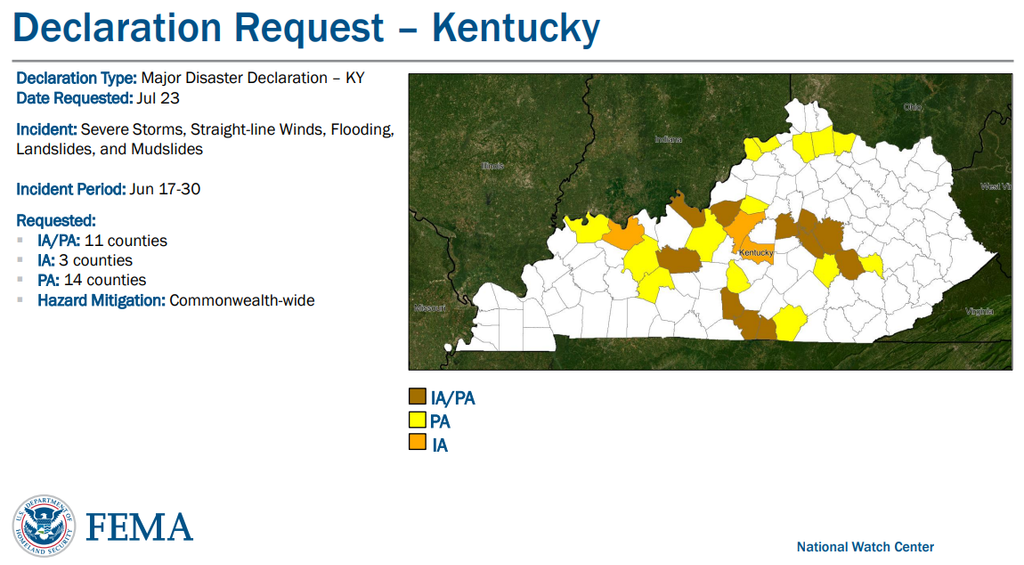
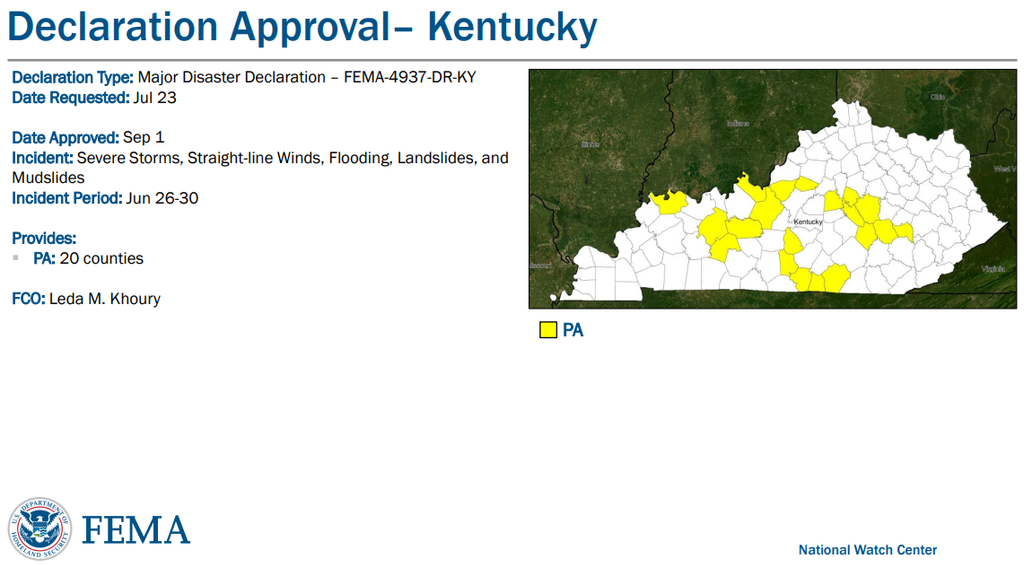
The September 3 briefing indicated that on September 1, 40 days later, Trump’s FEMA authorized Public Assistance for 20 counties. This suggested that the agency excluded 5 counties from Public Assistance and denied Individual Assistance and Hazard Mitigation grants.
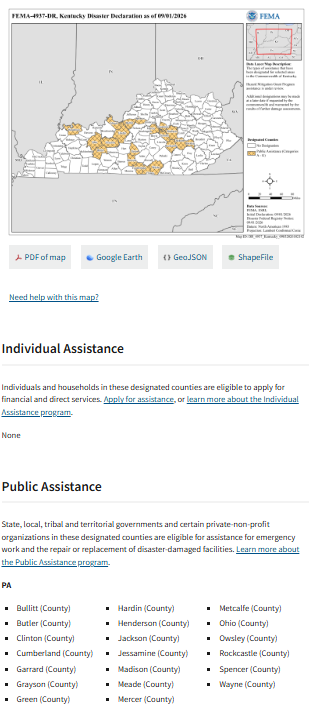
I checked FEMA’s disaster declaration page, where I was able to confirm that the agency had limited Public Assistance to 20 counties and denied Individual Assistance.
Later, I tracked down Democratic Kentucky Gov. Andy Beshear’s October 16 appeal letter in which he asked FEMA to reconsider its omission of five counties and its rejection of Individual Assistance and Hazard Mitigation grants. I captured all of this information in a spreadsheet, which is linked to an interactive map and embedded here.
Theoretically, similar results could be achieved if one can access original major disaster declaration requests or appeals and compare them with what FEMA publishes on its website. But this is tedious and bound to be uneven. Some governors publish press releases containing request details when they make one, but not all of them do that, and territories and tribes usually don’t.
The removal of disaster request information from FEMA’s daily briefing makes it virtually impossible to update the “waiting period” column in my spreadsheet consistently. Doing that every day is what enabled me to track patterns in close to real time.
To find denied requests, one has to navigate to a different part of FEMA’s website (assuming these data continue to be published). After downloading the data and sorting it by type (Major Disaster), request status (Turndown), and request status date, one sees that the most recently recorded rejection was West Virginia on October 7.
Now that these denials are no longer announced in FEMA’s daily briefing, it will be more difficult to stay on top of them. Same with appeals. Everyone will be playing catch-up, using the OpenFEMA portal to provide retroactive analyses (assuming, again, that the Trump regime doesn’t interfere with these data).
There’s still value in this. It’s how Politico quantified Trump’s partisan favoritism through the first 14 months of his second term and demonstrated how unusual it is historically, for example. This illuminating study, which inspired my own work when it was published in March, is based largely on data that FEMA published after requests were approved or rejected.
One thing that made my tracker unique was its focus on pending requests. By paying close attention to new and outstanding requests and appeals, I was able to confirm that unfair trends identified months ago by others were, in fact, continuing unabated.
Trump’s FEMA has effectively neutralized my efforts. RIP “Map: Trump Has Often Delayed or Denied Disaster Aid.”
Why conceal data now? Trump is poised to intensify his abandonment of communities
The timing of FEMA’s erasure of disaster request data is concerning. It followed news of the Trump regime’s inexcusable and dangerous plan to further shift the burden of disaster management onto ill-equipped states.
On October 15, FEMA Administrator Cameron Hamilton wrote in a memo to employees that “the agency will ‘strengthen state and local emergency management capacity’ in an effort to lower reliance on the federal government,” Politico reported. The memo reportedly says that “reducing federal dependency requires partners to build, maintain, and exercise the capabilities needed to manage incidents effectively.”
Then, on October 20, Hamilton told state officials that “every state must have the appropriate financial reserves” and other abilities “to ensure that recovery efforts can start immediately and not necessarily be held up simply because of the federal [disaster] declaration process,” according to Politico, which obtained a recording of his remarks. “A future that I hope we would shoot for is one where we wouldn’t require as many [presidential authorizations of federal disaster aid] because the capability of states is so high and so substantial,” Hamilton added.
To some extent, communities have already been left to face extreme weather on their own throughout Trump 2.0, with the administration abdicating its responsibilities during every phase of disaster management, from mitigation and preparedness to response and recovery. Pushing out thousands of FEMA workers and using Vought-inspired mechanisms to unilaterally deny funding have undercut the agency’s mission.
Trump’s political weaponization of relief means that in the aftermath of disasters, blue state residents have been hurt disproportionately. However, Trump’s partisan discrimination has been unfolding in the context of his administration’s broader assault on FEMA, which has negatively affected people across the country, red states included.
We shouldn’t pretend that Hamilton’s mid-October memo and comments mark a sharp departure from FEMA’s current modus operandi. Instead, we should view them, like the May report issued by Trump’s FEMA Review Council, as a harbinger of a coming intensification of devolution, stinginess, and other recent trends presaged in Project 2025 and in earlier communications between Hamilton and Vought’s office.
Put simply, the Trump regime’s callous approach to disaster management could get even worse. Curtailing information about aid requests at this juncture looks like a deliberate attempt to complicate monitoring efforts.
All of this warrants further scrutiny. Incoming congressional oversight committees are well-suited to launch investigations and hold hearings.
Follow the Revolving Door Project’s work on whatever platform works for you! You can find us on Bluesky, Twitter, Instagram, and Facebook. If you liked this piece, we’d love it if you would consider forwarding to a friend, sharing on platforms like Reddit, or otherwise helping expand our reach.
Want more? Check out some of the pieces that we have published or contributed research or thoughts to in the last week:
RELEASE: Shun Nvidia’s Board of Directors and Trade Associations, Demands Revolving Door Project
- ‘This Is What a Rigged System Looks Like,’ Says Van Hollen of Huang Reinstatement
- Trump helps the scandal-plagued Nvidia CEO get his job back. Van Hollen points to a $25 million donation: ‘This is what a rigged system looks like’
- Investigating Nvidia Just Shot Way Up on Dems’ Priority List
RELEASE: RDP Calls for Closing the Door to Any Possibility of AI Bailout
- ‘Not One Dollar’: Watchdog Says Lawmakers Must Make Clear No Industry Bailouts When AI Bubble Bursts
RELEASE: Homeowners Face Shrinking Coverage While Home Insurers Rake in Record Profits
Home Insurers Are Ripping People Off Amid the Climate Crisis
- Home insurance premiums rose twice as fast as payouts over 5 years, report finds
- As Climate Crisis Worsens, Home Insurance Giants Rake In an Extra $113 Billion
- Report: Homeowners Face Shrinking Coverage While Home Insurers Post Record Profits
- Insurers Collected 59% More in Premiums But Paid Out Far Less
- Watchdog groups say home insurers reaped $113 billion in excess profits
- Home insurance in Florida: premiums rise by 64% while claims payments fall by 67%
- Groups Say Home Insurers Collected $113B Excess
- Home Insurance Premiums Soar While Nearly 1 in 3 Claims Close Without Payment
How Congress’s Permitting Bill Doubles as an AI Bailout
What’s Next? I Don’t Really Know.
Corporate America went all in on Trump world. Now they’re hedging their bets.
Abundance, the Yimby movement, and the left media
The left and the Yimbys: A response
Democrats Must Pursue Dozens of Trump Regime Corruption Scandals
Broad Coalition Demands No Bailouts for Billionaires
The fight against an AI bailout
The Revolving Door Is the Policy: Big Tech and Its Regulators
Heads Up, Fuckers: Medicare For All Is Coming
Don’t Be Fooled by Elon Musk’s Big Pivot
Democrats’ Next Chapter, Brought To You By Billionaires
Van Hollen Wants Schumer’s Job. Here’s Where They Split.
Anthropic Is Already Part of the Security Establishment
What Would Democrats Look Like Under Van Hollen’s Leadership?
Wall Street Veteran Faces Progressive Revolt Over House Committee Seat
- FEMA said: “Daily Operations Briefings are designed to quickly provide federal, state, and local emergency managers with concise updates on current incidents and special events. The Daily Operations brief continuously evolves to meet our stakeholder needs. This most recent update focuses the briefing on monitoring incidents and supporting disaster operations nationally. This aligns with FEMA’s ongoing effort to align activities to the core mission of supporting—not supplanting—partners and ensures daily updates remain specific to FEMA’s role in monitoring incidents and supporting federally declared disaster operations.” ↩︎
Photo: Official White House Photo by Joyce Boghosian