
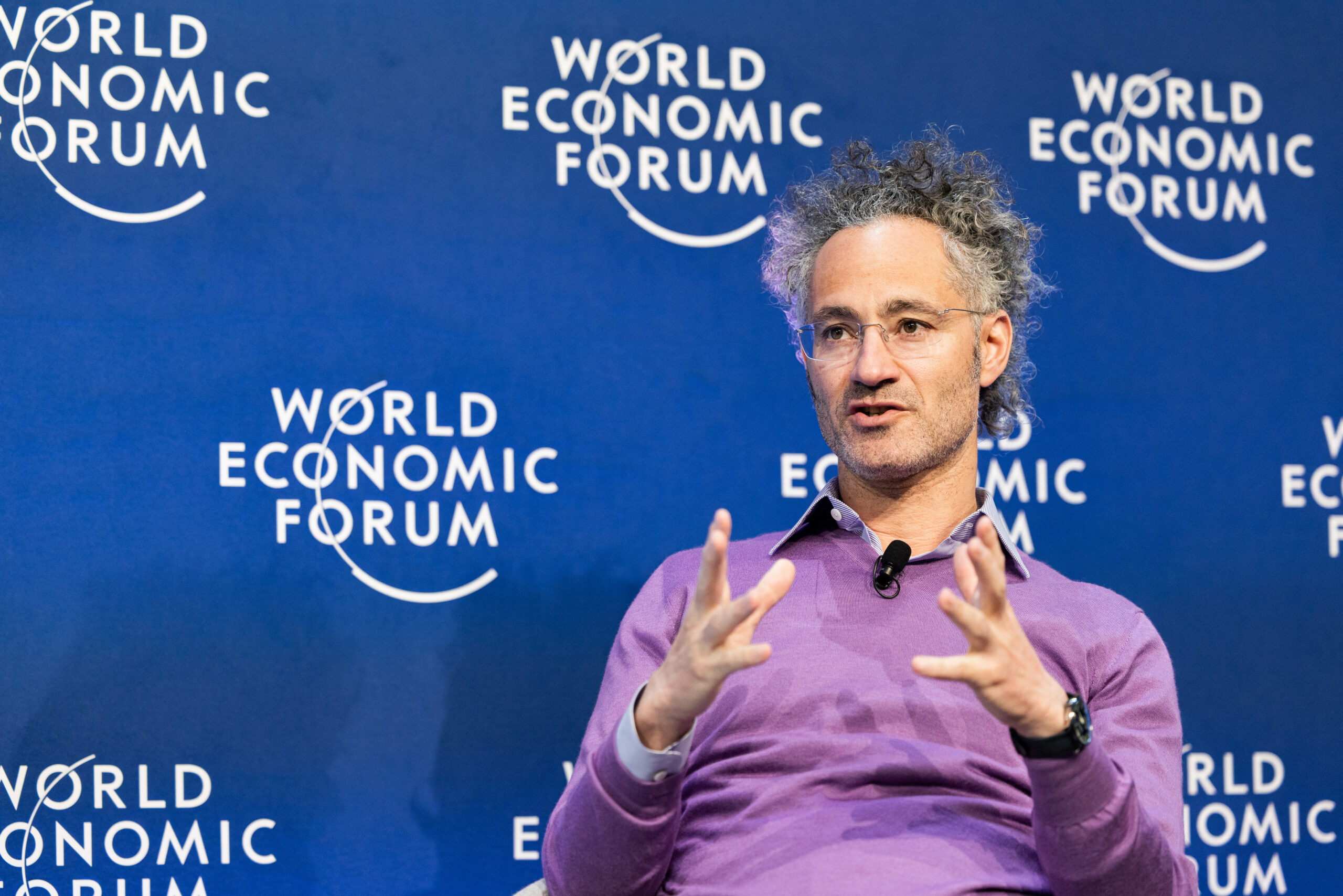
The narrative that Palantir’s billionaire CEO Alex Karp is or was ever a leftist is equally as inaccurate as it is dangerous.
On February 28, 2026, the first day of the joint U.S.-Israeli illegal war against Iran, U.S. military forces used Palantir’s Maven Smart System, a data integration platform that leverages AI for target and “threat” identification, to strike Shajareh Tayyebeh elementary school in southern Iran, killing at least 175 people, most of them children. This unlawful attack, which relied on outdated military information rendered lethal by Maven, is just the latest string of alleged human rights abuses linked to Palantir.
In the past year alone, Palantir, a U.S. defense contracting behemoth masquerading as a data analytics software firm, has faced relentless protests over its alleged role in enabling ICE’s mass deportation campaign (Palantir has collaborated with ICE since 2011) and complicity in Israel’s genocide in Gaza (Palantir has provided its software to the Israeli government since 2013). Given its explicit mission of serving as an arm of the American police state and concomitant track record of dismissing human rights, Palantir doesn’t exactly burnish the image of a revolutionary organization designed to uplift the working class.
And yet, Palantir’s billionaire cofounder and CEO, Alex Karp, continues to be portrayed in mainstream media as a “socialist” whose disillusionment with the Democratic Party has led him to embrace Donald Trump, all while remaining “progressive,” often in contrast to the swelling legion of tech bros like Elon Musk becoming openly right-wing. This narrative is as dangerous as it is inaccurate; it falsely conflates Karp, in truth a fascist-leaning neoliberal, with leftism and normalizes Karp’s warped conception of leftist politics, shifting the Overton window further to the right.
Karp’s characterization as a “socialist” or “progressive,” or that he in any way is on the left, is risible. Similarly, the mainstream narrative that Karp has undergone a “political evolution” now that Trump has returned to the White House is equally absurd.
Indeed, Karp’s leftist posturing is and has always been a smoke and mirrors show to balance out Peter Thiel’s conservatism. His “good cop” image juxtaposed with Thiel’s “bad cop” persona appears to be a public relations tactic, even if Karp may have deluded himself into believing his political identification to be sincere. Michael Steinberger, Karp’s biographer, told the New York Times in a November 2025 interview, “It was kind of disarming for critics for a long time, and very beneficial for Palantir.”
Karp Is Not A Leftist
In 2003, Karp cofounded Palantir with his friend and former Stanford Law School classmate, Peter Thiel, a staunch Trump ally. The company was created in the wake of 9/11 with the specific purpose of helping the U.S. and its allies continue to shape the world as they see fit and was backed early on by In-Q-Tel, the CIA’s venture capital fund.
Despite Palantir’s beginnings, media profiles of Karp have laundered this image of him as a leftist who had a purportedly difficult time navigating life during Trump’s first presidency. In 2018, the Wall Street Journal wrote that Karp was a “self-described socialist” whose sales pitches were complicated by the first Trump era. The following year, Bloomberg wrote that Karp was a left-of-center voter who openly disagreed with Thiel on supporting Trump 1.0 and “struggle[d]” with finding his political footing following Trump’s victory. And in the lead-up to the 2024 presidential election, the New York Times wrote about Karp’s leftist upbringing, Thiel’s description of Karp as a “crazy leftist,” and how Thiel’s support for Trump 1.0 was not enjoyable for Karp and didn’t make their “life easier.”
“Alex Karp is a leftist” is a house of cards argument collapsed by even the most cursory examination of his words and actions.
While Karp has spoken about being raised by socially active parents who took him to civil rights protests, he told Wired magazine in a 2025 interview that he has always been an “immigration skeptic.” He also told the New York Times that growing up, he heard a lecture “every Saturday and every Friday…about how the conservatives are going to destroy this country with illegal immigration, because it’s going to undermine the fabric of the American worker.” Immigrants make up part of the exploited working class, but such divisionist sentiments reveal that in Karp’s mind, there is a uniquely distinct American working class that is threatened by immigration. This line of thinking pits the poor against the poor and fails to grapple with the root cause for mass migration—U.S. interventionist foreign policy, which has exacerbated poverty in Latin America and beyond.
Karp’s consistent views on immigration belie his leftist origin story, as do his motivations pre-Palantir. Steinberger, who spent six years interviewing Karp for his biography of him, said to POLITICO in a 2025 Q&A that Karp pursued a PhD in Germany partly “to understand why Germany, this pillar of civilization, descended into such barbarism [during the Third Reich].” The interest Karp had towards Germany as a supposed bastion of civilization in the early twentieth century whitewashes Germany’s colonial and genocidal history in Africa, again betraying Karp’s lack of belief in a genuine leftist perspective and exposing his black-and-white view of the world—that the West is superior and a force for good—which is embedded in Palantir’s DNA.
As Nathan J. Robinson wrote in Current Affairs magazine, Karp’s “West is good, everywhere else is bad” mentality is more likely to lead to unprecedented harm for the masses and merely succeeds in further lining Karp’s pockets. Karp isn’t a “crazy leftist,” he’s just crazy.
And for all the noise Karp made about his dissatisfaction during Trump 1.0, Palantir carried on with business as usual, further ingraining itself into the government apparatus. Immigrant rights’ organization Mijente reported that Palantir’s software helped the first Trump administration “build profiles of immigrant children and their family members for the prosecution and arrest of any undocumented person they encountered in their investigation.”
In 2019, Edward Ongweso Jr hit the nail on the head when he wrote for VICE magazine: “Karp isn’t a progressive, he’s a capitalist concerned with preserving his company’s position as the data analytics that ‘powers a lot of the Western world[.]’ […] Karp’s rhetoric about progressive values is, like the rest of Palantir’s business model, a product meant to make you feel good about the horrible things being done behind the veil.”
Karp Has Not Shifted His Politics
As Karp’s “progressivism” has become ever harder to note with a straight face, the media has penned an equally inaccurate message of Karp having undergone a “political metamorphosis” following the October 7, 2023 infiltration of Israel, and the resulting ramping up of Israel’s aggression in Gaza, along with Trump’s 2024 presidential win. In November 2025, the New York Times wrote that Karp’s enthusiasm for Trump 2.0 was “befuddling” given his past support for Joe Biden and Kamala Harris and marked a “political evolution.” That same month, POLITICO reported on Karp’s “political evolution” and “Trumpy shift,” and the New York Post wrote about how Karp’s politics shifted “dramatically” in the wake of October 7.
Contrary to the narrative of Karp’s MAGA shift, the reality of the matter is that Karp has never been a leftist, so there was no political conversion to be had. What has changed is Karp’s comfort level in allowing his mask to slip, which interestingly parallels Palantir’s own journey and not-so-coincidentally tracks the global rise of far-right nationalism.
When Palantir was founded, it called Silicon Valley home until 2020. During that period, which spanned three presidents (both Democrat and Republican), ICE began using Palantir software in 2011 under the first Obama administration, and Israel started partnering with the company in 2013. At the time, Karp was a relatively low-profile figure, and Palantir had not yet attracted negative attention. Nevertheless, even then, the contradictions between Karp’s “leftist” calling card and his actions were on full display. For example, in 2011, leaked emails released by the hacker group, Anonymous, revealed that under Karp, Palantir had been involved in a proposal to wage attacks against the whistleblower website, WikiLeaks, and undermine journalists who were supportive of the site. The resulting scandal quickly prompted Karp to issue a damage control statement in which he publicly apologized “to progressive organizations in general” and one of the targeted journalists on behalf of himself and the company.
With the arrival of Trump 1.0, the tide began to change for Palantir. In 2016, protestors started mounting pressure on Palantir for its ICE collaboration. Publicly, Karp said that Palantir would not create a Muslim database (a promise that rings all too hollow in light of reporting that thanks to Palantir, “U.S. immigration and border-security agencies have already built something that can effectively serve the same purpose” as a Muslim registry, “if they want it to do so”) and aired his dislike for the Trump administration, which was regurgitated by the media. Meanwhile, Palantir continued to power the federal government’s deportation operations, providing tools used to digitally profile and target migrants and asylum-seekers.
During this time, Karp was also responsible for hiring the head of Palantir’s UK operations, Louis Mosley, a conservative whose grandfather, Oswald Mosley, was leader of the British Union of Fascists in World War II and previously named “worst Briton of the twentieth century.” According to Mosley, his interview began with Karp reciting one of his grandfather’s speeches from memory about the need for Britain to seek peace with Nazi Germany. Since his hiring, Mosely has arguably carried on his grandfather’s legacy of attempting to take over the British state, albeit more discreetly, by embedding Palantir throughout the UK government apparatus, including within the Financial Conduct Authority, Ministry of Defence, National Health Service, the nuclear submarine program, and the police. Remarkably, Karp later told the New York Times in a 2024 interview, “A lot of my populist-left politics actually bleed into my hiring stuff.”
In 2020, Palantir relocated its headquarters to Denver, Colorado. “I was fleeing Silicon Valley because of what I viewed as the regressive side of progressive politics,” he said to the New York Times. What Karp really seemed to mean is he wanted to escape protestors. But again, nothing about Palantir’s business model changed. On the contrary, Palantir’s business only continued to boom, not least because the company scaled up its support for Israel after October 7, 2023.
Karp’s politics did not change either. On a Palantir earnings call in May 2024, Karp referred to “wokeness” as a “pagan religion” and said that Palantir was the antithesis to woke ideology. His words could have been ripped right out from a conservative playbook. That same month, The Guardian reported that Karp attended an AI conference where he said, “The peace activists are war activists.” At a separate Capitol Hill event, he also mused over sending Palestine solidarity demonstrators on college campuses to North Korea and said that he had “fantasies of using drone-enabled technology to exact revenge” on his competitors.
Now that Trump has returned to the White House, the reactionary right has only grown more emboldened. So too has Karp. Previously, Karp was keen to sympathize with critics but appears to have since shed this placating image in favor of saying the quiet part out loud. In a 2025 interview with CNBC, for example, he signaled his support for the government’s DOGE initiative as a means to eliminate “the fraud, waste, and abuse we know is there.”
During a separate recent interview with CNBC, Karp said that AI would “disrupt the economic and therefore political power significantly of one party’s base – highly educated, often female voters who vote mostly Democrat….” Malcom Ferguson was spot on when he wrote in The New Republic that Karp’s message “sounds like a direct, long-term pitch to the GOP from a CEO whose tech firm already has numerous government contracts and is deeply embedded in the Pentagon.”
And just one month after Trump’s second inauguration, Karp’s The Technological Republic: Hard Power, Soft Belief, and the Future of the West was published, which Palantir demystified in an April 18, 2026 post on Twitter/X. According to the company, the book argues in favor of a “hard power” approach to foreign policy, which is precisely the strategy that Trump has adopted; calls for people to “show far more grace towards those who have subjected themselves to public life” (read: Trump); claims that “[n]o other country in the history of the world has advanced progressive values more than” the U.S.; says that figures like Elon Musk should be given their flowers for “attempt[ing] to build where the market has failed to act”; chides “[t]he elite’s intolerance of religious belief”; contends that some cultures are “regressive”; and rallies for the U.S. to build a nationalist identity. The “us” versus “them” mentality of Karp’s manifesto, which frames the U.S. and more broadly the West as superior to other nations, is an unsurprising progression of his work and sentiments on immigration.
Karp’s open embrace of Trump and right-wing talking points has been trailed by yet another relocation of Palantir’s headquarters to Miami, Florida—now home to a growing list of billionaires. Unlike Democratic-run California and Colorado, Florida is governed by Trump ally Ron DeSantis.
This re-brand, however, is all style, with no change in substance. Palantir and Karp’s abandonment of the blue for the red is not because of an ideological shift but because they feel comfortable enough in the current political climate to show their true colors.
The fact that Karp has financially backed Democrats while also occasionally donating to Republicans since at least 2010 and increasingly doing so since October 2023 and Trump’s return to office lends credence to this and reaffirms that Karp’s public persona has long been an illusory antithesis to Thiel’s conservatism. To be sure, as the U.S. political pendulum swings uncertainly between Democrats and Republicans, it has been key for companies like Palantir that seek government contracts and a favorable regulatory environment to have its prominent executives entrenched in the two major political parties. Such both-sides strategy, employed by Karp and Thiel, has clearly proven savvy with the federal government, but with Democrats’ feckless lack of fight against Silicon Valley and Trump’s normalization, Karp does not need to hide behind PR anymore.
Let this then serve as a critical reminder that media obfuscation of a rich Silicon Valley grandee’s politics can lead to serious misrepresentation of what it means to be an actual leftist fighting for the poor and marginalized.
Image Credit: “World Economic Forum Annual Meeting” by World Economic Forum is licensed under CC BY-NC-SA 2.0.
Related Articles
October 9, 2026
Map: Trump Has Often Delayed or Denied Disaster Aid
September 30, 2026
Reversing Voughtism; or, Creating a Pro-Worker Government to Save Lives
September 25, 2026
Unions Against Voughtism
September 25, 2026