
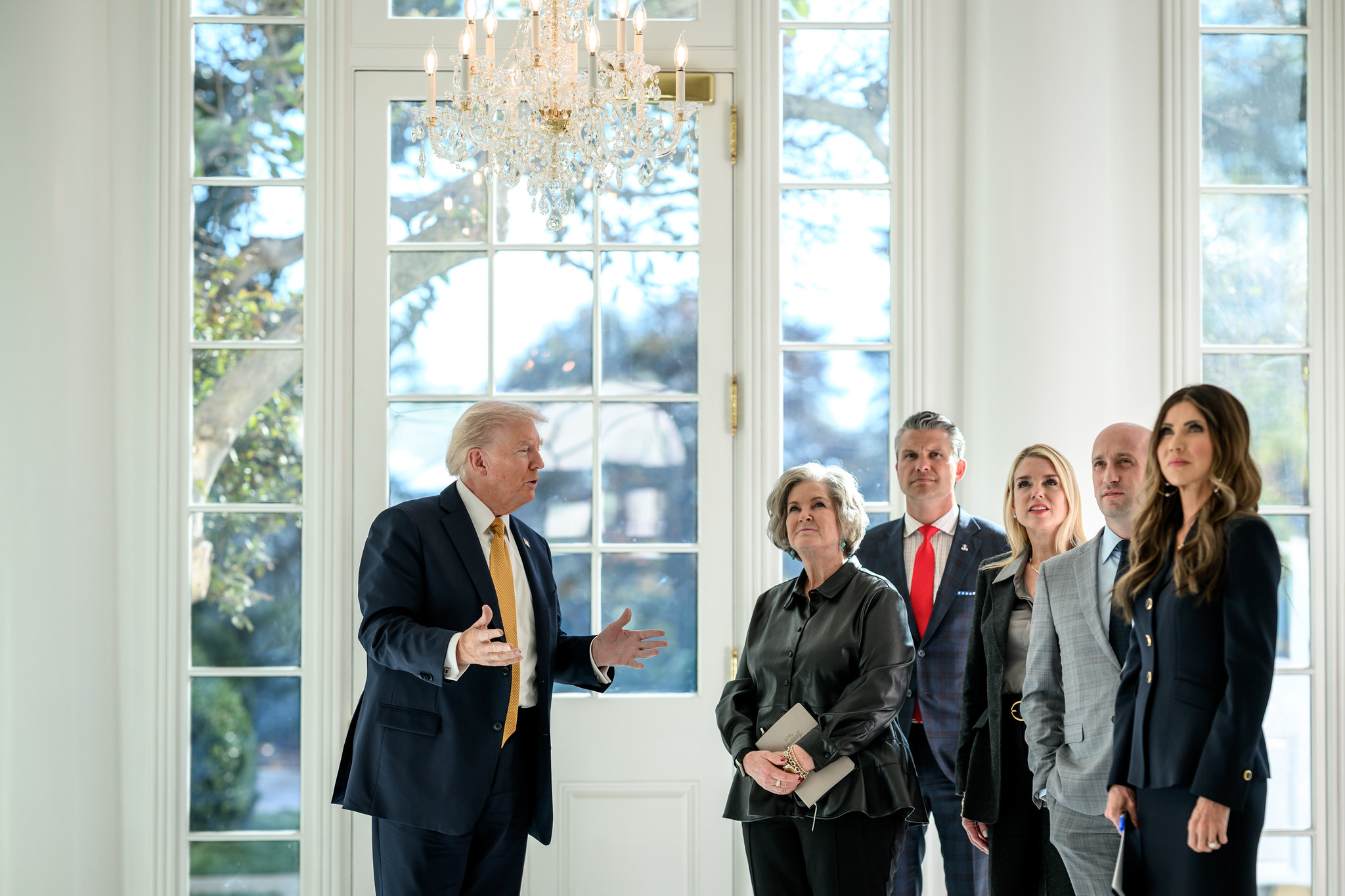
The consequences of the Trump administration’s unending depravity will be far reaching
This article originally appeared on Watchdog Weekly.
Welcome back to Revolving Door Project’s Corruption Calendar, where we provide in-depth explanations of the material consequences—real and potential—of the Trump administration’s corrupt policymaking, with an emphasis on tangible harms to working people. Read our first 43 issues here, and follow us on Bluesky, Linkedin, Twitter, Facebook, and Instagram for more updates on our work.
As most editions of this newsletter have shown, the Trump administration has happily embraced scandalous policies, positions, and people, betting that this transparent embrace would overawe the public. But a few events over the past few weeks are heartening indications that the seal protecting Trump administration personnel from accountability is starting to crack.
It starts at the top with the president himself, whose deeply concerning presence in the Epstein files continues to define the Justice Department’s underhanded tactics to evade legal responsibility to furnish the public with much needed information (Trump isn’t alone here; at least half a dozen top Trump administration officials appear in the Epstein files). Then there’s the salacious allegations implicating multiple cabinet secretaries—Lori Chavez-DeRemer and Kristi Noem have been questioned about alleged affairs while in office, while Linda McMahon faces scrutiny for her involvement in a sex trafficking lawsuit against her husband and former business partner.
We’re probably at a historically high mark for toxicity in Washington. The Trump administration is eagerly exporting this toxicity, killing hundreds of schoolgirls during its foreign misadventures, but the American people don’t want a war with Iran. And they most certainly don’t want ICE agents shooting people in the streets. That’s one of the many reasons Kristi Noem, also known as Ice Barbie, will soon be out of a job. Her firing is a welcome development, but changing the face of Trump’s deadly immigration crackdown is an ersatz accountability measure. Lawmakers should take advantage of this opening by pushing for even more changes from Trump’s deadly immigration enforcers. (Side note: if you’re eager for the next Congress to do a better job of holding the Trump administration accountable, consider voting for RDP’s proposed 2026 Netroots panel, “Overseeing Oversight: Make Congress do its job”!)
Meanwhile, everyday Americans are suffering more threats to their safety and health from the regulatory rollbacks and weakened enforcement these federal government officials have enacted. The Trump administration’s priority is narcissistic debauchery and corporate giveaways, not ‘making America great again.’
Labor’s Oversight Plummets While Secretary Racks Up Scandals
Trump’s Labor Secretary, Lori Chavez-DeRemer, has been in the headlines lately for the type of waste, fraud and abuse the administration implausibly claims to be rooting out. In February, the New York Times broke the first concerning story, reporting that the Secretary’s husband, Shawn DeRemer, was apparently barred from the Labor Department’s DC headquarters “after at least two female staff members told officials that he had sexually assaulted them.” The situation somehow got worse from there, as Chavez-DeRemer is now under investigation for “using taxpayer funds for personal reasons, including to throw herself a birthday party,” which she tried to pass off as a “swearing-in celebration.” Despite reports that attendees sang “Happy Birthday” to Chavez-DeRemer while she blew out candles on a birthday cake, Chavez-DeRemer later told the the House Appropriations Committee, “I did not have a birthday party.”
The latest bombshell dropped earlier this week. Reports revealed that two of Chavez-DeRemer’s top aides were forced out of the Department amid an internal investigation instigated by a whistleblower complaint that Chavez-DeRemer “drank on the job, that she was having an affair with a subordinate — a member of her security detail — and that she used department resources for personal trips.”
It’s hard to focus on actual job responsibilities when one is apparently too busy partying and mixing work with pleasure. Chavez-DeRemer’s behavior explains the Labor Department’s ongoing abdication of its duty to monitor and improve workplace conditions across the country. Case in point: the Labor Department’s Occupational Safety and Health Administration conducted fewer workplace inspections in 2025 compared to the same period in 2024, per the New York Times. That means more people are likely to get injured or die on the job as bad bosses rest easy with the knowledge they’re unlikely to be penalized for not keeping their workers safe.
The weakened OSHA enforcement is part of a larger trend within the Trump Administration to pull off regulatory guardrails that keep Americans safe. Is it any wonder that the administration that took direction from the producer of what “may be the deadliest road car for occupants ever sold” doesn’t value the safety of Americans?
The Coalition for Sensible Safeguards recently released a report with plenty of examples of the harmful impacts of these rollbacks, including weakened food safety standards and increased pollution. And as we’ve come to expect, this month brought even more examples of that erosion. The Department of Agriculture is seeking to increase how fast meat plants can slaughter livestock, a move environmental group Food and Water Watch says “will put unsafe food on grocery store shelves, create more pollution, and make one of the most dangerous jobs in the country even riskier.”
As our Jacob Plaza wrote in The American Prospect last year, increased line speeds at meat production plants increase the risk of workers developing injuries like carpal tunnel syndrome and other musculoskeletal disorders. Even under current slower line speeds, “worker deaths and serious injuries occur often—an average of 27 meatpacking workers have to get amputations or are hospitalized every day.”
Smorgasbord of Air Toxics, Carcinogens and Chemical Explosions
The Trump administration continues to prop up AI datacenters even as communities push back against development in their locales. The latest move was the Environmental Protection Agency’s announcement of plans to roll back air regulations for power plants limiting mercury and hazardous air toxics in an attempt to lower costs for utilities that run older coal plants, as demand for energy is driven up by AI datacenters. Environmental groups warn that mercury is “a neurotoxin that can impair babies’ brain development and other air toxics will lead to higher health-related costs.”
The threats to our collective wellbeing don’t end there. The Trump administration is also ghoulishly seeking to kill the rules that protect Americans from chemical disasters, like fires and explosions at high-risk facilities. In 2024, the Biden administration finalized a rule that strengthened protections at 12,500 high-risk facilities, each of which the EPA’s Response Management Program required to “develop protocols to prevent catastrophes, or limit fallout,” aimed at protecting “workers, first responders, and fence-line communities.”
But chemical companies have successfully convinced the Trump administration to eliminate the protections, and to further target the Chemical Safety Board, “which reviews accidents and develops actions to avoid a repeat.”
If you are hoping that these chemical disasters are a rare event, you would be wrong. The Guardian reports that the “US experienced a chemical accident that harmed humans or the environment every other day on average between 2004-2025. Among recent high-profile incidents are a Clairton, Pennsylvania steel plant explosion that injured 10, and a Roseland, Louisiana oil facility explosion that caused oil to splatter onto homes as far as 20 miles away.”
(It’s a tragic indication of weaknesses in our communications media ecosystem that these incidents, and the many like them, are not the topic of an effective communications campaign to gin up grassroots anger.)
It’s maddening that corporate interests so clearly define policy making priorities in Washington, but that’s what tends to happen when a disorganized public goes up against well-heeled corporate lobbying infrastructure. A new report from U.S. Right to Know details how one particular company, agrichemical and pharmaceutical giant Bayer, has utilized an extensive influence network to secure wins from the admin. Bayer’s champions include lobbyists and former chemical and biotech executives who’ve since joined the Trump administration. With the help of these figures, Bayer notched wins from the Trump administration such as: the administration invoking the Defense Production act to ramp up production of glyphosate, a probable carcinogen and the basis of Bayer’s Roundup weed killer; and regulators reapproving dicamba, “a Bayer herbicide twice blocked by federal courts.”
Trump World’s Contractors
In September 2025, the U.S. Department of Homeland Security announced a contract opportunity for “public affairs consulting services,” such as responding to media inquiries, disseminating information to journalists as well as “strategic counsel.” Just four days later, DHS awarded a $250,000 contract to American Made Media Company, a government relations firm newly launched by veteran Trump officials with ties to Corey Lewandowski, the top advisor to (soon-to-be former) DHS Secretary Kristi Noem, according to the Guardian. The DHS’s advertisement explicitly called for the demonstration of “an established track record of promoting Trump administration policies in the media” and expressed particular preference for applicants “who served in a cabinet agency during the first Trump presidency,” marking a sharp turn from federal procurement regulations that require agencies to transact “with complete impartiality.”
Meanwhile, Entra1 Energy, a “largely unknown” company with ties to Trump donors, is being considered for a $25 billion contract from a massive trade deal President Donald Trump brokered with Japan last year. Rigging giant government contracts is just business as usual for the Trump crew. Congressional oversight is the supposed bulwark against such gross portrayals of corruption. It’s hugely important that Democrats step up to their position as the opposition party and seize on opportunities like this to show the public that this does not need to be our new normal. Moreover, Democrats must make clear that the previous ‘normal’ was clearly less ethical than it should have been, and can be better—but what is happening under Trump 2.0 is unprecedented in scale and, we predict, will ultimately lead to tragic consequences.
White Collar Criminals Use Their Trump ‘Get Out Of Jail Free’ Cards
Crypto billionaire Justin Sun is off the hook. The Securities and Exchange Commission settled its case against Sun, requiring just a $10 million penalty to resolve a suit in which Sun had been accused of “a serious violation of securities laws involving self-trading.” A former Biden appointee said the penalty “is a drop in the bucket considering the SEC alleged that Sun made $31 million off” of a scheme to manipulate the price of a cryptocurrency developed on Sun’s crypto platform.
The settlement is remarkable for its brazen corruption: After Trump’s election, Sun bought $75 million in crypto tokens from the Trump family’s crypto firm, World Liberty Financial. The New York Times reported that Sun’s purchase “provided a cash infusion at a time when the company was struggling.” Now the Trump administration seems to have repaid the favor.
While Sun may be the latest high-profile friend of Trump to get a slap on the wrist from would-be law enforcers, a New York Times op-ed shed light on the disturbing trend of not-so low-level corporate fraudsters getting off scot-free thanks to Trump. One corporate exec was accused of stealing $47 million from his own fast-food company. But his case never went to trial; the CEO donated $100,000 to Trump’s 2025 inaugural committee and “a few months later, the prosecutor on his case was fired by a White House official, and a few months after that, the government dropped the criminal case entirely.” And that story is just the tip of the iceberg. As the op-ed author writes, such fraudsters are “helping to forge a new path in American justice, one that takes the rich quite literally beyond the reach of the law.”
Quick Hits
Betting on War
Six anonymous users with no previous account activity on the gambling platform, Polymarket, raked in combined profits of $1.2 million after correctly betting that the U.S. would strike Iran by February 28, 2026 just 24 hours before the attack. The bets have sparked suspicions of insider trading, adding to a growing chorus of calls for a regulatory crackdown on prediction markets. If advocating for shocking wars for which no predicates were established can lead to profit making opportunities… we might have more wars that are groundless.
IRS Grants Tax Break to Oil & Gas Giant
Trump’s IRS recently ruled that Cheniere Energy, a leading exporter of liquefied natural gas, qualified for a $370 million “alternative fuels” tax break for using the climate change-driving fossil fuel they are shipping to power their huge tankers. The company’s CEO, Jack Fusco, contributed at least $250,000 to Trump-aligned presidential campaign committees in 2024 and attended an April 2024 dinner alongside other oil and gas executives where Trump asked them to raise $1 billion for his campaign, amid promises to help them avoid taxation and regulation. This IRS decision is just “the latest in a pattern of pay-to-play donations leading to favorable treatment by the Administration,” Senator Jeff Merkley (D-Oregon) said in a statement to the Washington Post.
Trump Officials Scheme with Election Deniers
Trump officials, including a “White House lawyer charged with reinvestigating the 2020 election” and a DHS official “in charge of election integrity” attended a summit organized by MAGA election deniers. The organizers of the convening reportedly circulated “a draft of an executive order that would ban mail-in ballots and get rid of voting machines as part of a federal takeover.”
Lutnick’s Progeny Win Their Tariff Bet
Trump’s recent loss on tariffs at the hands of the Supreme Court was correctly predicted by at least two Trump World associates: In July 2025, Commerce Secretary Howard Lutnick’s two sons (who now run his company Cantor Fitzgerald) created “a way for investors to bet that President Donald Trump’s signature tariffs will be struck down in court.” Cantor Fitzgerald allowed “certain clients [to] wager that Trump’s tariffs will eventually be ruled unlawful, at which point companies that have paid the import duties can apply to get their money back.” The house always wins.
Revolvers Guarding the Accounting Oversight Henhouse
Securities and Exchange Commission chairman Paul Atkins announced new appointees to the Public Company Accounting Oversight Board, an independent organization which oversees public companies’ accounting. The Lever reported that one appointee revolved out from an auditing company he will now monitor, while two other appointees “come straight from the Trump administration, further tying the ostensibly independent organization to the Trump White House.” Increased corporate influence and decreased independence doesn’t bode well for the entity that was established to prevent another Enron scandal from happening—especially as worries about “private credit” are growing amongst savvy financial market watchers.