
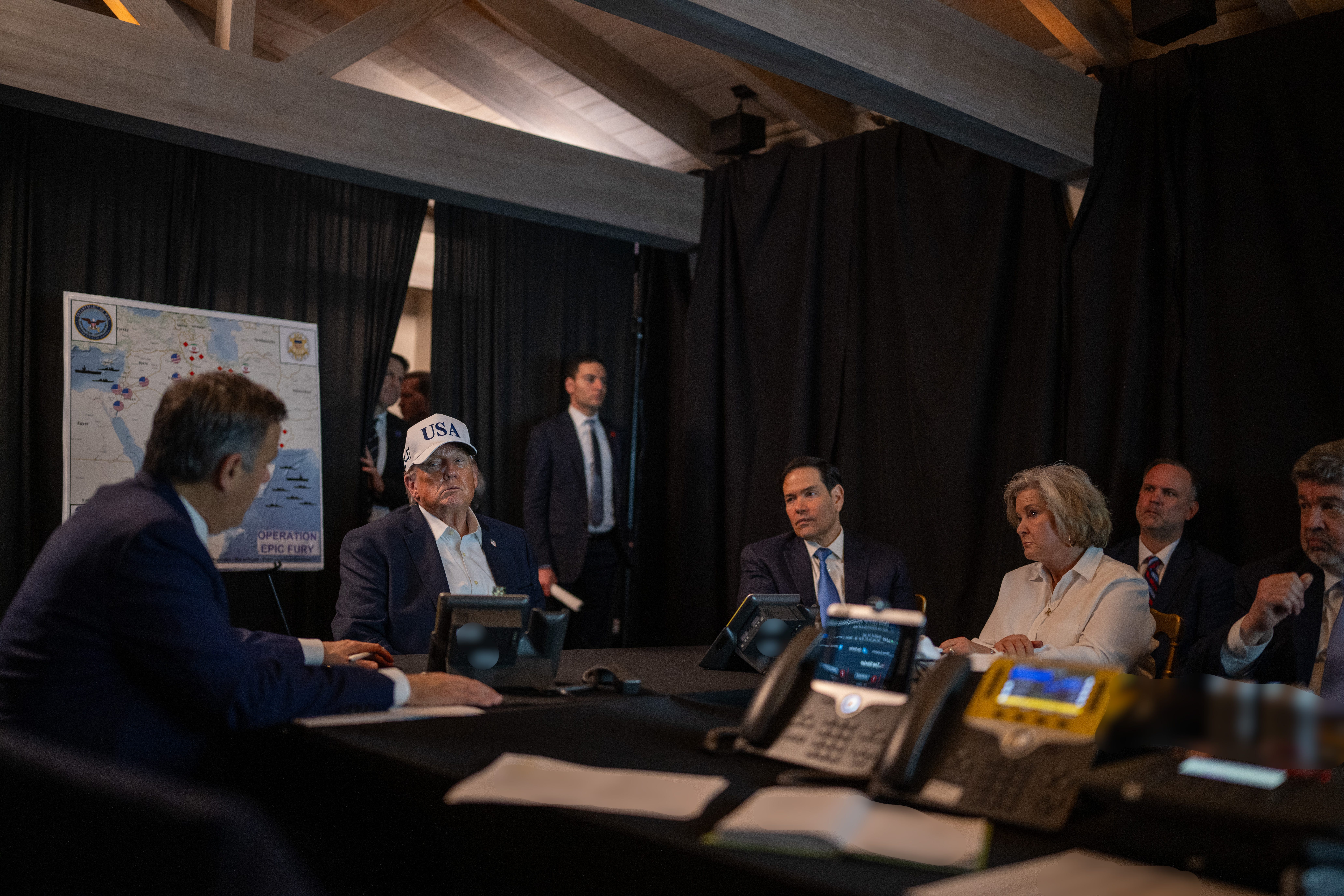
President Donald J. Trump oversees Operation Epic Fury at Mar-a-Lago, Palm Beach, FL, Feb. 28, 2026. (White House photo by Daniel Torok)
As Trump looks to make Mullin his new deporter-in-chief, $63 million evaporates into thin air and the DOJ stabs music lovers in the back
This article originally appeared on Watchdog Weekly.
Welcome back to Revolving Door Project’s Corruption Calendar, where we provide in-depth explanations of the material consequences—real and potential—of the Trump administration’s corrupt policymaking, with an emphasis on tangible harms to working people. Read our first 44 issues here, and follow us on Bluesky, Linkedin, Twitter, Facebook, and Instagram for more updates on our work.
This edition marks almost three weeks since the U.S. and Israel began their unlawful war of aggression against Iran, which 55% of American voters disapprove of, according to a recent Data for Progress poll conducted for Drop Site News and Zeteo. The first six days of the war alone cost $11.3 billion, a sum that could have wiped out federal student loan debt for roughly 300,000 people, reduced homelessness, helped low-income families pay their heating bills for two to three years, and more. Instead, the money has been used to bomb an elementary school in southern Iran, killing 168 people, including over 100 children, and to toxify the air with oily acid rain, all while Americans grapple with higher electricity bills, gas costs, and grocery prices. “Operation Epic Fury” sounds a whole lot more like “Operation Epic Fail.”
As the Trump administration continues to usher in humanitarian and environmental catastrophe abroad, it is treading new waters with its fascist agenda against those it deems enemies at home. On March 13, 2026, a federal Texas jury found eight ICE protestors labelled as “Antifa” (short for anti-fascist) by the Trump administration guilty of providing material support to terrorists, giving Trump the ammunition to go after dissenters. The case originates from a July 4, 2025 noise demonstration held at Texas’s Prairieland Detention Center to express solidarity with immigrant detainees. “Everything about this trial from beginning to end has proven what we have said all along: this is a sham trial, built on political persecution and ideological attacks coming from the top,” the DFW Support Committee, a group backing the defendants, said in an online statement.
The Prairieland verdict does not bode well for those resisting injustice, especially against ICE, and with Senator Markwayne Mullin (R-Oklahoma), a staunch ICE supporter who has harbored skepticism about birthright citizenship, set to succeed Kristi Noem as Homeland Security Secretary, pending Senate confirmation, the outlook remains bleak.
DHS Gets Its (MMA) Fighter
With Kristi Noem on the way out of the Department of Homeland Security, Trump has nominated hotheaded Senator Markwayne Mullin (R-Oklahoma) to be the new face of the administration’s callous mass deportation agenda. Mullin, who ignominiously tried to physically fight Teamsters president Sean O’Brien back in 2023, already considers himself part of the president’s inner circle, claiming they talk “all the time.”
Similar to most other members of Trump’s cabinet, Mullin is hauling concerning baggage to the confirmation process. As the New York Times put it, since his first election to Congress in 2012, Mullin has been one of its “most prolific stock buyers.” The Times’ reporting reveals how Mullin’s tenure in Congress has coincided with a dramatic increase in personal wealth, and his time in the Senate has coincided with a huge increase in the number of trades made on his behalf. In 2023, his first year as a senator, he reported 100 trades, which is 70 more than the year prior. This year, he’s on pace to go well beyond that, already having reported 40 trades in less than three months.
Senator Mullin does report using an ostensibly independent firm to manage stock investments on his behalf, but certain transactions deserve close scrutiny from his Senate colleagues and watchdogs. Most notably, Mullin purchased stock in the defense contractor RTX (formerly Raytheon) and Chevron just days before the Trump administration launched an attack on Venezuela to capture President Maduro. Today, Chevron is the sole American oil company operating within Venezuela and is poised to dramatically increase production in the wake of Maduro’s ousting. Considering the fact that the senator serves on the Armed Services Committee and talks frequently with the President, it’s an awfully fortunate coincidence that his independent portfolio managers made such trades at the right moment.
But enough about Mullin’s lucky streak in the market—let’s discuss how he would empower the Trump administration’s wider ambitions as Secretary. If given the chance to preside over DHS—the federal government’s third-largest agency by employment, with over 228,000 employees—Mullin would gain substantial control over a variety of areas key to the administration’s self-dealings and abuses of power. DHS is responsible for disaster response, election security and, of course, Trump’s daily obsessions: border security and Immigration and Customs Enforcement (ICE).
In his Wednesday confirmation hearing, Mullin gave alarming answers on every front. Senator Elissa Slotkin (D-Michigan) asked Mullin whether he stood by his prior refusal to certify the results of the 2020 election. Mullin responded with a glaring non-answer: “Ma’am, we know that President Joe Biden was sworn into office.” Mullin also refused to rule out the possibility of supporting Trump’s musings about illegally deploying federal agents to election sites. As the Brennan Center for Justice highlighted in a recent report on the deployment of ICE or the National Guard to polling sites, “both federal and state laws explicitly prohibit the federal government from carrying out these implied threats.” The exchange makes it clear: if the Trump administration is planning to contest the results of the 2026 midterms or a future presidential election, Mullin will oblige.
Mullin would also be in charge of FEMA, one of the agencies RDP is closely monitoring. The agency that he would inherit has been completely gutted by OMB Director Russell Vought and Elon Musk’s DOGE-fueled assault on the federal workforce. Senator Andy Kim (D-New Jersey) asked Mullin whether he would commit to ending these disastrous staffing cuts, but he refused: “Some of these agencies … not some, all of them got very bloated.” As our Kenny Stancil wrote in December, the administration’s staffing cuts at FEMA have made Noem’s previous plans to abolish the agency superfluous. While Mullin did agree to get rid of Vought and Noem’s directive requiring personal approval of all FEMA grants and contracts over $100,000 (which is most of FEMA’s grants and contracts) when asked, only time will tell if he makes good on that promise. Without a serious plan to restore FEMA’s workforce, authority, and funding, Americans caught in extreme weather should assume no help is coming from the federal government until further notice.
Live Nation and the Death of American Music
Much to the dismay of dozens of state attorneys general, the Trump administration settled a high-profile antitrust case against Live Nation last week. Live Nation, which holds exclusive rights to sell tickets at nearly 80% of major U.S. venues, operates a conspicuous monopoly over American entertainment.
But the slap-on-the-wrist approach to Live Nation should shock no one, considering the Justice Department Antitrust Division’s de facto abdication of its responsibility to enforce antitrust law. It also doesn’t hurt that Live Nation donated $500,000 to the Trump inauguration fund. The company has made other worthwhile investments too: employing MAGA monopoly-whisperer Mike Davis and hiring Trump’s 2016 campaign manager and former counselor Kellyanne Conway. Similar to the Bayer episode, which our colleague Andrea Beaty analyzed in the previous edition of Corruption Calendar, Live Nation’s scheme reveals corporate America’s strategy for getting out of any jam with the current administration: develop an influence network comprising Trump affiliates and aggressively donate to all pet projects. Any ambitious politicians serious about rooting out corruption in Washington must commit to confronting this now-established way of doing business head on.
To comply with the settlement terms, Live Nation has agreed to take small steps toward opening up the market to other consumers. The most important of these appears to be allowing competing ticket promoters to operate in Live Nation-owned venues. However, as New York Attorney General Letitia James put it, the settlement: “fails to address the monopoly at the center of this case.” Even while allowing small amounts of competition, Live Nation retains the powers that allowed it to crowd out other promoters in the first place, particularly existing exclusivity contracts with major artists.
Concerns of corruption are further vindicated by the fact that this settlement was a surprise to most people involved in the case. On the first day of the trial, presiding Judge Arun Subramaniaml, the 12-member jury, and even some of the DOJ’s own attorneys were completely unaware that the settlement was in the works. When he learned of the settlement, Subramaniam said: “It shows absolute disrespect for the court, the jury and this entire process.”
Let’s take a closer look at how consumers are getting the short end of the stick in the entertainment business. In a 2022 conversation about “ancillary fees,” two Live Nation regional ticketing directors bragged to one another that they were “Robbing them blind, baby.” Talking about Live Nation’s customers, Ben Baker wrote: “These people are so stupid. I almost feel bad taking advantage of them.”
Anyone who’s been to a concert at a large venue within the last few years would know what they’re talking about. According to Pollstar, the average ticket price for a top 100 tour was $135.92 in 2024—that’s due to a steady rise in prices since 2019 when tickets cost $96.17. In 2010, when Live Nation and Ticketmaster merged, prices were even lower: an average top 100 tour ticket in 1996 was just $62.57 and had been declining for the previous two years.
Although Trump and Vance promised to tackle corporate consolidation on the campaign trail, they have repeatedly proven to consumers that this was all smoke and mirrors. In February, the DOJ’s top antitrust official Gail Slater resigned over frustrations that the administration wouldn’t let her take decisive action. Indeed, Trump’s FTC and DOJ have been more than willing to facilitate big time deals. By gutting regulatory capacity and facilitating monopolization, the Trump administration has sowed major problems that American consumers are now reaping. The case is moving forward at the behest of most of the country’s AGs, including major entertainment markets California, New York and Texas. But the DOJ’s double crossing makes things difficult for State AGs. They’re left to cobble together a case on a tight timeline. Worst of all, Live Nation now has the strong argument that it has already settled the violations it’s being charged for.
Money Disappearing Act
In other news, the dissolution of Trump’s proposed presidential library fund, which contained at least $63 million in settlement money from ABC News, Meta, Paramount, and X, has Congressional Democrats channeling Jerry Maguire, asking the private companies to show them the money.
On March 9, 2026, Senators Elizabeth Warren (D-Massachusetts) and Richard Blumenthal (D-Connecticut), alongside Representative Melanie Stansbury (D-New Mexico), requested information from the four firms about the terms of their settlement agreements with Trump and the status of their contributions.
“It is unclear where this money has gone, exacerbating concerns about corruption that were raised at the time of the settlement[s],” they wrote.
In December 2024, Disney-owned ABC agreed to pay $15 million for Trump’s planned presidential library in Miami, Florida to resolve a defamation lawsuit with Trump. Thereafter, the Donald J. Trump Presidential Library Fund, Inc. was set up by an attorney previously with the Dhillon Law Group, whose managing partner, Harmeet Dhillon, serves as Trump’s Assistant Attorney General at the Justice Department. (The library is intended to house, among other things, Trump’s $400 million Boeing 747 jet, courtesy of the Qatari government, that will be ready for takeoff as Trump’s Air Force One later this year.)
Similar settlements with Meta, Paramount, and X soon followed. In January 2025, Mark Zuckerberg’s Meta agreed to pay $22 million towards the library fund to settle a lawsuit with Trump over suspending his social media accounts after the January 6, 2021 Capitol riot. The next month, Elon Musk’s X resolved a similar lawsuit with Trump for $10 million, agreeing to commit whatever remained to the presidential library fund after Trump’s legal fees were deducted. In July 2025, Paramount, run by David Ellison, the son of Oracle founder and Trump’s billionaire friend, Larry Ellison, struck a deal to settle a lawsuit with Trump accusing the company of deceptively editing a CBS news program, agreeing that its $16 million settlement payment, minus Trump’s legal fees, would go towards the presidential library fund.
Democrats were ringing the alarm bell at the time, calling the Paramount payment a “bribe” to secure approval of the company’s then-pending merger with Skydance Media. Indeed, a few weeks later, Trump’s Federal Communications Commission gave its blessing to Skydance’s acquisition of Paramount. And now, Paramount is poised to merge with Warner Bros. Discovery, a deal that FCC Chair Brendan Carr has told CNBC news will be approved “quickly.”
To be sure, the ABC, Meta, X, and Paramount settlements are yet another example of major media and tech companies capitulating to Trump in order to try to curry favor with the administration, which, in turn, has resulted in increased attacks on media freedom, looser content moderation rules, and a rolling back of diversity, equity, and inclusion programs.
But the corruption does not end there.
In December 2025, just a year after the presidential library fund was established, the fund was voluntarily dissolved. It is unclear what happened to contributions in the fund.
The four companies have until March 23, 2026 to respond to lawmakers’ questions. Note that if and when there is a Democratic majority in one or both branches of Congress, questions can be turned into legally enforceable subpoenas quite readily.
Quick Hits
Rubio Shakes Down H.I.V. Patients in Zambia
Marco Rubio and Trump’s State Department are mulling over a stunningly evil gambit in a new memo, deciding whether or not to use H.I.V. assistance as a bargaining chip to gain access to critical minerals in Zambia. According to reporting from the New York Times, a draft memo from the State Department’s Africa Bureau proposes that “We will only secure our priorities by demonstrating willingness to publicly take support from Zambia on a massive scale.” This policy would be in line with a recent push by State to condition American health funds to African nations on political support. It would also line up with the Trump administration’s disastrous shutdown of USAID, one that public health experts estimate had “already caused the deaths of six hundred two thousand people, two-thirds of them children” last November.
Trump’s $10 Billion Windfall
Investors MGX, Oracle, and Silver Lake will reportedly gift $10 billion to the Trump administration for brokering the deal that allowed them to gain majority ownership of TikTok’s U.S. entity from Chinese parent company, ByteDance. Regrettably, Trump’s track record of exploiting his executive office to enrich himself means that this $10 billion kickback could end up in his pockets or otherwise serving him and his family’s parochial interests, without a dime going to programs that uplift the working class.
Shillin’ Like a Villain
Trump isn’t the only one blurring the line between his government office and the private sector. His son-in-law and Middle East special envoy, Jared Kushner, has been approaching foreign governments in the region to raise at least $5 billion for his private equity firm, Affinity Partners, according to the New York Times. The Public Investment Fund, Saudi Arabia’s sovereign wealth fund led by Crown Prince Mohammed bin Salman, is already the largest investor in Affinity with $2 billion in backing and is among those that met with Affinity during its latest fundraising pitch. Notably, Affinity is a major shareholder in Phoenix Financial, an Israeli asset management company with alleged ties to illegal settlements in occupied Palestine. Such an investment is par for the course for Kushner who is overseeing Trump’s so-called Gaza “Board of Peace”—a brazen cash grab veiled as a reconstruction plan. To make matters worse, Kushner has not filed a public financial disclosure report, rendering his plunder of the Middle East a black box.
A Troika of Spendthrifts
Trump’s law, sword, and shield are burning through taxpayer dollars. In September, which marked the end of the government’s 2025 fiscal year, Defense Secretary Pete Hegseth and co. at the Pentagon spent $93.4 billion on external costs, including a bizarre hodgepodge of luxury foods, musical instruments, stickers, and other non-military assets, according to an investigation by the fiscally conservative watchdog Open the Books.
In March 2026, the New York Times reported that Attorney General Pam Bondi had discreetly relocated from her apartment to heavily secured military housing in the D.C. area amid criticism of her mishandling of the Jeffrey Epstein files and other perceived threats. She is the latest senior official to move into taxpayer-subsidized military housing, joining the likes of Hegseth, former DHS Secretary Kristi Noem, DHS advisor Stephen Miller, and Secretary of State Marco Rubio. The increasing number of Trump appointees moving into military housing without possessing any direct military connection seems to be a historical first. What is more, they may be paying nothing at all to reside in these historic properties.
Meanwhile, the Washington Examiner revealed that ICE purchased thousands of gaudily-branded trucks and SUVs that it can’t even use. These examples of the frivolous squandering of taxpayer dollars come as Americans continue to struggle with food insecurity, shoulder the housing affordability crisis, and face transportation hardships.
Trump Quixote: Tilting at Windmills Part Six
On Tuesday of this past week, the New York Times reported that the Department of the Interior is considering a new strategy to kneecap the buildout of the US’s offshore wind industry. The deal would pay the French energy company TotalEnergies $1 billion to not build their proposed wind farms. Then, TotalEnergies would invest that money in the Texas natural gas industry instead. The proposed wind farms would create over 4 gigawatts of electricity—enough to power millions of homes—and would help combat the trend of rising US energy prices squeezing household wallets. In the past, federal judges have blocked five previous attempts from the administration to stop major offshore wind projects.
P.S. Mark your calendars. The third nationwide No Kings Day protests against Trump’s pro-billionaire, anti-working class agenda will be on March 28, 2026. Find your local No Kings event to make it clear that America rejects the regime’s brutality at home and abroad.
Related Articles
April 9, 2026
Map: Trump Has Often Delayed or Denied Disaster Aid
April 6, 2026
The First Amendment Does Not Grant Carte Blanche to Social Media: A Reply to David French
April 3, 2026
Corruption Calendar Weeks 62-63: Enforcement Has Left The Building
April 2, 2026