
How the Trump Administration Is Redirecting Funds From National Treasures To DC Vanity Projects
Introduction
The National Park Service (NPS) is charged with stewarding what author and environmentalist Wallace Stegner called America’s “best idea.”
From the striking expanse of the Chihuahuan Desert, partially contained in Big Bend National Park, to the towering stone walls of Yosemite, the United States government has the privilege of caring for some of the most overwhelmingly beautiful vistas in the world.
For more than 100 years, recreational fees have been collected at a subsect of our National Parks to explicitly and specifically support the management and responsible stewardship of these lands on behalf of present and future generations.
Per NPS, the “Federal Lands Recreation Enhancement Act (FLREA) […] requires that fee revenue is used to enhance visitor experience. At least 80 percent of funding from recreation fees stays in the park where it is collected, and the other 20 percent is used to benefit parks that do not collect fees or parks which generate only a small amount of revenue.”
Donald Trump is stealing that rich legacy from the American public through a callous divestment and diversion campaign that treats our National Parks as a mere “balance sheet” to be used, abused, and looted in favor of Trump’s D.C.-based vanity projects and so-called “beautification projects.”
By using public data to examine the funding obligated to twenty individual parks and D.C. from of NPS’ Recreational Fee account from 2025 to June 2026 and comparing it to funds obligated those same parks and D.C. during 2023 and 2024, a Revolving Door Project analysis found that more NPS fee money has been obligated to D.C. than the top-ten most visited fee collecting and top-ten non-fee collecting parks combined.
Further, RDP found that D.C. based awards out of this account has increased by a staggering 1673 percent, while awards out of the same account over the same period has decreased by 75.52 percent for the top-ten fee collecting parks, and 34.22 percent for the top-ten non-fee collecting parks.
To be clear, a lack of federal investment in Washington, D.C.’s federally managed public spaces has long been an affront to all residents of the nation’s capital who still suffer from taxation without meaningful representation in Congress, even as they remain more vulnerable to the political will of any given administration than many other states, localities, and communities.
It is good that D.C. residents are benefitting from long overdue investment in federally managed spaces in the city. However, not all of D.C. seems to be facing the same level of interest from the administration, with particular fervor (and funds) reportedly being funneled to the National Mall, the White House, and other spaces that are essentially Trump’s own backyard.
Ethical questions also continue to abound in this administration’s use of no-bid contracts and awards made to friends and political allies of the administration in and outside of D.C.-based beautification projects, further muddying—or algae blooming—the waters of Trump’s motivations for the sudden increase in spending in Washington, and the benefit to D.C. (and the broader American public) that these projects bring.
There are also a slate of questions about how much of this information is actually making it to public view.
The Revolving Door Project’s review is rendered solely from publicly-accessible data discovered on USASpending and reproduced in charts below, whereas recent reporting from The Atlantic interrogating similar questions, utilized internal budget documentation to reveal similar trends, but was working with disparate numbers. When and how such internal figures will be reflected in budget materials available for public view remains to be seen.
Regardless, what we know is that Trump continues bulldozing existing laws and policies in his execution of a number of D.C.-based projects, which include a slate of projects and proposals that totally ignore the existing $2.7 billion maintenance backlog in D.C.-based National Parks in favor of Trump’s personal pet projects.
D.C.’s maintenance backlog has for a decade (or more) been vulnerable to NPS’ tightening budgets and cross-the-board cuts—as has been true of other parks across the country.
A Congressional Research Service report found that over the last ten years, NPS’ deferred maintenance backlog “nearly doubled, staffing declined by an estimated 18 percent, and a landmark funding mechanism that had been filling the gap expired at the end of fiscal year 2025.” As of 2025, NPS’ deferred maintenance backlog for parklands nationwide is estimated to be more than $24 billion.
Further divestments will only further exacerbate the dangerous dynamic already unfolding at many of our parks “where there may not be enough staff on site to guarantee adequate safety infrastructure for visitors who rely on the service’s lifeguards, wildfire firefighters, and emergency rescue experts.”
As many parks approach peak tourism season again this summer, with millions of people planning to visit parks nationwide, we are concerned to report that the hyperconcentration of funds in D.C. may be reaching even more extreme heights with every passing day.
Methodology
Award totals for each individual park were compiled by searching USASpending for any award obligated out of Treasury Account: 014-5110, known as the Recreation Enhancement Fee Program of the National Park Service, and tagged with official National Park Service park codes (as listed per-park in charts below).
For D.C., both place of performance (Washington, D.C.) and capitol area codes including NAMA, NACE, ROCR, GWMP, and PRPA.
Each search was conducted for award years 2025&2026, as well as 2023&2024, with all contracts and subsequent totals located in charts in the Contract Addendum located at the bottom of this report.
Reported totals for each contract were drawn directly from obligations from the Recreational Fee account itself. Meaning, if a contract pulled source funding from both donations to the National Park Service and NPS’ recreational fee account, numbers reported here reflect only the latter, not the former.
Methodological Gaps
This method of research is inherently vulnerable to contracts filed with misspelled places of award, recipient park codes, or park names, and so these totals may exclude any awards translated into USASpending with such errors, missing information, or other informational gaps that the Revolving Door Project does not have the ability to account for.
Further, this report only analyzes spending earmarked during 2023 & 2024 and 2025 & 2026. We are unable at this time to make claims regarding broader trends in award out of and distributions made from the National Park Service’s recreational fee account.
Lastly, contracts/grants are not the only way that funds in the FLREA can be spent. This report is not an accounting of *all* funds from that account, but rather an accounting of the FLREA funds awarded to non-governmental third parties via contracting/grantmaking avenues in these parks and Washington, D.C.
Amendment
An earlier version of this report mistakenly reported contracting totals from 2023-2024 and 2025-2026, implying the evaluation of a single 12-month fiscal year. This report evaluates contracts listed on USASpending for both FY2023 and FY2024 as well as FY2025 and FY2026.
Summary of Findings
These charts compare the disbursements made out of the National Park Service’s entry fee fund (014-5110) to the top 10 most visited fee-collecting parks, the top 10 most visited non-fee collecting parks (outside of D.C.), and to D.C. based projects.
- During 2025 & 2026, approximately $54,253,908 in contracts and another $5,661,616.28 in grants from the Rec Fee account have so far been directed to the top 10 fee collecting parks – a total investment of $59,915,524.28
- During 2025 & 2026, approximately $8,129,920 in contracts and $47,688 in grants from the Rec Fee account has been directed to the top 10 non-fee collecting parks — a total investment of $8,177,608
- During 2025 & 2026, approximately $86,773,479.45 in contracts has so far been awarded to D.C.-based projects.
This marks a stark departure from the documented totals during 2023 & 2024.
- During 2023 & 2024, approximately $221,638,467 in contracts and another $2,255,322 in grants were awarded out of the Rec Fee account to the top 10 fee collecting parks – a total investment of $223,893,789.
- During 2023 & 2024, approximately $12,358,645 in contracts and another $607,053 in grants were awarded out of the rec fee program to the top 10-non fee collecting parks – a total investment of $12,965,698.
- During 2023 & 2024, approximately $4,893,676 in contracts were awarded to D.C.-based projects.
Overall, these figures represent a 75 percent decrease in funds awarded to the nation’s top-ten most visited fee collecting parks out of the National Park Service’s , a 34 percent decrease in funds awarded to the nation’s top-ten most visited non-fee collecting parks, and a staggering 1,673.23% increase in funds awarded to projects based in Washington D.C., specifically (Table 1).
Table 1 : Contract Award Totals For Fee-Collecting Parks, Non-Fee Collecting Parks, and D.C.
| Contract Totals | |||
| Designation | 2023 & 2024 Total (Only Contracts) | 2025 & 2026 Total(Only Contracts) | Differential |
| Top 10 Fee Parks | $221,638,467* | $54,253,908† | 75.52% decrease |
| Top 10 Non-Fee Parks | $12,358,645 | $8,129,920 | 34.2167% decrease |
| D.C.-Based | $4,893,676 | $86,773,479.45 | 1,673.23% increase |
This chart compares the contracting disbursements made out of the National Park Service’s entry fee fund to the top ten most visited fee-collecting parks, the top 10 most visited non-fee collecting parks (outside of D.C.), and to D.C. based projects.
*The total contracts awarded for the top ten fee-collecting parks (2023 & 2024) is skewed by a massive $144 million award for work within Grand Canyon National Park to improve potable water supply and infrastructure in the park. Such a project is anomalous for both the amount awarded and the breadth of work undertaken by virtue of it, but is also exactly the ambitious project that the FLREA was created to enable. Even if that award is removed from the overall total, resulting in approximately $77,478,967 in other contracts over the two-year period (2023 & 2024), there is still a 29.99999 percent decrease in contracts awarded between 2023 & 2024 and those awarded between 2025 & 2026.
†The total contracts awarded for the top ten fee-collecting parks (2025 & 2026) is also skewed by a $19 million award to rehabilitate the Tuolumne Meadows water distribution system in Yosemite National Park. This award represents 35.09 percent of the total received across all ten parks in 2025 & 2026.
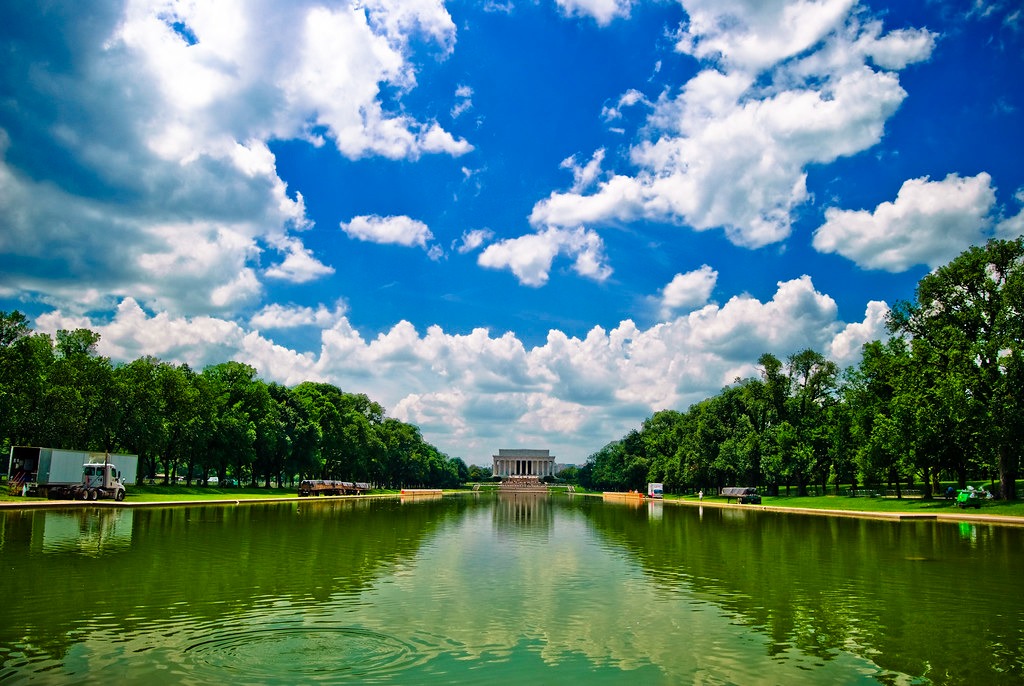
“The Lincoln Memorial’s Reflecting Pool” by multisanti is licensed under CC BY-NC-SA 2.0.