
Will a Supreme Court willing to grant Trump immunity for his crimes do the same for Trump’s oil industry backers?
This article was originally published in The American Prospect. Read on the original site.
It’s been seven years since Boulder, Colorado, took oil companies Exxon and Suncor to court for decades of lying about the dangers of their products, one of dozens of parallel lawsuits brought by local, state, and tribal governments against fossil fuel companies. In May, the Colorado Supreme Court ruled that the case could move toward discovery and trial, something the companies are desperate to avoid.
Now, Exxon and Suncor are once again seeking refuge at the Supreme Court. The oil companies insist that if these cases are allowed to proceed, it could have major ramifications for the future of their industry, and are asking the Court to intervene “before the energy industry is threatened with potentially enormous judgments.” The Court’s decision is likely to come next month, and the outcome may depend on how many justices participate in considering the petition. Petitioners need four of nine justices to agree to grant a writ of certiorari, and any recusals could diminish the odds of getting enough votes.
Justice Samuel Alito, whose most recent financial disclosure shows he has stock in oil companies ConocoPhillips and Phillips 66, and up to $100,000 invested in a high dividend yield fund in which ExxonMobil is its third-largest holding, is not the only justice whose stake in the oil industry should preclude his involvement in these cases. Justices Amy Coney Barrett, Neil Gorsuch, and even Chief Justice John Roberts have past or present financial or familial ties to the oil industry that could raise questions about their impartiality. But as long as the ethics standards for judges remain lowest at our highest court, there is little way to compel the recusal of justices with conflicts of interest, short of public shame.
“The American people get that this Court has been compromised: Public confidence in the Court is at the lowest point in the decades since such polling began,” said Lisa Graves, co-founder of Court Accountability and author of a recent book on Supreme Court corruption, Without Precedent. “America needs a Congress that will reform the Court in order to ensure that laws are fairly and impartially applied and to restore rights and protections that the captured Roberts Court has eroded.”
An Oily Finger on the Scales
Exxon and Suncor are counting on the Trump administration’s support for their petition bolstering their chances before the Supreme Court. After all, the Court has repeatedly wielded the shadow docket to grant Trump sweeping powers, and Trump has not been subtle in his corrupt quid pro quo with oil interests, asking for $1 billion in industry donations during the campaign in exchange for fossil fuel–friendly regulations.
The last time the oil companies petitioned the Court in this case, Biden Solicitor General Elizabeth Prelogar told the Court that the petition should be denied. But the Justice Department under Trump has changed positions, filing amicus briefs to support Exxon and Suncor’s claims, suing New York and Vermont over their climate superfund laws, and even preemptively suing Hawaii and Michigan to try to block the states from taking oil companies to court.
Though the oil companies’ petitions in these climate cases have been repeatedly denied by the Supreme Court over the last few years, the recusal of conflicted justices from considering those petitions has been inconsistent at best.
The last time the Court considered Exxon and Suncor’s petition against Boulder, I wrote for the Prospect that the oil companies’ lawyers were urging Justice Alito to use the Boulder case, in which ConocoPhillips and Phillips 66 are not direct parties, as a vehicle to decide the other state-level climate cases in which they are. Exxon’s lawyers were explicit that they viewed the Boulder case as the “ideal vehicle” for getting around recusal issues. As Freddy Brewster explored in The Leverlast week, oil companies may also be attempting a similar play in another pending case where a ConocoPhillips subsidiary withdrew from the suit, possibly to avoid Alito’s recusal.
Back in 2023, I wrote that a “blanket recusal” for justices with financial interests in these interconnected climate liability cases was the only ethical option. Justice Barrett should also have recused herself from considering the petitions. As a circuit judge, she consistently recused from cases involving Shell because her father was one of Shell’s top lawyers for 29 years, as well as the chairman of an American Petroleum Institute subcommittee. But since Barrett joined the high court, where the decision to recuse is made by individual justices without review, she stopped recusing from cases involving Shell. Barrett considered unsuccessful petitions from Shell against Rhode Island and Honolulu and from the American Petroleum Institute against Minnesota in 2023 and 2024.
The last time Exxon and Suncor’s petition against Boulder was before the Court, Alito did recuse, Barrett did not, and the Court did not take up the petition, though Justice Brett Kavanaugh said he would have granted it. Since then, the Court has denied subsequent petitions from various oil and gas companies being sued by Hoboken, New Jersey, and Delaware; by the state of Minnesota; and by the city and county of Honolulu. But Alito’s recusals have not been reliable. He recused from considering the petitions in Hoboken and Honolulu’s cases but not in Minnesota’s.
Alito also participated in consideration of Alabama v. California this year, in which 19 states petitioned the Supreme Court to stop California and four other states from suing oil and gas companies, claiming that holding the energy companies accountable for their misinformation campaigns threatened “our basic way of life.” Alito actually joined Justice Clarence Thomas in a dissent saying they would have taken the case. Though the oil companies in which Alito owns individual stock were not the direct petitioners in the case, the connection is undeniable. ConocoPhillips and Phillips 66 are defendants in the lawsuits brought by California, New Jersey, and Rhode Island that Alabama sought the Court’s help to challenge.
A Slippery Set of Ethics Questions
A closer examination of the justices’ recent financial disclosures reveals that Alito and Barrett haven’t been the only ones with vested interests in the oil industry’s future.
Throughout 2022, 2023, and 2024, Justice Gorsuch bought and sold various investments in three energy sector funds that were largely or entirely composed of fossil fuel holdings, and disproportionately weighted toward fossil fuel companies including ExxonMobil, Chevron, ConocoPhillips, and Shell. Gorsuch sold off those holdings by the end of 2024, but we won’t know what investments he held in 2025 until the justices file their disclosures next year.
Investment in truly diversified mutual funds (e.g., funds tracking the Russell 2000 or S&P 500 indices) is often viewed as the more ethical alternative to investments in individual stocks, because one’s economic interests are spread out widely enough that an outcome favorable to a specific sector is not obviously meaningful. However, Gorsuch’s investment in extractive energy sector funds while he considered taking up cases with potential sector-wide ramifications raises significant ethics concerns.
Chief Justice Roberts’s holdings, meanwhile, illustrate the ethical questions that can arise even with investments in diversified funds. In 2024 alone, Roberts made between $50,001 and $100,000 in dividends from up to $1 million he has invested in a fund he’s consistently held, and bought and sold in part, for years: First Eagle Global SGIIX. In 2023, ExxonMobil was the fund’s fourth-largest holding, and in 2024 it was the fifth-largest. But by Roberts’s standards, this wouldn’t necessarily constitute a financial interest, much less one that would compel his recusal.
In November 2023, amid escalating ethics scandals at the Supreme Court and days before the Senate Judiciary Committee would vote to subpoena billionaire Court influencers Harlan Crow and Leonard Leo, Justice Roberts published a code of conduct signed by all the justices that outlined the standard to which they purportedly held themselves. The code is unenforceable, and sets a lower standard for recusals than that for lower-court judges.
The code of conduct establishes that a justice should “keep informed” about their own financial interests, but that “ownership in a mutual or common investment fund that holds securities is not a ‘financial interest’ in such securities unless the judge participates in the management of the fund.” Though the code states that a justice should disqualify themselves when their impartiality “might reasonably be questioned,” it also asserts that “the rule of necessity may override the rule of disqualification.”
That is, a justice with an overt conflict of interest could still be asked to sit, and even cast the tie-breaking vote, if the alternative is no decision. The “absence of one Justice risks the affirmance of a lower court decision by an evenly divided Court,” Roberts writes, “potentially preventing the Court from providing a uniform national rule of decision on an important issue.” The code of conduct does not attempt to justify the claim that a conflicted decision is preferable to the Court reaching an impasse.
While legislation that would hold the Court to a higher ethics standard languishes in committee, the Supreme Court’s new term began last month. We will likely know by mid-December whether the Court is interested in taking up the oil companies’ latest plea, or if it is too busy stoking other disastrous fires. Meanwhile, Big Oil isn’t placing all their hopes in the corrupted Court. The industry is also fueling a coordinated lobbying effort with congressional Republicans and right-wing attorneys general to try to convince Congress to pass a liability shield that immunizes them from consequences.
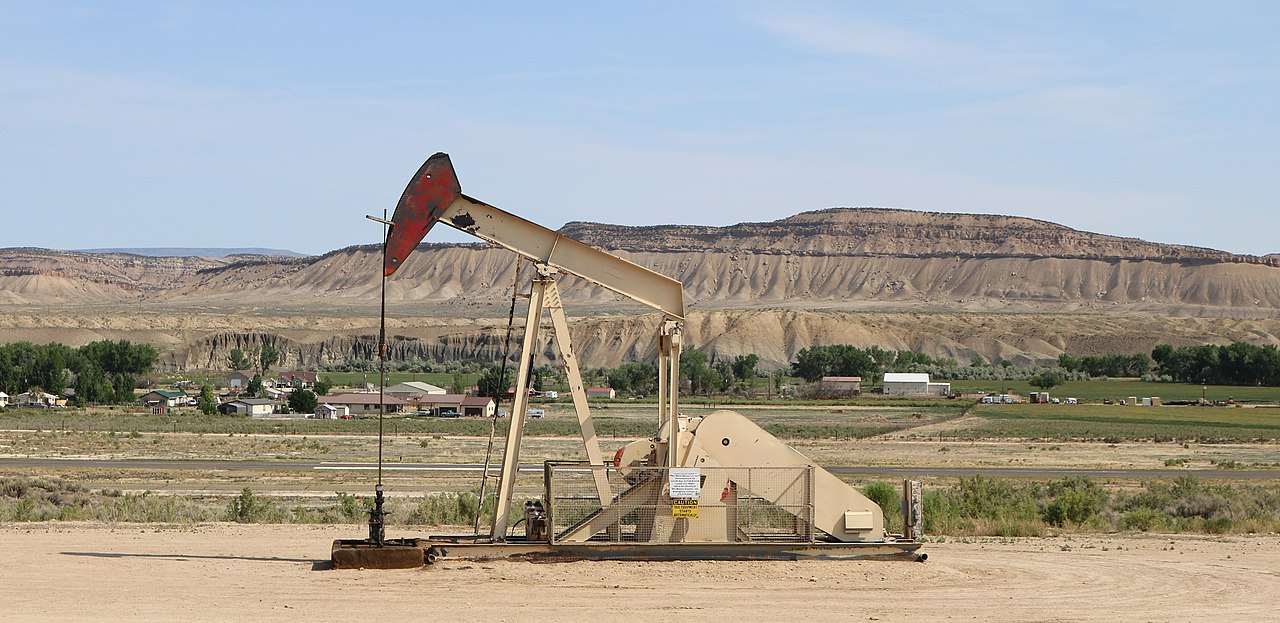
Image: this photo of a Colorado oil well is licensed under the Creative Commons Attribution 4.0 International license.
