
AI use is worsening problems of transparency and accountability in a government whose leaders are opposed to democracy.
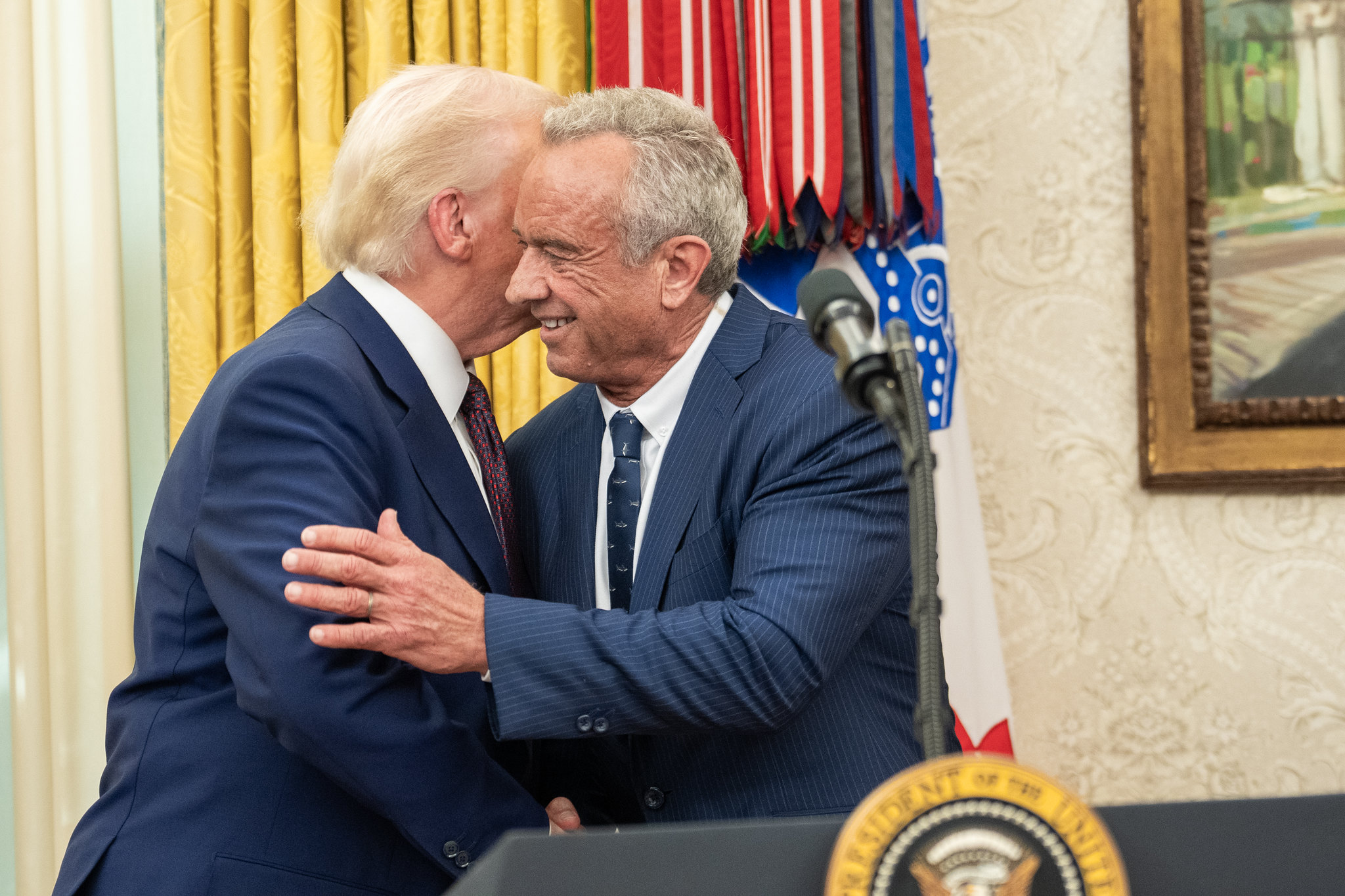
Photo: President Trump embraces Health and Human Services Secretary RFK Jr. at his swearing-in ceremony. Official White House Photo by Joyce Boghosian. Both Trump and RFK Jr. have been all-in on AI.

This newsletter was originally published on our Substack. Read and subscribe here.
This much is clear: artificial intelligence has permeated just about every corner of the federal government.
The Revolving Door Project has been tracking news stories and reports of the Trump administration’s adoption of AI, which has been at turns benign, ridiculous, and dangerous. By the administration’s own measure, forty-one departments and agencies reported 3,611 distinct use cases of AI in 2025.
The rapid adoption of AI tools by an administration whose leaders disdain democratic processes has already caused disasters small and large. From the Justice Department filing documents in court with false case citations invented by AI, to the hijacked Environmental Protection Agency adopting as its new mission the transformation of the U.S. into the “AI capital of the world,” Trump’s “AI First” position has repeatedly degraded the integrity of government activities.
AI is not only being used in low stakes, administrative capacities but in high stakes, “mission critical” contexts. It is increasingly shaping how agencies undertake the rule-making process, with AI tools sorting through and categorizing public comments. It has been incorporated into law enforcement activities, into benefits programs that serve millions of people, and into the determination of who gets federal grants and contracts.
The Trump administration is quickly discarding even the most basic guardrails:
- The Department of Transportation is considering whether there are some cases in which human oversight of AI decisionmaking is unnecessary, calling human workers a “limiting factor.”
- The Inspector General for Veterans Affairs has issued a warning about healthcare providers using AI chatbots without adequate patient safety review. The VA has incorporated AI into other sensitive operations as well, including its automated claims process for its $195 billion disability benefits program, and its suicide prevention program for flagging files of at-risk veterans.
- The Pentagon claims that nearly half of its employees are routinely using AI, a 1,775% boost in AI use in one year. The Army is being sued over by a contractor alleging that AI hallucinations caused them to be passed up for a $450 million contract.
Within the Health and Human Services Department, AI use has skyrocketed under RFK Jr.’s mismanagement. The Food and Drug Administration saw the greatest increase between 2024 and 2025 (148%), alongside major jumps in use at the Centers for Disease Control and Prevention and the Centers for Medicare and Medicaid Services. The overall largest AI user under the HHS umbrella remains the National Institutes of Health. While RFK Jr. touts AI as a miracle solution, a federal AI pilot program under his oversight has been slowing and denying medical care for senior citizens in Washington, New Jersey, Ohio, Oklahoma, Texas and Arizona, prompting several lawmakers to introduce a bill to repeal its authorization.
Energy and environmental agencies are rolling out the red carpet for polluting, land-intensive data centers for AI. The Energy Department is soliciting private equity investment to repurpose decommissioned nuclear weapons facilities into polluting gas-powered AI data centers in Kentucky, Ohio, and South Carolina. The Environmental Protection Agency (Environmental Pollution Agency, really) is approving chemicals known to have reproductive health risks for use in semiconductor manufacturing, and proposing rules that would limit public input into AI data center permitting while seeking to expedite their construction. All the while, the EPA has internally been experimenting with using AI for “everything.”
In many cases, the incorporation of AI into the government’s workflows has outpaced its guardrails. It is unevenly understood internally and unevenly disclosed to the public. The Federal Bureau of Investigations, for example, disclosed only 50 AI use cases in its public inventory, yet the Bureau’s Chief AI Officer told a defense intelligence conference audience that the FBI had 139 AI use cases with “all different manners of data, all different manners of processes and certainly all manner of risk.”
Government AI is increasingly interfacing with the American public in ways both benign and violent, from IRS chatbots answering tax questions to AI tools powering ICE’s surveillance and targeting of immigrants. Given the broad scope of what the federal government does, and how many disparate tools fall under the name “AI,” it is in some ways more confusing to consider all these use cases together as “AI in government” rather than parsing them out individually. What makes it reasonable to consider them together are the novel risks of these “black box” systems substituting for the reasoning and determinations of humans, and how that compounds existing transparency and accountability issues.
As Boston University law professors Woodrow Hartzog and Jessica M. Silbey argue in their 2025 paper, “How AI Destroys Institutions,” AI systems as they function today are fundamentally anti-democratic, and erode the civil institutions that are the backbone of a democratic society by their incorporation:
“AI is uniquely dangerous because it is the only tool that encourages offloading three key parts of institutional resilience and legitimacy—human language, human relationships, and human accountability. In combination, and in the context of late-stage capitalism, the erosion of these characteristics at scale is progressively lethal to our civic institutions on which we all depend.”
We should make the Trump administration politically own the risks and harms of its overtly pro-AI, anti-guardrail stance. The rampant, unchecked use of AI by a conspicuously hollowed-out federal workforce mirrors the administration’s approach towards the AI industry broadly. The administration’s embrace of artificial intelligence is aligned with its broader agenda: attacking public input and Congressional power, violating public record-keeping requirements, firing scores of civil servants, wantonly expanding presidential power, and other brazen acts of disregard for public service and the importance of public trust in government.
As tends to be the pattern with the AI boom, public trust is lagging far behind institutional adoption. We can recognize both that rebuilding public trust in government activity is of paramount importance, and that it cannot happen without major reforms. Our current distrust is reasonable, our anger and moral outrage legitimate. The Trump administration has offered up American citizens’ data to Palantir on a gaudy gold plate, while using AI tools to surveil and deport our noncitizen neighbors. The Pentagon likely relied on AI in mistakenly targeting a girls’ school in Iran for a missile strike, killing 168 people, most of them children. AI cannot be investigated and imprisoned, but the people who deployed it to murder innocents can be.
At bottom, the ideal of a government of the people, by the people, for the people is incompatible with handing over authority to make consequential decisions to inscrutable AI systems. There is no utopia just ahead, if only we let the tech billionaires lead us down the path of their fantasies. There is only us, and the stakes of what we choose.
Want more? Check out some of the pieces that we published or contributed research or thoughts to in the last week:
Tracking Uses of AI in the Trump Administration
Illuminating the Home Insurance Crisis
TRACKER: Trump’s Disastrous Disaster Policy
Map: Trump Has Often Delayed or Denied Disaster Aid
AI Villains and the Trump Administration: Eric Schmidt
Revolving Door Project Condemns Trump’s Corrupt Crypto and Prediction Market Roundtable
An AI Bailout Will Be a ‘Which Side Are You On’ Moment
Booming Oil Profits Show Why Policymakers Can’t “Wait and See” on Gas Prices
Is Trump Making Natural Disasters Worse?
‘Shamelessly Corrupt’: Recusal From Climate Cases Demanded After Alito’s Fossil Fuel Profits Exposed
Samuel Alito’s Oil Money Reveals the Worthlessness of the Supreme Court Ethics Code
We Uncovered Where Your Insurance Payments Are Really Going
US taxpayers set to provide millions for Trump’s ‘beautification’ efforts in DC
Illinois steps in where feds won’t: Pritzker signs relief bill for storm-damaged homes
Trump Expected to Join Crypto CEOs at the White House a Day Before the CFTC’s First Innovation Panel