
This review originally appeared in The Sling. Read the original here.
As the calendar flipped from 2021 to 2022, orthodox economics found itself on the back foot. The all-knowing oracles of the neoliberal order were beset by unforeseen global conditions.
The COVID-19 pandemic unleashed a series of economic shocks that broke the delicate balance of globalization we took for granted. With modern trade and technology, supply-chain frailty had become ever less of a concern, shoved further and further down the policy priority list. The global inflation that terrorized working people in the 1970s and 1980s was reduced to a memory. For half a century, deregulation had accompanied prosperity (albeit inequitably distributed), masking the brittleness undergirding the modern neoliberal economy. It is worth bearing in mind that this vulnerability was intentionally manufactured; cutting redundant backups was an opportunity to reduce overhead (along with the labor share) and increase operational efficiency. Capacity investments that are held in reserve don’t generate revenue, so cutting them can function as corporate stat-padding.
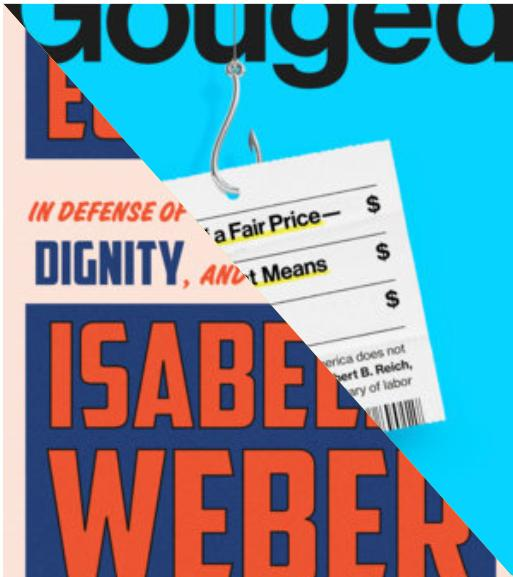
As this system fell apart amidst a global pandemic, unorthodox economists long pushed to the discipline’s fringe finally found an opportunity to make themselves heard. Out of this opening emerged both Lindsay Owens’s Gouged:The End of a Fair Price–and What That Means for Your Wallet (Viking, September 2026) and Isabella Weber’s Anti-Fascist Economics: In Defense of Affordability, Dignity, and Democracy (Random House, October 2026).
These two books are a pleasure to read and review, not only because they’re both good (which they are!), but also because they come from two people who I deeply admire. They helped me to recognize that economics need not be doctrinaire, and that there is a much greater wealth of thinking about the world than you get in micro and macro classes.
They also are especially relatable to me because, in my own (much less significant) way, the story of how I came to do the work I do overlaps with Owens’s and Weber’s rise to prominence surrounding inflation dynamics. The first op-ed I ever published on my own (as a bright-eyed intern) was an argument that, contra the teachings of Larry Summers, consolidation creates the dynamic for rent-seeking to cause upward pressure on prices. So it was great fun to be along for the ride in that small way.
The deregulation of the 1970s and 80s was accompanied by a coup in the war of ideas. Neoliberal deference to markets quickly became hegemonic across the halls of power in the United States. In time, the United States forced neoliberalism down the throats of developing countries as well, through punitive international finance agreements and sometimes even violent force.
But in the pandemic’s wake, the ground underneath mainline, neoclassical economic theory and policy was buckling. Inflation—a dragon long since slain in the United States—roared back with a vengeance, fueled on by cascading macroeconomic shocks. And as the neoclassical economists floundered, new heterodox thinkers stepped up to the plate, offering new (and old forgotten) insights into the mechanics of the modern economy.
Providing for the General Welfare
Both Gouged and Anti-Fascist Economics are part of a growing canon that flips neoliberalism on its head. In what I’m calling a tradition of general welfare economics, Owens, Weber, and an increasing number of other writers and scholars articulate a vision where economic policy is designed around directly serving people, rather than around optimal efficiency and growth. This vision will be familiar to those versed in socialist thought, but is in no way inherently socialistic. While Weber describes the tradition she writes in as “one of democratic and liberal socialism,” Owens articulates the conflict in her story as “The end of a fair price undermin[ing] honest markets.” Owens’s primary recommendation is a shopper’s bill of rights, not exactly a sweeping rejection of private enterprise. (Although her prescription is not incompatible with the more socialist strain of thought either.)
Weber, Owens, and company are the successors of an economics that has been largely dormant for decades. As Weber describes, emphasis on the common good used to be commonplace in the discipline. For much of the 20th Century, economists cared a great deal about ensuring an economy that served the public interest and felt fair to participants. The new common welfare economics has no shortage of influences to draw on: John K. Galbraith, Karl Polanyi, Thorstein Veblen, Louis Brandeis, Franklin Delano Roosevelt, and E.F. Schumacher all articulated such a vision.
While such thinking was sidelined, that care for the public good never fully disappeared. Figures including James Galbraith (John’s son), Robert Reich, Marianna Mazzucato, Joseph Stiglitz, Jayati Ghosh, and Robert Pollin have been holding down the fort.
As Weber writes, “It took a whole army of economists to reinvent economics and overturn the interventionist policy lessons of World War II. Milton Friedman, the Chicago economist and fierce critic of government intervention, was this army’s top general.” Owens and Weber are among the ranks of a new heterodox top brass, marshalling strength to topple Friedman’s successors and F.A. Hayek’s bastards. Their pair of new books serve a dual purpose, acting as both a clarion and a strategic blueprint.
The two books are facially very different. Where Gouged is snappy and grounded, Anti-Fascist Economics can often be sweeping and philosophical. The former’s subject is the mechanics of corporate pricing, while the latter’s is the nature of democracy and how to build an economic framework in service to it.
Yet the commonalities between the two volumes are myriad. Both find their origins in a viral post on Twitter, an op-ed in prominent papers, and unglorious work on inflation combing through corporate earnings calls. Both were (somehow, miraculously) written by mothers of young children. Both ground their message in a historical account of economic policy. And both intersperse snippets of first person backstory describing the authors’ involvement in the great “greedflation” debate of the early 2020s–a term propagated by neoliberals like Jason Furman and Catherine Rampell to mock the notion that a company’s conduct could be responsible for contributing to inflation.
Of the two, Gouged is the more relatable and fun. While both conclude with thoughts on how to address the issues they detail, the recommendations in Gouged include things that any reader can actually do about it. It is also the shorter and more digestible of the two. Anti-Fascist Economics, on the other hand, is the more serious effort at tackling crucial philosophical questions surrounding the modern economy.
The Subjective Function
“In economics, the public good is a correction,” an adjustment captured in externalities, as the economist Mariana Mazzucato put it on X (nee Twitter), promoting her own recent addition to the canon of general welfare economics. But perhaps we need an economics where “The common good is not a correction but an objective, where all relationships embed it from the start.”
The in-the-weeds work of (especially micro-) economic theory usually revolves around actors making constrained decisions to optimize their “objective function.” Those objective functions are usually profit-seeking or cost-minimizing. Could we create a framework where powerful economic actors are instead corralled into acting in ways consistent with maximizing fairness or democracy?
Both Owens and Weber indicate that the answer could be “yes.” Owens cites to some examples of corporations opting not to ring every last dime out of their customers and even proactively operating under an ethic of civic responsibility. Using Home Depot as an example, Owens points out that the company preemptively surges extra goods to areas hit with natural disasters rather than gouging the ravaged communities. Weber sketches an expanded role for a proactive government to single-mindedly pursue an agenda of providing universal access to the necessities. Neither vision is conducive to the financialized ethos of doing everything possible to maximize profit margins (aka shareholder welfare) that has permeated corporate culture since popularized by Jack Welch at General Electric.
Some proponents of neoliberalism will retort that while well-intentioned, such efforts only undermine the ability of free markets to allocate resources efficiently, which would be more welfare-enhancing. Under that view, such an approach would inherently yoke policy to less measurable, more subjective goals. We can measure GDP and wages and inflation and job starts. We have an entire sprawling public infrastructure dedicated to quantifying such things, supplemented by an enormous private industry offering curated data and insights. Some would argue that because growth is generally good and because it is quantifiable, we should center it in policymaking in the name of objective results.
The biggest problem embedded in this approach, however, is that focusing on these “objective” metrics can obfuscate the reality of people’s lives as they move through the economy in their daily lives. Recall the discourse around the “vibecession;” many economists and pundits thought poor economic sentiment flew in the face of a strong economy. But the sentiment gap is understood easily enough when you recognize that what macroeconomists are measuring does not actually line up with a lot of what people are complaining about. Tackling inflation via interest rate hikes can make sense to an economist but still be punishing for working people who incur more expensive consumer credit and housing.
Beyond the mismatch between statistical measures and household budgets, the traditional neoliberal agenda completely writes off how the economy feels to the people comprising it. The central story that both Weber and Owens tell is one of disempowerment. They both present compelling cases that power imbalances are resulting in a punishing crisis of agency. And that we need to reorient our economic thinking to tackle those harms.
We Are the Economy
The tagline for Groundwork Collaborative, the think tank Owens heads up, is “We are the economy.” This is the central contention that unites Gouged and Anti-Fascist Economics; the economy is us.
To Weber, the neoliberal ascendence in the 1970s pushed government policy away from an active emphasis on providing a basic level of economic welfare to all of its constituents. The coup de grace in neoliberalism’s triumph, at least in Weber’s account, was Friedman’s 1977 Nobel Prize. This was a watershed moment because it capped off years of neoliberalism’s rise in policy and academic circles, just as it sidelined older schools of antitrust and Keynesian economics. The philosophy’s rapid ascendance, boosted by a coordinated corporate effort to shift economic and legal thought towards libertarianism, resulted in a widespread acceptance of the Chicago School’s central premises as the “common sense” findings of economic science.
The persistence of neoliberal thought owes much to deference to economic expertise; after all, these Chicago School economists were highly-trained scientists! When it comes to many questions of economic governance, however, it is actually impossible to come to an objective “best” policy. Macroeconomics has been effectively deployed to cloak neoliberal, free-market dogma with “no mention of vested interest, no ideology, no political agenda, no class alliances, no power structures,” as Weber describes it.
I’m personally more sympathetic to the idea of economics having a foundation in scientific principles than Weber; I think that much of our fundamental economic behavior is downstream of physical realities like entropy, which is why, for instance, the Law of Demand can be observed in primates. That said, the broader dynamic that Weber outlines as a way for scions of the Chicago School to gild their ideological preferences in scientific slogans is very accurate.
Former IMF chief economist Olivier Blanchard recently complained that while “most people, smartly, do not try to engage and question medical researchers. Unfortunately, this is not true for economics. Many too many self-appointed experts, including among politicians.” Setting aside that we are currently overrun by medical skeptics (that was the whole anti-vax thing), there are a lot of problems with this sentiment, not least that economics certainly is not scientific in the same sense that medicine is, as indicated by the discipline’s abysmal replication rate. Not to mention how fundamentally anti-democratic such a sentiment is.
Moreover, what is required for a healthy economy is much more a matter of preference than what makes for a healthy body. To most mainstream economists, a wealthier economy is inherently preferable. But many people do not actually prioritize total productivity or maximal income and wealth. We care about other concerns including dignity, equality, personal freedom, meaningful relationships, and beauty. A nation that chooses to forgo extra growth to prioritize minimal inequality, protect people’s physical and mental wellbeing, or preserve natural landscapes is not making an unhealthy decision if that is what its people prefer.
Owens details a narrower path to powerlessness, laying out how corporations have increasingly weaponized information asymmetry to exploit consumers, leaving us experiencing the economy as a never-ending series of extortions, watching helplessly while necessities drift further out of budget.
In what is probably the greatest gap between Weber and Owens, Gouged includes insights from behavioral science as one of the key ways corporations have been able to build up internal capacity to maximize the rents they can extract. To Weber, the notion of economics as a scientific endeavor is a way to conceal ideological priors. To Owens, it is precisely because of scientific discovery within behavioral economics that companies are able to exploit our powerlessness.
While both books are grounded in a vision of humanized economics, Weber’s articulation can still feel foreign and distant at times. Theorizing about how to navigate the way we encounter the economy does take away from being able to draw clear parallels between the story she tells and things that are readily recognizable to an average reader. Anti-Fascist Economics will frequently invoke necessities and affordability crises, but they are almost universally then rolled up into a grander narrative about a struggle between economics built to serve democracy and one built to serve capitalistic markets. And there is certainly value there! Much of it is a compelling accounting of economic thought and anyone interested in the history of ideas or theories of democracy will find it invaluable.
What Owens manages to do far better in Gouged, though, is to ground the loss of agency in things to which everyone can relate. A lot more people will see their lives reflected in her accounts of price manipulation, spiking rents, or “dark patterns” interface designs that “make it easy to get in, but nearly impossible to get out” of subscriptions than will be able to relate to tracing the intellectual legacy of Karl Polanyi (which is not a small part of Weber’s work). Gouged is approachable and digestible, and a typical reader will find themselves better informed about how they fit into the economy for having read it.
That is not to say that Owens does not include economic history. But where Weber embeds lived experiences that can resonate with people into a discussion of economic theory and systems of government, Owens embeds economic history into stories of lived experiences.
The Economy Is Society
Tucked away in the middle of a long paragraph in Anti-Fascist Economics (Weber is handily the more verbose of the two) is a quietly profound sentence: “The economy, ultimately, is society.” That sentiment is at once obvious and radical. For decades, economics has cordoned itself off from politics, government, and other social institutions as different bits of what was once called political economy came to be separated into new disciplines. But obviously in a broad sense every social relationship is also an economic one. When you cook your friend dinner, you change their consumption patterns and infinitesimally reduce GDP. When a loved one helps you talk through an emotional tempest, you see more clearly that the sky is not falling and that life continues. To econ nerds, you could describe that phenomenon as reducing your “discount rate” for future time periods.
Perhaps not surprisingly, making the leap into a systemic discussion of people’s economic powerlessness is where Weber outpaces Owens. In much of Gouged, people are reduced to consumers. The book is an account of “the corporate boardrooms where pricing decisions are made” versus their customers. Gouged aims to equip “us with the essential knowledge we need to first recognize, and then sidestep the traps that corporations try to conceal from us” and advertises itself as an essential aide for “anyone looking to stay an informed consumer.” There is one chapter that discusses algorithmic wage-fixing and how corporations short-change their workers that starts to flesh out the complexity of economic life, but it comes all the way at the end. It feels somewhat appended. The entire book to that point was all about consumers, then it pivots to workers, and then goes straight into the conclusion, which again focuses almost entirely on the consumer side.
In Owens’s defense, her coverage of employment is valuable, and my critiques are quibbling with details. At only 176 pages, it is hard to imagine a much more graceful way of including the employment chapter. In any case, Gouged equips the reader with invaluable information about how to better navigate the economic system we move through every day.
Weber’s aim is more ambitious, plotting out an entire economic system that reorients both the discipline and the state itself towards serving an ideal of democracy. The reader gets a laundry list of policies as Weber does a one-woman rendition of Bretton Woods, sketching out the contours of wholesale reform across trade, the energy industry, healthcare, housing, and more. The goal is nothing less than saving the world.
The first two-thirds or so of Anti-Fascist Economics walks through the case that fascism is on the march across developed countries because of neoliberal economics divorcing people from the base level of dignity and wellbeing that they need to feel like a valued part of society. Weber resurfaces insights from liberal economic titans like John Galbraith and Karl Polanyi, and then integrates their models of democracy with contemporary discussion of the far right’s ascendance, particularly Naomi Klein’s and Astra Taylor’s articulation of “end times fascism” (the title of their own recent book), where overlapping climate, economic, and geopolitical crises have instilled a deep seated nihilism in the public, who are more susceptible to narratives that provide an enemy to channel their frustration.
An anti-fascist economics, at least in Weber’s description, is inherently an intersectional economics. It recognizes and grapples with the fact that economic policy will collide with social hierarchy and systems of oppression. It challenges us to consider that unless anti-fascist is also anti-sexist, anti-racist, anti-elitist, and so forth, the “fascist virus” will have hosts in which to incubate. As the great philosophers of Chumbawumba teach in “The Day the Nazi Died,” fascist tendencies were not vanquished, they merely moved to the outskirts of society, ready to spread as soon as the conditions became favorable again.
Rather than merely wanting to hold fascism at bay and buttress existing liberal institutions, Weber wants to marshall a whole-of-society effort to stamp out the conditions that enable it in the first place. That means tackling climate change, ensuring economic equity, and building countervailing powers (hat tip to John Kenneth Galbraith) to check each other’s actions and ensure pro-social behavior. Her proposition is that the moment we are living in right now will present an opening for rapid, massive economic reorganization. She points to some case studies, headlined by Zohran Mamdani in New York City. But the vision articulated is not just a pitch for the Mamdani administration and other progressives in power, it is laying stake to all current and future policymakers’ imaginations as we head into the years that will test whether liberal democracy can continue. Particularly to a potential Democratic trifecta, the pitch is to one-up Franklin Delano Roosevelt’s New Deal.
Economics as if People Mattered
Both Anti-Fascist Economics and Gouged help to flesh out a heterodox way of thinking about economic policy, one where the general welfare is not an adjustment tacked on at the end of policymaking, but the entire point. The growing body of work to which Owens and Weber are contributing is the successor to Schumacher’s outline of “economics as if people mattered,” the subtitle of his hit Small is Beautiful. Both leave the reader with a better understanding of how we came to live in the economy we inhabit.
Owens tells an eminently readable and relatable story about the rise of corporate pricing strategies and how it shaped the way we all shop. It’s impossible to read her book without recognizing something that pissed you off in nearly every chapter. Weber offers an account of the intellectual and political tides in which these strategies are swimming. They pair very well, together providing both a human and a systemic vantage point overlooking the rot in our socioeconomic system.