
Trump’s SEC continues the administration’s poor track record on corporate enforcement and the EPA pulls back regulations on another cancer-causing toxin.
This article was originally published on Watchdog Weekly.
Welcome back to Revolving Door Project’s Corruption Calendar, where we provide in-depth explanations of the material consequences—real and potential—of the Trump administration’s corrupt policymaking, with an emphasis on tangible harms to working people. Read our first 45 issues here, and follow us on Bluesky, Linkedin, Twitter, Facebook, and Instagram for more updates on our work.
Trump’s illegal war against Iran just entered its second month and some conservative estimates put the cost upwards of $39 billion. As gas prices continue to balloon from the Strait of Hormuz’s closure, oil company shares have hit all-time highs: their combined market share rose to $130 billion in the first two weeks of the war. The war’s effect on oil prices has also led to suspicions of insider trading among Trumpworld. Minutes before Trump took to Truth Social to say he was halting planned strikes on Iran due to “productive conversations,” a person or group of people “bought large quantities of stock market futures and sold large quantities of oil futures.” Trump’s announcement sent the S&P 500 futures soaring 2.5%, and whoever had the foresight insider knowledge could have pocketed anywhere from $34 to $75 million from selling just those oil futures. There’s no reasonable way to explain what happened without a tip or a wink or a strong suggestion being shared. While insider trading appears to be the new norm for the Trump administration, this haul goes a step further, since the confidential information used for profit is privy to a national security decision. As economist Paul Krugman wrote, the word for that is treason.
Trump also fired Attorney General Pam Bondi this week. Trump had reportedly grown increasingly frustrated with Bondi over her handling of the Epstein files and for failing to deliver “wins in investigations against the president’s political foes.” Bondi couldn’t be the enforcer Trump wanted her to be, but she did do a lot to push his immigration agenda, putting criminal cases on the back burner in the process. ProPublica reported that in the first six months of the administration, the Justice Department dropped a staggering 23,000 criminal investigations involving terrorism, white-collar crime, and drugs as the department shifted resources towards Trump’s brutal immigration agenda. While Bondi couldn’t meet all of Trump’s lofty standards, she did well in keeping the DOJ consistent with other executive branch agencies: letting corporate crime go unpunished.
Shortchanging Enforcement
Barely more than six months on the job, Margaret Ryan resigned from her post as the Securities and Exchange Commission’s Enforcement Division Director. Ryan, who was selected by Trump’s SEC Chair Paul Atkins and (lest you think she was some stealth liberal) is a former clerk of Supreme Court Justice Clarence Thomas, offered no explanation for her departure, but during her time as the enforcement chief, Ryan had clashed with agency leadership “over the direction of its enforcement program, including the handling of cases with ties to President Donald Trump and his family.”
Ryan sought to aggressively pursue charges for misconduct, including cases close to the president. Settlement talks around cases against Trump allies Justin Sun and Elon Musk created visible conflict of interests concerns and became points of tension between Ryan and SEC chair Atkins. Atkins has pivoted the SEC away from big corporate cases and cracking down on crypto to instead focus on “bread-and-butter fraud and manipulation cases” like insider trading. Atkins seemingly did everything to make Ryan’s job more difficult. Under Atkins’ leadership, Ryan’s authority as enforcement director to open investigations was removed and given to the Commission itself, enforcement division staff was cut 13%, and the crypto enforcement team cut 40%.
The SEC’s settlements with Trump allies, and its soft handling of crypto is a microcosm of the weakened enforcement apparatus spread across all of the executive branch agencies. The second Trump administration has dropped federal enforcement actions against corporate wrongdoers at an unprecedented rate, with at least $3.1 billion in penalties owed to the country by our oligarch class avoided. And even if a Trump appointee like Margaret Ryan wanted (against all odds) to hold corporations accountable, Trump’s drastic cuts to staff and funding leaves agencies under-resourced to meaningfully investigate misconduct.
By allowing alleged corporate criminals like Justin Sun and Elon Musk to get off scot-free, the Trump administration has created a culture of impunity for anyone willing to pay enough for it. If corporations and their leaders are able to worm their way out of real consequences for all wrongdoing, soon enough the government-enforced guarantees that uphold our society, like trust that the food you eat is safe, the house you buy won’t fall on your head, the money you place in the bank won’t disappear, will erode.
Not long ago, we witnessed how a motivated government enforcer could make people’s lives better: The Consumer Financial Protection Bureau under the Biden administration used its enforcement powers to protect military families from illegal high-interest loans, stopped banks from illegally charging junk fees, and took against illegal discrimination in credit card applications. It’s near impossible for ordinary people to go it alone. Enforcement stands between you and entities with vastly more knowledge and resources.
Contrast Biden’s CFPB with Russell Vought’s. The acting CFPB director is attempting to kill the agency for good, and we’re worse off because its enforcement power has been diminished. Vought has taken billions out of the pockets of consumers and made filing complaints of fraud or scams more difficult. If you get screwed in the Trump era, you’re going to stay screwed. And as businesses adjust to the changing (i.e., plummeting) likelihood that scams will be punished, the odds are that rational and amoral businesses will be doing even more to take advantage of the relatively weak. Quite the Hobbesian moment–isn’t government supposed to protect the prey from predators?
Strong executive branch enforcement can mean cleaner air and water, less fraud, and better working conditions for everyone. Weak enforcement brings the opposite.
The EPA’s Carcinogenic Love Affair
The Trump administration loves a good carcinogen. Since January 2025, Trump’s Environmental Protection Agency has proposed rules changes or relaxed regulations on a range of toxic cancer-causing chemicals. Here is a non-comprehensive, but still frightening long, list:
- Ethylene Oxide
- Benzene and Chloroprene
- Asbestos
- Perfluoroalkyl and Polyfluoroalkyl Substances (PFAS) aka “Forever Chemicals”
- Trichloroethylene (TCE), tetrachloroethylene (PCE), methylene chloride
- Ethylene dichloride and vinyl chloride
- Dicamba
The EPA just added to that list. After taking cues from chemical industry scientists, the EPA killed strong regulations around formaldehyde, “a highly toxic carcinogen widely used in everyday goods” which has been linked to an increased risk of cancer. During the Biden administration, the EPA determined that any exposure to formaldehyde increases cancer risks. The Trump admin’s scientific justification for doing away with stricter regulations comes from a handful of studies that found some exposure to formaldehyde is safe. These studies were led by Rory Connolly, a chemical industry scientist who was funded by chemical trade groups such as the Chemical Industrial Institute of Technology and the American Chemical Council. Maria Doa, a former EPA scientist, told the Guardian that Trump’s EPA cherry-picked Connolly’s data and that the chemical industry’s supported his research to protect their profits.
Sadly, the revolving door typically operates exactly as the oligarchs plan.
Eroding health and safety seems to be the mission not just at the EPA, but for the Trump administration at large. Regulatory rollbacks have gone hand-in-hand with DOGE style cuts to staff and funding for key programs across the executive branch, led by Trump’s right hand, Russell Vought. At the EPA, DOGE cuts reduced staff and cut programs that monitored pollution and environmental health. As director of the Office of Management and Budget, Vought has proposed even more cuts in the 2026 budget – a total of $5 billion cut to the EPA.
At the Department of Health and Human Services, DOGE cut research funding and put the safety of our food and drug systems at risk by forcing the exodus of thousands of staff.
Vought proposed an $18 billion reduction in the National Institute of Health’s budget for 2026, putting health and cancer research at risk which could be used to treat the 2 million Americans diagnosed with cancer each year. On top of that, Vought already froze $15 billion in NIH funding in July 2025, putting ongoing research in limbo. The termination of research grants disrupted 383 clinical trials serving 74,000 patients; at least of those 160 trials focused on cancer, HIV/AIDS, and chronic disease. Vought does not want to see the government succeed, and that includes any part of it that works for cleaner air and water, and better health.
Quick Hits
SECuring Crypto’s Regulator of Choice
The Securities and Exchange Commission issued new guidelines that narrowed the definition of “securities” to exclude crypto-based assets. The new guidelines, published jointly with the CFTC, exempt crypto from the SEC’s “most stringent oversight and disclosure requirements,” the exact outcome the crypto industry has been seeking for years. The decision also benefits the Trump family crypto business, as the USD1 stable coin issued by the World Liberty Financial, the Trump family’s primary money making machine, will no longer be considered a security, meaning disclosure requirements and anti-fraud protections won’t apply under securities law. Given Trump’s history of using his meme coin as a “pump and dump” scheme to defraud investors of $2 billion, I’d guess the president very much likes these new guidelines.
In his second round as president, Trump has embraced crypto as the main vehicle to boost his family’s fortune. Since the start of his administration, the Trump family’s wealth has grown by at least $5 billion thanks to crypto schemes.
It’s not surprising, then, that the SEC under Trump, then, is handing off regulatory authority to the weaker CFTC and that Atkins’ new priorities ensure that any crypto enforcement that does happen is light touch. In 2025, the SEC dropped 60% of crypto cases, some against the biggest crypto platforms such as Ripple, Coinbase, and Binance.
Trump is lining his pockets with crypto cash while Americans are more vulnerable to investment scams, extortion, and overall swindling thanks to his decision to let the industry run wild.
Musk’s Favors Haven’t Run Out
Elon Musk is also set to receive a gift from the SEC as the two parties work towards a settlement over Musk’s failure to disclose his purchase of Twitter stock before he purchased the company in 2022. The settlement was arranged as Musk planned to take SpaceX public; X, as Twitter is now called, is a subsidiary of SpaceX, and any pending investigations could spook investors. Musk must feel confident that settlement talks are going well: SpaceX filed paperwork for an IPO earlier this week.
I Predict… Trump Will Get Rich
The Trump Media and Technology Group announced plans for Truth Predict, a “prediction cryptocurrency-platform.” Like its soon-to-be competitors Kalshi and Polymarket, Truth Predict will let users “bet on everything” including sports, elections, business, entertainment, and of course, the Trump administration’s actions. Prediction markets are regulated by the Commodity Futures Trading Commission (CFTC), and Trump-appointed commissioners are doing their best to pave a smooth path for the industry: the CFTC and DOJ dropped Biden-era probes into Polymarket in July 2025, and CFTC Chairman Michael Selig indicated a more free-market approach to regulation than the previous administration. Even if Truth Predict goes the way of Trump’s casinos, Don Jr.’s role as an adviser to both Kalshi and Polymarket means the Trump family can likely profit.
Department of War Profiteering
Between espousing Christian nationalism at monthly prayer meetings and whining that the press is making him look bad, DOD Secretary Pete Hegseth may have found time for a little insider trading. The Financial Times reported that, shortly before the US military launched attacks on Iran, Hegseth’s broker contacted the investment management firm BlackRock to make a “multimillion-dollar investment” in its Defense Industrials Active ETF, an investment fund that bundles together stocks from some of the largest military contractors. Trump has suggested that it was Hegseth who was most excited to bomb Iran, perhaps motivated by his chance to cash in on his knowledge. Which might infuriate the families of those service members who have died, or been seriously injured, in the course of Trump’s war.
Loyalty Pays
One of Trump’s most vocal supporters is set to win big after settling a lawsuit with the Trump’s Justice Department. Michael Flynn, Trump’s first term national security advisor, reached an agreement with the DOJ to settle a political prosecution lawsuit for $1.2 million. In 2020, Trump issued a full pardon for Flynn for charges brought for lying to the FBI during the Mueller investigation into Russian election interference. Flynn then sought damages for what he said was a political prosecution, seeking $50 million. A federal judge threw out the lawsuit in 2024 for failing to meet essential elements showing he was maliciously prosecuted, but Flynn’s attorneys revived the case after Trump’s return to office.
That’s basically a $1.2 million taxpayer gift to Flynn for placing his loyalty in Trump rather than his country.
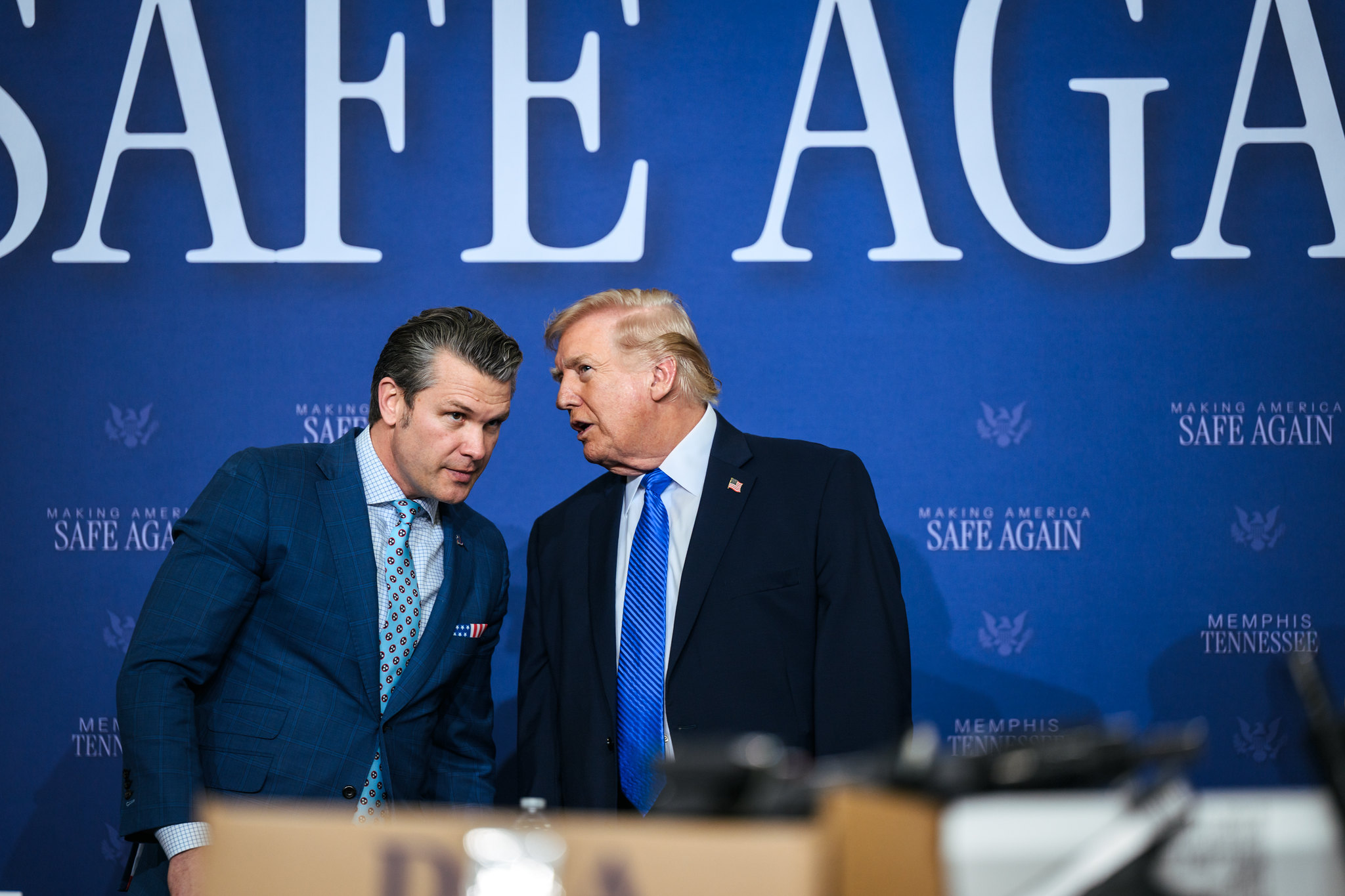
Photo: President Donald J. Trump attends the Memphis Safe Task Force roundtable on public safety at Tennessee Air National Guard Base, Tennessee on Monday, March 23, 2026. (Official White House photo by Molly Riley)