
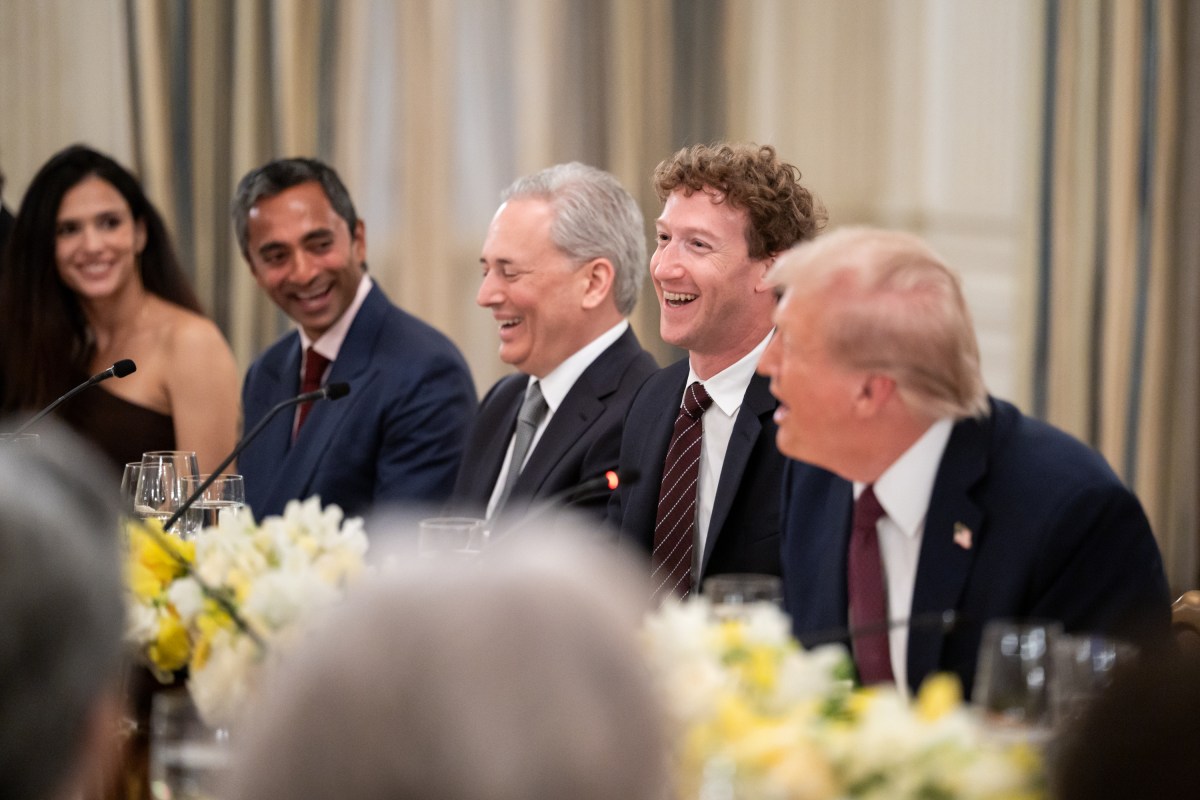
Trump has filled the advisory board with billionaires, Big Tech, and crypto interests.
The Trump administration recently announced its first slate of appointees to the President’s Council of Advisors on Science and Technology (PCAST). The council, co-chaired by venture capitalist David Sacks and White House science advisor Michael Kratsios, will “advise the President and provide recommendations on strengthening American leadership in science and technology.” While previous councils comprised doctors, accomplished academics, and research scientists, this iteration boasts just one scientist. The remaining 12 members of Trump’s PCAST are tech industry executives and venture capitalists with substantial AI and crypto investments, and an eye-watering collective net worth currently exceeding a trillion dollars.
The composition of the advisory council is yet another proof point of the administration’s alignment with Silicon Valley elites’ vision for the country. This is not a group of people with policy chops or technical expertise. Instead, the council is a vessel that permits these individuals to freely lobby on behalf of the tech industry’s interests without the need for lobbyist intermediaries—especially at meetings with the president and his closest advisors.
What’s more, it’s obvious that the remit of this board won’t be the production of rigorous analyses of scientific literature or policy implications. Judging by the cast of characters, this PCAST will likely prioritize the advancement of policies that boost the bottom lines of their various companies, regardless of the impact on the public and our environment. In effect, leadership and progress for this collective will be marked by wielding the federal government’s levers to ensure the market cap of American tech companies outpaces foreign competition. That’s exactly why it’s worth understanding who the members are, how their investments and businesses create massive conflicts of interests in the objectivity of PCAST reports, and how they’ve ingratiated themselves with Trump’s inner circle.
Conflicts and Financial Interests of PCAST Members
David Sacks (Co-founder of VC firm Craft Ventures, Co-Host of All-In)
- Sacks supported Trump in the 2024 general election, raising $12 million at a fundraiser held at his San Francisco home where tickets cost up to $500,000 per couple. Sacks also personally gave $400,000 to Trump 47 Committee, Inc. and spoke at the Republican National Convention.
- Sacks is the co-founder of venture capital firm Craft Ventures, which has stakes in AI and crypto companies, including defense tech firm and government contractor Anduril. According to a New York Times analysis, Sacks’ financial disclosure showed 708 investments in tech companies.
- Sacks previously served as the White House AI and Crypto czar. Sacks used the role to reduce federal oversight of the industries, advising Trump on his AI Action Plan and executive orders that aim to remove regulatory barriers to AI infrastructure and proliferate the use of AI by government agencies.
- Sacks also facilitated increased communication and collaboration between Silicon Valley and the White House, including helping to negotiate the deal between Nvidia and the White House that allowed the chip manufacturer to sell its AI chips to foreign countries, namely China and the United Arab Emirates.
Marc Andreessen (Co-founder of Andreessen Horowitz, Net Worth: $1.9 Billion)
- Andreessen was a major financial backer of Trump’s 2024 campaign, donating $2.5 million to the pro-Trump Right for America PAC in 2024. Andreessen has continued to be a major player in campaign spending, propping up the major pro AI and crypto super PACs. His $12.5 million donation to Leading the Future PAC and $11.9 million gift to the Fairshake PAC in 2025 have been instrumental to the special interest groups’ ongoing pressure campaigns.
- Andreessen Horowitz has substantial investments in both AI and crypto companies, with at least 125 investments in its active portfolio for each industry. This includes stakes in giants like OpenAI and early funding for Coinbase. Andreessen also sits on the board of crypto-exchange Coinbase.
- Andreessen recently downplayed fears of AI-induced layoffs, claiming “essentially, every large company is overstaffed […] a lot of them are overstaffed by 75%,” and companies are using AI as the “silver bullet excuse” to fire employees. This is consistent with Andreessen’s techno-optimist outlook, exemplified by his 2023 Techno-Optimist Manifesto wherein he claims “We believe that there is no material problem – whether created by nature or by technology – that cannot be solved with more technology.”
- Andreessen was a vocal critic of the Consumer Financial Protection Bureau (CFPB) ahead of Trump’s reelection, claiming Biden’s CFPB was “terrorizing” financial tech companies, which Andreessen Horowitz has invested heavily in. What Andreessen described as terror was really the CFPB’s proper enforcement of the law. Take for example, the bureau’s shut down of one of Andreessen’s numerous investments, fintech firm LendUp, in 2021 for allegedly violating fair lending regulations.
Sergey Brin (Co-founder of Google, Net Worth: $264.3 Billion)
- Despite financially supporting the Obama campaign in 2011 and calling Trump’s 2016 election “deeply offensive,” Brin has since become a major Republican donor. In May 2025, he donated over $400,000 to the Republican National Committee. Google also donated $1,000,000 to Trump’s inauguration fund, which guaranteed Brin a seat amongst the other tech moguls present at Trump’s inauguration. In December 2024, Brin and Google CEO Sundar Pichai attended a small dinner at Mar-a-Lago with then president-elect Trump.
- Since Trump’s re-election, Brin has increasingly floated in MAGA circles and is in a romantic relationship with Gerelyn Gilbert-Soto, whom the New York Times described as “a Trump-loving gut-health influencer.” Brin’s relationship with Gilbert-Soto began after he divorced Nicole Shanahan, RFK Jr.’s 2024 running mate. In May 2025, Brin attended a Republican fundraiser where JD Vance spoke. Brin has also donated millions to Steve Hilton, a Republican gubernatorial candidate for California who has been endorsed by Trump.
- Since returning to Google in 2023, Brin has been hellbent on developing AI products to compete with OpenAI and ChatGPT. In 2025, Brin told the New York Times that “Competition has accelerated immensely and the final race to A.G.I. is afoot” amid a push to get google engineers to work 60 hour weeks. At a previous All-In summit, Brin expressed regret that the company had been “too timid” in rolling out large language models because mistakes made by LLMs are overshadowed by how powerful they are.
- Since 2022, Google has been one of the leaders in the multi-trillion dollar AI race. This includes plans to spend $185 billion in capital expenditures in 2026—a 107% year-over-year increase—to support its AI system Gemini.
- Brin is a major believer of using AI for human-oriented tasks like summarizing group chats or selecting employees for promotions, leading him to claim that “Management is like the easiest thing to do with the AI.”
Larry Ellison (Executive Chairman of Oracle, Net Worth: $216 Billion)
- Ellison is a long time Republican donor and Trump supporter, giving tens of millions to PACs affiliated with Republican House and Senate candidates. In the lead up to the 2020 election, Ellison hosted a fundraiser for Trump at his California estate where donors could pay $100,000 to play a round of golf with Trump. Following Trump’s 2020 election loss, Ellison joined a call with Trump’s attorney, Sean Hannity, Senator Lindsey Graham, and Republican activists to discuss ways to challenge and overturn the presidential election results.
- Oracle was the major beneficiary of the forced sale of TikTok by the US government. After Trump repeatedly delayed the deadline of the forced sale, Oracle emerged as one of three major investors that took control of the American version of the company, TikTok USDS. Oracle, along with two investment firms, owns a 45% stake of the joint venture. Kenneth Glueck, an Executive VP at Oracle, also serves on the board of TikTok USDS.
- At the start of the second Trump administration, the President announced Stargate, a joint venture consisting of Oracle, OpenAI, and SoftBank that plans to invest $500 billion in AI infrastructure over five years. In September 2025, Oracle and OpenAI announced plans to build five data centers under the Stargate project, though plans for an expansion of a Texas data center have since been scrapped over financing disagreements.
- The Ellison family is the majority owner of Paramount Skydance, the media conglomerate formed through a 2025 merger approved by Trump’s FCC shortly after Paramount agreed to pay Trump $16 million to settle a baseless lawsuit over the editing of a 60 Minutes interview. Larry Ellison owned the majority of both equity and voting shares in Skydance prior to the merger. His son, David, serves as CEO of Paramount Skydance and owns 50% of voting shares of the new company, while Larry owns 27.5%.
- Paramount Skydance is in the midst of an attempted $111 billion acquisition of Warner Bros. Discovery with financial backing from Larry Ellison through an “irrevocable personal guarantee of $40.4 billion of the equity financing.” Paramount, which needs approval from the Department of Justice Antitrust Division to finalize the deal, recently hosted an event “honoring the Trump White House” that was attended by Trump, acting attorney general Todd Blanche, David Ellison, and Paramount subsidiary CBS’ editor in chief Bari Weiss, among other senior officials and Paramount executives.
- Ellison also has a stake in Elon Musk’s tech companies X and Tesla. Ellison provided $1 billion in backing for Musk’s takeover of Twitter and reportedly owns 45 million shares of Tesla. He previously sat on Tesla’s board of directors from 2018-2022.
Safra Catz (Executive Vice Chair of Oracle, Net Worth $2.9 Billion)
- Catz is a long-time Trump supporter, serving on his 2016 presidential transition team. During Trump’s first term, she was considered for the position of U.S. Trade Representative and Director of National Intelligence. Catz was also reportedly a top contender to replace Lt. Gen. H.R. McMaster as National Security Adviser.
- Although Catz never served in the first Trump administration in an official capacity, she was a close external advisor to Trump. She even faced accusations of advocating against the award of a $10 billion defense contract to Oracle competitor, Amazon, at a private dinner with Trump. Amazon did, in fact, lose out on the contract, which the Pentagon eventually called off entirely.
- In 2020, Catz maxed out the legal limit on individual contributions to Trump’s reelection campaign. She and her husband, Gal Tirosh, also contributed $250,000 to Trump Victory, a pro-Trump PAC.
- In 2024, Catz again backed Trump, donating $1 million to Preserve America PAC, a pro-Trump super PAC.
- Catz sits on the Board of Trustees of In-Q-Tel, the CIA’s venture capital arm that contracts solely with the federal government.
- Oracle’s first customer was the CIA, which still works with the company today. Among other activities, Oracle is helping the CIA deploy generative AI for its missions.
- Catz also sits on the board of directors of Paramount Skydance, alongside Larry Ellison’s son David Ellison, after Trump’s Federal Communications Commission approved the Skydance-Paramount merger in July 2025.
- Born in Israel, Catz is a staunch Zionist who has previously said that Oracle’s “commitment to Israel is second to none.” According to the Quincy Institute for Responsible Statecraft, Catz was CEO of Oracle until September 22, 2025, which means she likely “oversaw much of the negotiations involving the TikTok purchase” and may just get her wish of attempting to shift American public opinion in Israel’s favor.
- Catz’s sister, Sarit Catz, serves on the Board of Directors of AIPAC, the largest pro-Israel lobbying group in the U.S. and an institution that regularly shells out millions of dollars to boost Democratic and Republican advocates for watertight US-Israel relations.
Michael Dell (Founder and CEO of Dell Technologies, Net Worth: $180 Billion)
- Dell Technologies has pivoted aggressively towards AI infrastructure, including a 2024 deal with Nvidia for a Dell AI Factory that aims to facilitate AI adoption for other companies. Dell Technologies is heavily reliant on AI adoption as part of its current and future business model, with $30 billion in sales of its AI servers in fiscal year 2026.
- In 2025, Dell Technologies and Nvidia won a contract with the Department of Energy to develop the agency’s supercomputer at the National Energy Research Scientific Computing Center. Energy Secretary Chris Wright said the project was vital for the US to “win the global race for AI dominance.” The price of the contract has not been released.
- In April 2026, Michael and Susan Dell announced a $750 million gift to the University of Texas at Austin to open the first “AI-native” hospital.
- In December, Michael and Susan Dell made a $6.25 billion contribution to fund “Trump Accounts,” a tax-deferred savings account for children born between January 2025 and December 2028. The accounts include a $1,000 contribution from the US government, and an additional $250 contribution from the Dells for qualifying households. The accounts will be invested in stock-market index funds.
Jacob DeWitte (Founder of Oklo, Net Worth $1.7 Billion)
- DeWitte founded Oklo, the small nuclear reactor developer, in 2013. He serves as its CEO. DeWitte has a history of donating in small amounts to both Republicans and Democrats, but his largest contributions came in November 2025, when he sent over $50,000 to the Republican National Committee. Oklo also ramped up its lobbying during the Trump administration, spending over $2.4 million on lobbying in 2025, up from $520,000 in 2024.
- Energy Secretary Chris Wright sat on Oklo’s Board of Directors prior to his appointment.
- Oklo’s stock valuation climbed rapidly after Trump’s reelection, especially after the signing of a May 2025 executive order designed to expand deployment of “advanced nuclear reactor technologies for national security.” DeWitte was one of the five people invited to stand by Trump as he signed the order in the oval office.
- In September 2025, Oklo’s price spiked again as the Trump administration and the UK government signed an agreement to invest $350 billion in AI, quantum computing, and nuclear energy—at the time, this led Forbes to estimate that DeWitte and his wife Caroline were both worth approximately $1.7 billion.
- Oklo is backed by OpenAI CEO Sam Altman, who Trump embraced upon re-election by hosting Altman at the announcement of the Stargate project. Altman is a major backer of nuclear energy because he believes that nuclear energy is a route to generating the “abundant energy” that would be necessary for continued buildout of AI. This view is shared by DeWitte, who has stated that the “recognition of AI being real” and the subsequent need for “a lot of power” was a part of why his company was so successful starting in 2024.
Fred Ehrsam (Co-founder of Coinbase and Paradigm, Net Worth: $2.6 Billion)
- In the lead up to the 2024 election, Ehrsam donated $250,000 to Fairshake, a crypto-supporting super PAC. When Trump won the 2024 election, Ehrsam was quick to signal his support through a $1 million contribution to Trump’s inaugural fund.
- In February 2025, Trump’s Securities and Exchange Commission announced that it was dropping its civil enforcement action against Coinbase, the cryptocurrency exchange platform co-founded by Ehrsam. The lawsuit had accused Coinbase of operating an unregistered securities exchange.
- Ehrsam left Coinbase in 2017 but remains on its board of directors with 4% stock ownership.
- According to CoinDesk news, Epstein files released by the U.S. Department of Justice revealed that Ehrsam had direct communications with Jeffrey Epstein’s team and was emailing about a potential meeting with Epstein in New York regarding his $3 million investment in Coinbase. The email exchange took place in 2014, six years after Epstein became a convicted child sex offender.
- Under Ehrsam, Paradigm, a venture capital firm he co-founded that invests in AI, crypto, and other tech, has supported prediction markets. In February 2024, Paradigm submitted an amicus brief in a lawsuit between Kalshi, a prediction market platform that Paradigm was not invested in at the time but has since significantly backed, and the Commodity Futures Trading Commission (CFTC). Paradigm argued that Kalshi’s contracts forecasting which political party would control each house of the U.S. Congress post-election could help crypto startups hedge regulatory risks and that the court should therefore vacate the CFTC’s decision prohibiting the contracts. The federal district court ultimately sided with Kalshi, and the CFTC appealed the ruling in September 2024 before the Trump administration abandoned it in May 2025.
- Paradigm has also filed amicus briefs in support of Kalshi in other cases, including a lawsuit alleging that Kalshi’s sports event contracts violate Massachusetts’ sports wagering law; similar lawsuits in Maryland, New Jersey, and Nevada; and a lawsuit seeking to block Kalshi from offering its event contracts on the lands of three tribes in California.
- Ehrsam is an investor in Proto-Town alongside billionaire hedge fund manager Bill Ackman and venture capitalist Josh Kushner, brother to Trump’s son-in-law, Jared Kushner.
- Proto-Town is a 1,200-acre campus in Lockhart, Texas that functions as a capitalist “cowboy” hub for startup founders and employees who live and work on-site with the purported intention of reviving U.S. manufacturing. Startups are invited to live and work on the ranch for several days, and from there, they can decide whether to remain or not. Dwellings in Proto-Town are referred to as “man camps.”
- In 2024, Ehrsam cofounded Nudge, a company that is developing headset-type technology that interfaces with the brain to treat brain disease and improve cognitive functions like sleep. The company has hired former employees of Neuralink, Elon Musk’s brain chip enterprise, and is backed by Josh Kushner’s venture capital firm, Thrive Capital.
David Friedberg (Co-host of All-In, CEO of the Production Board, Net Worth: $1 Billion)
- Friedberg is co-host, along with PCAST chair David Sacks, of the tech booster All-In podcast. All-In hosted a conversation with Trump in June 2024, and has since become a media fixture in Trump world, with Sacks taking the role of AI and Crypto Czar until March 2026. While Friedberg is less sycophantic than Sacks, he has been open to arguments from the MAGA wing of Silicon Valley and provided a positive spin for Trump’s industrial policy on the podcast.
- Friedberg made his initial wealth by selling The Climate Corporation, a company which attempts to predict weather through machine learning, to Monsanto for $1 billion dollars in 2013. Friedberg’s current company, The Production Board, has a portfolio focused on life sciences, agriculture, food production, energy, and software; many companies in the portfolio also have a distinctly ‘AI-forward’ business model.
- Friedberg is also CEO of Ohalo, an agriculture tech company focused on increasing crop yields through genetic modifications supposedly augmented by AI.
- Friedberg is an AI booster. He has speculated that AI might “break” higher education by providing anyone “the equivalent of a Harvard graduate school degree at a cost of zero” and that AI will replace TV and film through user-generated content, among other fantastical claims. In December 2025, Friedberg called AI a “lightning rod” for misguided populism; rather than making the economy less equal, he expects it will diffuse wealth to end users rather than concentrating it in hyperscalers. More recently, in an April 2026 episode of the All-In podcast, Friedberg called AI data centers the modern “temple of the wealthy” that has led to a populist swell of people who are left out of the “progress” being reaped by the rich.
Jensen Huang (CEO of Nvidia, Net Worth: $187.1 Billion)
- Since Trump’s 2024 presidential win, Huang has institutionally aligned himself and his AI computing company, Nvidia, with the second Trump administration, signaling a major shift from his previous desire to remain distant from Washington. “I come with only one purpose,” Huang said at Nvidia’s 2025 Global Tech Conference in D.C. “To inform and to be in service of the president as he thinks about how to make America great.”
- In April 2025, Nvidia pledged to invest up to $500 billion with OpenAI in the U.S. over the next four years to build AI infrastructure.
- In August 2025, Nvidia cut a deal with the U.S. government to give the Treasury 25% of its revenues from H200 AI chip sales in China as a condition for obtaining export licenses.
- In October 2025, Huang confirmed that Nvidia’s Blackwell AI chips were being manufactured in Arizona in accordance with Trump’s vision “to bring American manufacturing back.”
- Also in October 2025, Huang announced that Nvidia would create seven new AI supercomputers for the Department of Energy (DOE). As part of the endeavor, Nvidia will partner with Oracle to build the DOE’s largest AI supercomputer.
- In addition to institutionally aligning Nvidia with Trump 2.0, Huang has cozied up to Trump by joining him in a $1 million-per-attendee dinner at Mar-a-Lago, accompanying him on official state visits to the Middle East and the United Kingdom to unveil tech deals, and donating to fund his $300 million White House ballroom. Nvidia also contributed $1 million to Trump’s inaugural fund.
- Commerce Secretary Howard Lutnick reportedly gave Huang a direct line to Trump. On a Joe Rogan podcast interview, Huang recounted a conversation with Lutnick, where Lutnick said, “‘I just want to let you know that you’re a national treasure. Nvidia is a national treasure. And whenever you need access to the president, the administration, you call us.’” Huang told Rogan that Lutnick’s offer “was completely true.” He said, “Every single time I called, if I needed something, I want to get something off my chest, express some concern, they’re always available.”
- In May 2025, Trump announced that the United Arab Emirates, a major investor in AI data center infrastructure, would be permitted to import 500,000 Nvidia chips annually. That same month, Nvidia announced an agreement to sell chips to Saudi Arabia, coinciding with Trump’s visit to the region.
- Partly as a result of the Trump administration’s efforts to scale up AI and energy infrastructure in the U.S., Nvidia became the first-ever company to reach a $5 trillion market capitalization.
- As a major player in the AI space, Nvidia has much to gain from influencing the Trump administration’s AI policy. On December 3, 2025, Huang urged lawmakers to oppose legislation that would allow states to regulate AI. The following week, Trump issued an executive order, which provides that U.S. AI companies “must be free to innovate without cumbersome regulation” and authorizes the creation of an AI Litigation Task Force to challenge “burdensome” state AI laws.
- According to an April 2026 polling memo by Public Citizen, across parties, Americans largely support stronger AI regulation.
- As a major player in the AI space, Nvidia has much to gain from influencing the Trump administration’s AI policy. On December 3, 2025, Huang urged lawmakers to oppose legislation that would allow states to regulate AI. The following week, Trump issued an executive order, which provides that U.S. AI companies “must be free to innovate without cumbersome regulation” and authorizes the creation of an AI Litigation Task Force to challenge “burdensome” state AI laws.
- Huang has downplayed fears about an AI bubble, which occurs when the trillions being poured into AI development and infrastructure and the corresponding company valuations dwarf the industry’s actual profits. “There’s been a lot of talk about an AI bubble,” Huang told shareholders. “From our vantage point, we see something very different.”
- According to a 2025 MIT report, despite pouring billions into generative AI tools, 95% of organizations are witnessing zero returns.
Bob Mumgaard (Co-founder and CEO of Commonwealth Fusion Systems)
- Mumgaard’s company, Commonwealth Fusion Systems, is a nuclear fusion company with interests in continuing AI investments. When the White House released its AI action plan last July, Mumgaard was in attendance and proceeded to hype up the administration’s prioritization of new energy technologies for powering AI development. To this end, Mumgaard published an article with former Google CEO Eric Schmidt advocating for using fusion technology to power the expected 40% increase in global energy demand for data centers in the next decade.
- That same month, Commonwealth Fusion reached an agreement with Alphabet Inc., Google’s parent company, to sell 200 megawatts of power from its first commercial plant. Shortly after, Google also participated in a $1.8 billion funding round for Commonwealth, though the size of their contribution was not disclosed at the time.
- In April 2026, Commonwealth became the first fusion company to apply to connect to a major US power grid operator, with plans to join the grid in the early 2030s to support AI energy build out.
Lisa Su (CEO of Advanced Micro Devices, Net Worth: $2.1 Billion)
- In July 2025, the Trump administration released its AI Action Plan, which promised to accelerate AI development, ramp up AI infrastructure in the U.S., and curb AI regulation. Su threw her full support behind the plan, telling the Fox Business show, “The Claman Countdown,” that she has the “opportunity of a lifetime” with the Trump administration. “The AI Action plan that has been put out by the administration is actually an excellent blueprint for what it takes for America to lead…America leads in AI today, and we need to run fast and run even faster,” she said. “No question that, in partnership with the U.S. government and in partnership with this administration, we can actually accelerate the rate and pace.”
- Consistent with Trump’s supposed pro-American manufacturing agenda, Su has indicated that the semiconductor company she heads, Advanced Micro Devices (AMD), is actively working to shift its manufacturing to the U.S. In April 2025, AMD announced it was going to begin manufacturing its next-generation EPYC processors for the first time in the U.S. at an Arizona facility. Prior to the announcement, AMD processors were manufactured exclusively in Taiwan.
- Like Nvidia, AMD agreed to give the U.S. government 25% of its revenues from chip sales in China as a condition for obtaining export licenses.
- In a November 2025 interview with the Wall Street Journal, Su expressed doubts about an AI bubble problem. “I am not concerned about an AI bubble,” Su told the Journal. “I do think that those who are thinking that way are a bit too shortsighted. They don’t really see the power of the technology.”
- Su chairs the board of directors of the Semiconductor Industry Association, a trade association and lobbying group that advocates for policies that promote significant investment in U.S. chipmaking, narrow export controls and technology restrictions, and soften regulations and permitting requirements to spur “innovation and industry growth.” The association spent over $2.6 million on both lobbying Congress and the executive branch on semiconductor issues in 2025.
Mark Zuckerberg (Co-founder and CEO of Meta, Net Worth: $239 Billion)
- Zuckerberg has increasingly aligned himself and his company with the second Trump administration, with Zuckerberg attending a private dinner with Trump at Mar-a-Lago following his 2024 election victory and Meta donating $1 million to Trump’s inaugural fund. Meta also settled a case brought against them by Trump over his suspension following the January 6th insurrection, agreeing to donate $22 million to Trump’s presidential library. In October 2025, the White House revealed that Meta had donated an undisclosed amount of money to Trump’s White House ballroom project.
- In November 2025, Meta announced plans to spend $600 billion in US infrastructure over the next three years, mainly on building out AI data centers.
- In January 2026, Meta hired former Trump adviser Dina Powell McCormick as President and Vice Chairman to help implement their planned AI investments.
- In March 2026, Meta announced a $10 billion data center in El Paso, Texas, bringing their total number of data centers in the US to 26.
- A Meta data center in Newton County, Georgia came under scrutiny for using 10% of the county’s daily water usage and allegedly causing sediment build up in local well water that contributed to taps going dry.
- Meta is embroiled in an ongoing antitrust lawsuit brought by the Federal Trade Commission (FTC) over its acquisitions of Instagram and WhatsApp. While Meta prevailed before a district court last year, the FTC appealed the ruling in January, though FTC chairman Andrew Ferguson previously left the door open to dropping the case if Trump directed him too.
Image Credit: President Donald Trump and First Lady Melania Trump host business and technology leaders for a dinner in State Dining Room at the White House via the White House Gallery.