
State insurance commissioners cannot tackle the deeply intertwined crises of fossil fuel-driven climate change, insurance rate hikes and cancellations, and housing injustice on their own. But their role in aggravating or ameliorating problems deserves greater scrutiny.
This is one part of our effort to help shed light on the home insurance crisis. It is based on our compilation of publicly available information. We have done our best to be comprehensive and accurate. Please contact stancil@therevolvingdoorproject.org with corrections or suggestions about how to improve this resource.
This resource was originally published in March 2026 and will be updated periodically.
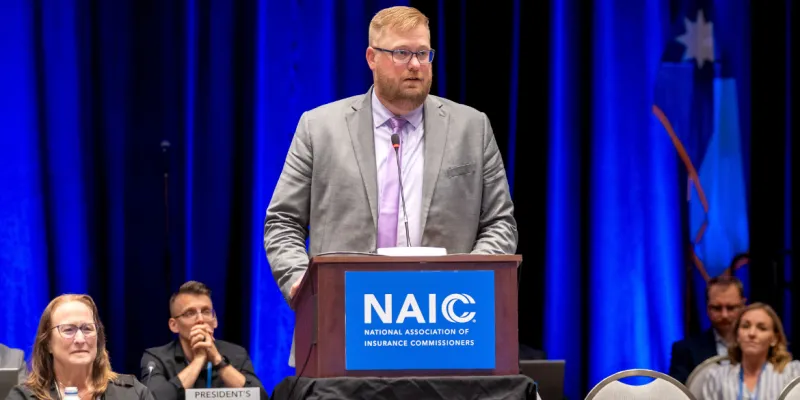
Many people in the United States are likely unaware that the insurance industry is regulated primarily at the state level thanks to an obscure 1945 federal law called the McCarran-Ferguson Act. Even fewer have heard of the National Association of Insurance Commissioners (NAIC), a private non-profit association to which all 56 state-level insurance regulators belong—and which sets the standards for state level insurance regulation.
The deeply intertwined crises of fossil fuel-driven climate change, insurance rate hikes and cancellations, and housing injustice are escalating. Although insurance commissioners in the 50 states plus D.C., American Samoa, Guam, Northern Mariana Islands, Puerto Rico, and the U.S. Virgin Islands cannot tackle these problems on their own, their role in aggravating or ameliorating them deserves greater scrutiny.
To that end, the Revolving Door Project has created a database containing information about current state-level insurance regulators and their immediate predecessors. We used professional networking sites, press releases, and other internet sources to compile details about commissioners’ professional backgrounds and trajectories.
As we show, many of the current insurance commissioners came directly from the insurance industry they’re now tasked with regulating, and many past commissioners rejoined or joined the industry after leaving office. Only a few ex-commissioners moved into consumer advocacy, a phenomenon documented several years ago by investigative journalists reporting on the pernicious effects of the “cozy relationships” between insurance regulators and the insurance industry.
Key Findings
As of March 17, 2026:
- 23 of the 56 current state insurance commissioners (41%) have experience in the private insurance industry.
- 23 of the 56 previous state insurance commissioners (41%) had experience in the private insurance industry, including lobbying roles, before becoming regulators.
- 22 of the 56 previous state insurance commissioners (39%) returned to or joined the private insurance industry, including lobbying roles, after leaving office.
- 13 of the 56 previous state insurance commissioners (23%) came from and returned to the insurance industry, including lobbying roles.
- Only 3 of the 56 previous state insurance commissioners (5%) moved into consumer advocacy following their tenure: Dave Jones (California), Steve Kelley (Minnesota), and Teresa Miller (Pennsylvania).
Why Is the Revolving Door a Problem?
Previous research on state insurance commissioners’ pre- and post-agency employment suggests that the “career aspirations” of departing regulators can lead to higher prices for consumers. According to Grace and Phillips (2007), the largest effect is seen among those insurance commissioners who seek higher political office following their term, a result that they attributed to regulators using their position “to gain favor with the industry presumably in return for political support during future campaigns.” However, the authors also noted that “regulators who pass through the revolving door to industry appear mildly lenient during the rate setting process.”
Consistent with our findings, more recent research has found that 38% of recent state insurance commissioners became “revolvers” who returned to the industry. While in office, future revolvers “are more lenient when regulating insurers’ solvency,” according to Tenekedjieva (2021), who noted that “insurers in revolver-led states over-reported their capitalization during the 2008 financial crisis by up to 10%.” The leniency of revolvers, the author added, “can lead to inflated insurer credit ratings, and consumers can be overpaying up to $27 billion in insurance premiums a year.”
Where Commissioners Come From
It’s misleading to suggest that past experience in the private insurance industry automatically turns an insurance commissioner into a captured regulator. Indeed, the nature of the industry varies widely (e.g., working as an analyst for a non-profit health plan is not the same as being an executive at a for-profit corporation), making further qualitative research necessary.
For instance, among current officials, Connecticut Insurance Commissioner Josha Hershman came from the Immigrant Life Insurance Company of America, where he “helped build an admitted-market life insurance carrier designed to close coverage gaps for immigrant families.” Massachusetts Insurance Commissioner Michael Caljouw was previously a senior analyst at the Kaiser Foundation Health Plan.
Those experiences are different from being an industry lobbyist, of which there are examples: Arizona Insurance Director Chuck Basset previously worked as VP of Government Relations and Public Policy at Blue Cross Blue Shield of Arizona; Missouri Insurance Director Angela Nelson was a VP of Public Affairs and Government Relations at AAA Missouri; and Nebraska Insurance Director Eric Dunning had a similar role at Blue Cross Blue Shield of Nebraska. But even in these latter cases, more research is needed to determine whether insurance regulators’ prior jobs with the insurance industry (and/or return to the industry post-commissionership) are negatively affecting their protection of the public interest today.
That said, we do have evidence of industry-derived state insurance regulators working to advance corporate interests over the public good. For example, Louisiana Insurance Commissioner Tim Temple, who made his fortune as an executive in the industry, has advocated for legislation that would make it easier for insurers to drop homeowners. North Carolina Insurance Commissioner Mike Causey, the former owner of an insurance agency, has defended industry-friendly “consent to rate” policies that enable insurers to charge consumers more than the state-approved maximum. Oklahoma Insurance Commissioner Glen Mulready, previously a VP of marketing at Blue Cross Blue Shield of Oklahoma, has “never exercised his power to deny a rate increase requested by an insurance company for home insurance,” The New York Times reported in 2024.
Where Commissioners Go
Not every former commissioner who moves into the private insurance sector is necessarily an industry shill. But some are.
A quintessential case of bad faith revolver activity came from former Florida Insurance Commissioner David Altmaier (2016-2022). Altmaier resigned abruptly at the end of 2022, just days before Florida’s “cooling off” period limiting ex-officials’ ability to lobby their former agencies was set to increase from two years to six years. A few months later, Altmaier became a board member of the Aspen Insurance Group, and he also accepted a lucrative job as a lobbyist at the Southern Group. (Even if Altmaier hadn’t resigned before 2023, Florida’s revolving door restriction only prohibits ex-regulators from directly contacting their former agencies, not from lobbying lawmakers or engaging in “strategic consulting.”)
Before making his post-government career move, Altmaier’s time at the helm of the Florida Office of Insurance Regulation (OIR) was marred by anti-consumer actions. Under his watch, OIR buried a study revealing that from 2017 to 2019, Florida insurance executives reported losses to the state while funneling billions of dollars to affiliate companies and nearly $700 million in dividends to shareholders. Though the taxpayer-funded study was finished in early 2022, Florida lawmakers and the public didn’t see it until 2025, and only then thanks to public records requests. Meanwhile, in late 2022, Florida Republicans passed legislation—pushed by Gov. Ron DeSantis (R), Altmaier, and industry lobbyists who cited fabricated loss figures—that made it harder for consumers to sue insurers, among other industry-friendly provisions. What’s more, amid Altmaier’s lax oversight, insurance companies low-balled Hurricane Ian survivors.
In the interest of promoting the public good, it’s important to document where ex-insurance regulators end up. Here are more than 20 additional examples of revolvers from the previous generation of insurance commissioners:
- Former Arkansas Insurance Commissioner Alan McClain (2023-2025) founded his own insurance consultancy in 2025;
- Former Connecticut Insurance Commissioner Andrew Mais (2019-2025) returned to Deloitte, which provides consulting services to insurance companies, as a senior advisor in 2025. Mais was previously a member of the firm from 2011-2019;
- Former Delaware Insurance Commissioner Karen Weldin Stewart (2009-2017) returned to the Weldin Group in 2017. Weldin Stewart was previously president of the firm, which advises insurance regulators, from 1993-2005;
- Former D.C. Insurance Commissioner Stephen Taylor (2015-2020) became a policy director and assistant general counsel at the Surety and Fidelity Association of America (2020-2022);
- Former Guam Insurance Commissioner Artemio Ilagan (2011-2018) has been a financial services consultant at Calvo Enterprises, whose clients include insurance companies, since 2022;
- Former Illinois Insurance Director Dana Popush Severinghaus (2022-2024) became a partner at Noted Advisory, which provides consulting services to the insurance industry, in 2024;
- Former Iowa Insurance Commissioner Nick Gerhart (2013-2017) is a serial revolver. His insurance-related post-commissioner roles include chief administrative officer at Farm Bureau Financial Services (2017-2020); board member at Carpe Data (2017-2022); advisory board member at Gain Compliance (2017-present); board member at Sureify (2017-present); advisory board member at Harbor.ai (2020-present); advisor at Gigaforce (2020-present); and advisor at Pinpoint Predictive (2022-present). Notably, Gerhart also came from the industry, having been counsel at American Equity (2003-2010) and VP of Compliance and Regulatory Affairs at Sammons Financial Group (2011-2012). In addition, Gerhart served as a mentor at Global Insurance Accelerator (2015-present) before, during, and after his stint in office, according to LinkedIn;
- Former Kansas Insurance Commissioner Ken Selzer (2015-2019) was, according to his LinkedIn profile, an executive managing director at insurance broker Aon (1993-2021) before, during, and after his regulatory tenure;
- Former Kentucky Insurance Commissioner Nancy Atkins (2017-2020) became executive vice president of government relations at OneShare Health in 2020;
- Former Mississippi Insurance Commissioner George Dale (1976-2008) became a senior governmental affairs advisor at Adams and Reese, which represents insurance industry clients, in 2008 and a senior public policy advisor at Baker Donelson, which also represents clients from the insurance industry, in 2019;
- Former Missouri Insurance Director Chlora Lindley-Myers (2017-2024) joined Caterpillar Financial Services, which provides captive insurance to businesses, as a director in 2025;
- Former Nevada Insurance Commissioner Scott Kipper (2008-2010, 2011-2015, and 2023-2025) has a long history of moving back-and-forth between insurance regulation and the industry itself. He was the senior regional director of the Health Insurance Association of America from 2001-2005 before working in the Louisiana Department of Insurance as deputy commissioner (2005-2007), the Oregon Insurance Division as administrator (2007-2008), the Nevada Division of Insurance as commissioner (2008-2010), again in the Louisiana office as deputy commissioner (2010-2011), and again in the Nevada office as commissioner (2011-2015). Then he returned to the industry as VP of state affairs for the Pharmaceutical Care Management Association (2015-2017), principal at Capitol Partners Inc. (2020), VP of regulatory affairs and compliance at Dental Health Services (2020-2021), and president of Kipper Strategic Solutions from 2017-2022. This was followed by a stint as deputy insurance commissioner in Washington (2022-2023). During his third stint as Nevada’s insurance commissioner (2023-2025), Kipper’s main accomplishment was pushing for the passage of AB 376. That law, now in effect, made Nevada the first state to allow insurers to exclude wildfire from the perils they must cover to sell policies. Kipper is now principal at Paularoo LLC, an insurance-related consulting firm (2025-present);
- Former New Hampshire Insurance Commissioner Christopher Nicolopoulos (2020-2023) has assumed multiple insurance-related and lobbying roles since leaving office: VP of government affairs at Enhance Health (2023-2024); president of Granite Strategic Advisors (2024-2025); senior regional VP at the National Association of Mutual Insurance Companies (2024-2025); and CEO of Davis and Towle Insurance Group (2025-present). Before his stint as commissioner, Nicolopoulos was president and CEO of the New Hampshire Association of Insurance Agents (2014-2020);
- Former North Carolina Insurance Commissioner George Wayne Goodwin (2009-2017) became president and CEO of Seaboard Strategic Consulting LLC, which provides consulting services to insurance companies. He also joined the advisory board at Nelson Taplin Goldwater, an insurance consultancy, in 2017 and became the independent director of the American European Insurance Group, Inc. in 2025;
- Former North Dakota Insurance Commissioner Adam Hamm (2007-2016) became Allianz’s chief compliance officer for North America in 2020 and the chief compliance officer of Zurich North America in 2025;
- Former Oklahoma Insurance Commissioner John Doak (2011-2019) became director of Energi, Inc. and executive VP of government and regulatory affairs at Insurance Care Direct and Entratus.ai in 2019;
- Former Rhode Island Insurance Superintendent Joseph Torti III (2002-2015) joined Fairfax, Inc. as VP of regulatory affairs in 2016;
- Former South Dakota Insurance Director Merle Scheiber (2005-2014) has been president and CEO of CorInsurance since 2014;
- Former Tennessee Insurance Commissioner Hodgen Mainda (2019-2020) took the position of global head of insurance at Transcard in 2022;
- West Virginia Insurance Commissioner James Dodrill (2019-2021) has been a “business leader” of government affairs at Progressive Insurance since 2021. He also began serving as chairman of the West Virginia Insurance Federation (2012-present) while he was in office, according to his LinkedIn; and
- Former Wisconsin Insurance Commissioner Mark Afable (2019-2021) has served on the board of directors of American Family Insurance since 2024.
Aren’t There Laws Against This?
Of the 50 states, 29 have some form of “cooling-off” period that is applicable to departing insurance regulators, according to this list compiled by Public Citizen. These laws seek to prevent former public officials, including insurance commissioners, from lobbying their ex-colleagues for a specific window of time after they leave office. Unfortunately, the laws are typically weak, apply for only a brief period, or both. Most restrict lobbying contacts—i.e., they prohibit ex-regulators from directly contacting their former agencies, but allow them to join a lobbying firm or engage in “strategic consulting.” Some do restrict lobbying activities more generally. But the vast majority of restrictions last less than two years, so their effects are limited. For more details, see our related resource, “Mapping Home Insurance Regulation.”
Simultaneous Roles
Our research also revealed another phenomenon: state insurance commissioners working simultaneously in private sector roles. This isn’t necessarily illegal if properly disclosed (which we assume has happened when positions are listed on public LinkedIn profiles). But it does warrant attention. Examples include:
- Former Alabama Insurance Commissioner Jim Ridling, who served as director of the River Bank and Trust (2006-2023) during his regulatory term (2008-2022);
- Peni “Ben” Itula Sapini Teo, former insurance commissioner in American Samoa, who, according to LinkedIn, served as CEO of BJ Company Investors LLC (2015-present) while in office (2021-2025);
- Former Iowa Insurance Commissioner Nick Gerhart (2013-2017) served as a mentor at Global Insurance Accelerator before, during, and after his stint in office (2015-present), according to LinkedIn;
- Former Kansas Insurance Commissioner Ken Selzer, whose LinkedIn profile suggests that his tenure as a regulator (2015-2019) overlapped with his job as an executive managing director at Aon (1993-2021);
- Former North Carolina Insurance Commissioner George Wayne Goodwin, whose LinkedIn says he was a co-owner of the Cotton Exchange Investment Group (2001-2011) for part of his regulatory tenure (2009-2017); and
- Former West Virginia Insurance Commissioner James Dodrill, who appears to have started serving as chairman of the West Virginia Insurance Federation (2012-present) while he was in office (2019-2021).
Lack of Regulatory Capacity Is Also a Problem
Potentially captured regulators aren’t the only impediment to robust oversight of the insurance industry. Most state insurance departments are also under-resourced. For more details, see our related resource, “Mapping Home Insurance Regulation.”
All of this work is based on the following database of current and past insurance commissioners, along with state regulatory capacity.
Note: This is a substantially reworked version of a tool that was originally published in 2024. For earlier research assistance, we thank Fatou Ndiaye and Jacob Plaza.
Photo: National Association of Insurance Commissioners