
This article was originally published in The American Prospect. Read it here.
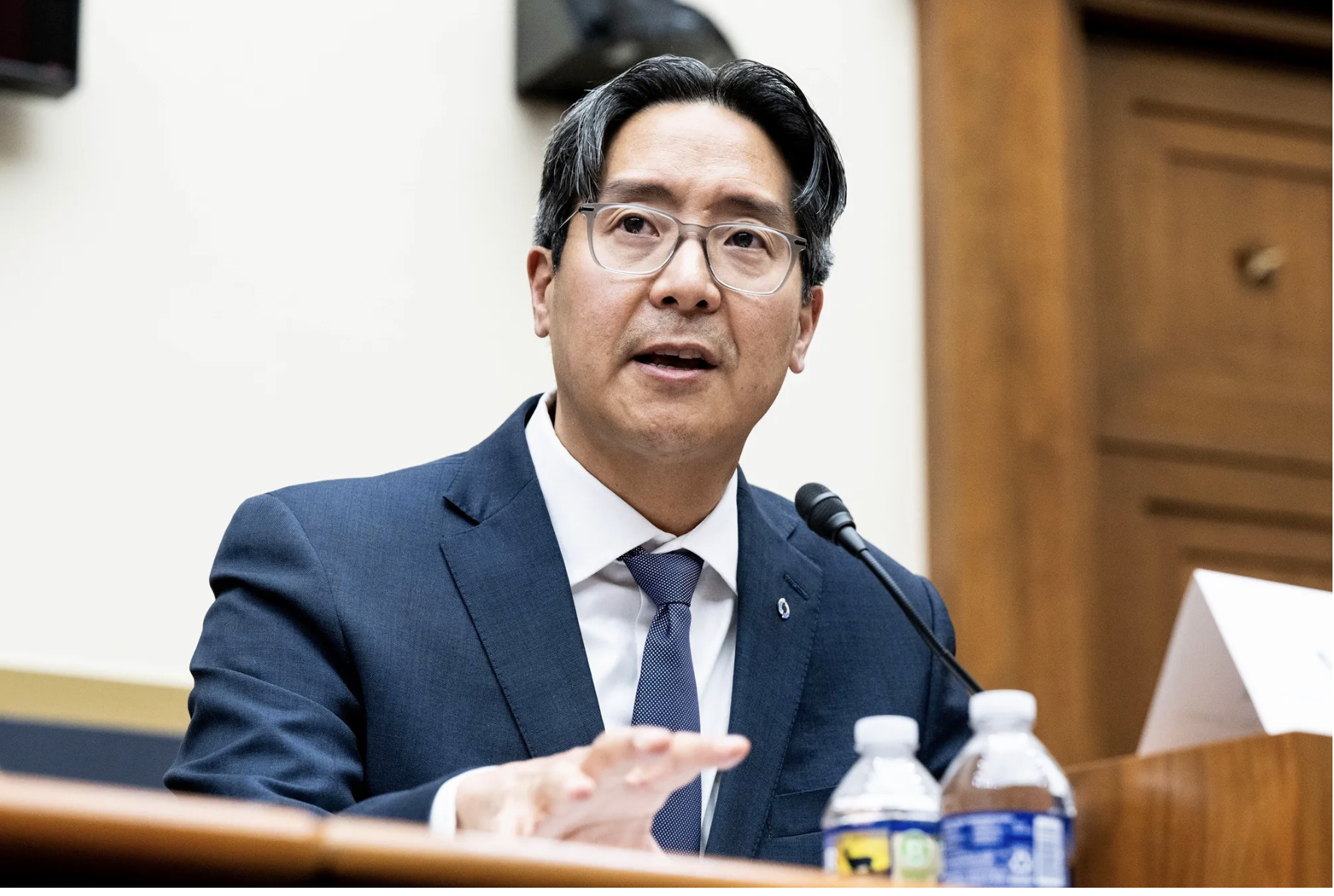
Michael Hsu, former OCC head, has joined a VC firm backing crypto and fintech companies.
It’s hard times at the Office of the Comptroller of the Currency (OCC), one of the three principal bank regulators in the country, along with the Federal Deposit Insurance Corporation and the Federal Reserve. All three, plus other financial institution regulators at the National Credit Union Administration and the Consumer Financial Protection Bureau, have been gutted to varying degrees over the first year of Trump 2.0.
The decline of bank oversight is also coinciding with a number of rising threats to the financial system. In addition to possible asset bubbles in the tech and private lending sectors, traditional banking has been significantly increasing its exposure to risky assets like cryptocurrencies. Earlier this fall, the OCC granted a federal bank trust charter to crypto firm Anchorage Digital. Last week, five more crypto firms received charters: Circle, Paxos, Ripple, BitGo, and Fidelity Digital Assets. Other crypto and fintech platforms have sent in applications, including PayPal and Coinbase.
For almost the entirety of the Biden administration, Michael J. Hsu ran the OCC. In May 2021, Hsu, who described himself as a “career public servant and a bank supervisor” to the core, was tapped by Biden’s Treasury Secretary Janet Yellen to serve as first deputy Comptroller; with the Comptroller position itself vacant, that made Hsu acting Comptroller. At that point, he had been in financial regulation for more than two decades—first joining the Federal Reserve Board’s legal division in 2002, then serving stints at the Securities and Exchange Commission, Treasury Department, and International Monetary Fund before returning to the Fed and overseeing its Large Institution Supervision Coordinating Committee.
Alas, no longer. Last week, Hsu joined the venture capital firm Core Innovation Capital as a venture partner.
Core Innovation Capital likes to brand itself as a socially conscious partner of “mission driven companies whose financial success aligns with creating value for their customers.” Progressive branding is all over its website. CIC’s founder and managing partner quotes Banksy on the company’s staff page: “There is nothing more dangerous than someone who wants to make the world a better place.” Their regulatory partner adopts a similar vein, stating, “I’d love to see fintech solve for getting high-quality financial advice to everyone, not just the wealthy and large corporations that can afford to pay for existing low-tech solutions.”
Despite these proclamations, CIC’s actual portfolio is littered with companies that have faced enforcement actions from a number of regulators, including the one Hsu himself only recently departed, for allegedly violating basic consumer protection laws and engaging in other abusive or potentially illegal activities.
CIC’s portfolio includes Brigit, which was sued by former President Biden’s FTC for false advertising, charging junk fees, and entrapping users in a misleading and confusing cancellation process for its subscription model. The portfolio also includes Ripple, which was first sued by Trump’s SEC in 2020 for alleged violations of securities law which were ultimately settled in 2025.
Notably, Trump’s second term SEC reportedly attempted to ease its enforcement actions against Ripple despite years of agency work to the contrary. Why? It could be that the company also donated nearly $5 million to the Trump inauguration. Ripple is also among the crypto companies granted a bank trust charter by the OCC last week. Poetically, Ripple’s charter came just one day after the announcement that Hsu had joined CIC.
Klover, another member of CIC’s portfolio, has allegedly charged as high as 1,000 percent interest on its cash advance product, leading to an ongoing class action suit in Pennsylvania, where the interest rate limit is six percent.
Jiko, which received a citation from the Fed in 2024 for “‘significant deficiencies’ [found by] the San Francisco Fed […] in capital planning, cash flow, liquidity, strategic planning and earnings.” The company was once advised by Larry Summers, the former Treasury Secretary and close friend of Jeffrey Epstein. Jiko also helped jumpstart the crypto and fintech instability invasion of traditional finance when it purchased Mid-Central National Bank in September 2020.
Jiko’s move was part of a major pro-crypto, pro-fintech push under then-Comptroller Brian Brooks’ tenure in Trump’s first term. Only days before he left the OCC, Brooks issued an interpretive letter which weakened the requirements for issuing bank trust charters, a move that specifically opened the door to fintech companies receiving national charters. Several fintech firms were chartered as national bank trusts under the standards outlined in Brooks’ letter before Hsu was appointed to the OCC in May 2021.
Needless to say, a former top regulator joining such a company is unfortunate. Notwithstanding a new administration and plenty of staff turnover, former regulators still offer their corporate clients deep institutional knowledge of the agencies they served, even years later. Established relationships with career agency staffers may inspire preferential treatment of their former bosses and their new private-sector clients. Their clients also may learn how to sidestep existing regulatory regimes and exploit obscure loopholes. At minimum, this access creates the appearance of impropriety, and is often straightforwardly corrupt. Public trust in our regulatory institutions suffers.
It’s particularly awful today. Crypto and fintech—whose potential for fraud, abuse, and financial collapse are scarcely possible to exaggerate—are increasingly becoming intermingled with the traditional finance sector. That’s where Americans’ 401(k)s, mortgages, and car loans live, now increasingly infested with some of the worst financial products ever imagined. A former top bank regulator joining a VC firm investing in those companies, at precisely the same time that they are pursuing game-changing charters from his former agency, is deeply irresponsible.
On one level, this isn’t too surprising. Hsu’s tenure at OCC left much to be desired, and he was ultimately disappointing particularly as compared to a slate of actually hard-hitting regulators that the administration could boast, like both Lina Khan and Jonathan Kanter. Folks like Khan or Kanter are not generally offered jobs at venture capital firms.
But beyond that, we should expect more from our public servants (and, if we’re being honest, pay them more). Cryptocurrency is almost certainly going to cause a major financial collapse at some point; the only questions are when, how big it will be, and who else will be taken down with it. Democratic Party officials should be warning the public about that danger, not trying to cash in with the industry they regulated before the music stops.