
AI Isn’t Human, But Its Profiteers Are
Artificial intelligence has become one of the most animating topics in American politics. Since the launch of ChatGPT in November of 2022, key questions have percolated through both wonkish and popular discourse: Where and how many data centers should be built to facilitate the growth of this product? Should the federal government be able to overrule states and local communities’ desires for regulating AI’s uses? Should creators be compensated for unwittingly providing “training material” to for-profit companies? What institutions should actually make use of AI? Schools? Newspapers? Courts?
While reasonable people could disagree about the answers to these questions (and many more), the second Trump Administration’s policy thus far has been to accept Big Tech’s maximally irresponsible recommendations. (My colleagues recently collaborated on a deep dive report with Climate and Community Institute examining the harms and opportunity costs of this “AI First” national strategy.)
Trump has knighted tech oligarchs as “special government employees” (SGE) and stuffed the Presidential Council of Advisors on Science and Technology with investors and podcasters. Through these spaces and more, Silicon Valley’s elite have made their mark on Trump’s AI policy. To understand the Trump administration’s policy on AI, one has to look beyond Trump’s own pronouncements to the AI “experts” he surrounds himself with. To that end, we at the Revolving Door Project are launching our AI Villains Tracker—an compendium of the people responsible for crafting and delivering some of the least popular policy decisions made by the second Trump Administration.
David Sacks was first brought into the second Trump Administration as the White House AI and Crypto Czar; he remained in that role as an SGE until March 2026, well over 130 days after his appointment. Sacks is a member of the “PayPal Mafia” which now dominates a sizable slice of the economy. According to his financial disclosure, Sacks stands to gain tremendously from deregulation.
As AI czar, Sacks’ major visible contributions were co-authoring the July 2025 AI Action Plan and overseeing the March 2026 National Policy Framework for AI. These documents elevated “preemption” to the front of the national conversation. Sacks and his allies believe state laws that would “burden” AI companies need to be preempted by a federal framework. Failure to assert such dominance, he warns in the AI Action Plan, would prematurely “smother” American AI innovation.
In March, Sacks was tapped for a new role as co-chair of the Presidential Council of Advisors on Science and Technology, or PCAST. In the past, PCAST has been a direct line between the executive branch and leading experts in medicine, technology, and scientific research. Of PCAST’s 13 current members, 12 are executives or venture capitalists with significant AI investments.
Michael Kratsios joined the administration in two roles: director of the Office of Science and Technology Policy and Assistant to the President for Science and Technology. Today, Kratsios also co-chairs PCAST with his partner in deregulation, David Sacks. Just like the vice president, Kratsios is a Peter Thiel acolyte, having previously served as chief of staff at Thiel Capital and CFO of Clarium Capital Management.
Kratsios has made his mark on government-wide efforts to shape AI adoption. Along with assisting Sacks on the AI Action Plan and the National Policy Framework, Kratsios is also key to the White House’s “Genesis Mission” in November of 2025. This executive order establishes a “coordinated national effort” between Kratsios and the Department of Energy to “accelerate scientific discovery.” To achieve these goals, the executive order proposes that feeding National Labs’ data into AI models will lead to some hazy vision of a scientific golden age.
Larry Ellison is chairman of Oracle and one of Trump’s top fundraisers; he also organized the effort to challenge the 2020 presidential results. Ellison is a member of PCAST as well as a co-investor in Stargate, so the fact that he’s also a data center booster is a given. Oracle belongs to the Data Center Coalition, a trade association dedicated to stomping out local opposition.
One of Ellison’s more controversial stances has been his support for the consolidation of all government data into a single repository. He hopes that Oracle’s products can be used as its “technological backbone,” allowing the federal government to engage in “real-time machine-learning-powered monitoring” of American citizens. In Ellison’s own words, this would keep American citizens “on their best behavior” for fear that Big Brother is watching.
No list of the Trump Administration’s “AI First” acolytes would be complete without Elon Musk. After Musk became Trump’s top donor in 2024 and manipulated X’s algorithm to support right-wing views, he earned Special Government Employee status just like David Sacks. Leading the Department of Government Efficiency (DOGE), Musk was, in some ways, the face of the early Trump Administration. In this role he worked alongside Trump’s lieutenant Russell Vought to slash the federal workforce and shoehorn AI into everyday governance wherever and whenever possible. As we have tracked, AI is being used by the government for everything from surveillance of immigrants to military strategy. Musk supposedly stepped back from government life in May 2025, but his cronies at DOGE and OMB have continued demolishing human expertise in the government.
With the purchase of xAI by SpaceX and the latter’s massive trillion dollar IPO, Musk also remains an influential voice shaping Trump’s (de)regulatory approach to AI. In May, Musk reportedly teamed up with Mark Zuckerberg and David Sacks to convince Trump to put an end to an executive order that would have regulated frontier AI models. After their lobbying, Trump reintroduced a gutted version of the EO which places softer requirements on AI firms.
As co-founder and CEO of OpenAI, Altman is in the driver seat of the company responsible for the most recognizable generative AI product: ChatGPT. Altman has also backed a host of startups in the AI ecosystem that synergize with his own. He donated $1 million to Trump’s second inaugural fund, and joined Trump, Ellison, and Softbank CEO Masayoshi Son the next day to announce Stargate. In May 2025, Altman traveled with Trump to the Gulf, where the UAE announced that a new Stargate campus would have a gigawatt dedicated to OpenAI. Stargate has faced construction delays and funding challenges, but Altman appears to be committed to it in the long term—assuming he can keep the fundraising train on track.
Since Trump’s reelection, Altman has mingled with Trump World at Mar-a-Lago dinners and White House roundtables. The president and wunderkind have evidently built a correspondence; in December, shortly after Altman and OpenAI wrote in favor of preempting state regulations, the president signed an executive order instructing federal agencies to challenge “burdensome” state AI laws. One of OpenAI’s most conspicuous moves was to fill in for its competitor Anthropic when the latter got into a spat with the Pentagon over using its generative AI models for killing and surveillance.
Sam Altman owes some of his policy relevance to OpenAI’s top lobbyist Chris Lehane. Lehane originally gained fame as a “Master of Disaster” in 1994 by co-managing the Clinton campaign’s response to the Whitewater Scandal. In 2015, Lehane brought his PR expertise to Silicon Valley, saving Airbnb from the brink when San Francisco’s Proposition F threatened to undermine its business model. When the crypto industry faced its own Sword of Damocles, FTX’s 2023 collapse, Lehane built the Fairshake Super PAC to crush, along with AIPAC, crypto skeptics.
Since coming aboard, Lehane has led OpenAI’s push for preemption and argued that light-touch regulations are key to keep “AI with democratic values…ahead of China.” Last March, Axios reported that Lehane went to the White House to discuss a memo on the subject of US-China cooperation and preemption. During this year’s G7 Summit, Lehane attended a meeting along with Trump and a panoply of corporate leaders to discuss how to promote the dominance of American AI products over their Chinese counterparts.
Since the full federal preemption of state regulations dreamed about by Lehane and his friends is still as yet unrealized, he has advocated for a backup plan he calls “reverse federalism” in posts and discussions with the press. This strategy consists of sponsoring state-level laws in major markets like California, New York, and Illinois that achieve the same goals. By watering down major state-level bills, Lehane hopes to achieve a de facto national framework that’s amenable to Big Tech.
In addition to his White House ties, Lehane has repeated the crypto playbook with AI, advising on the creation of the massive Leading the Future Super PAC to wash pro-regulation candidates out of congressional races. To date, LTF’s largest gamble has also been their largest success, spending over $8 million to narrowly defeat Alex Bores in the Democratic primary for New York’s 12th district.
Marc Andreessen is co-founder and general partner Andreessen Horowitz, MAGA’s favorite venture capital firm. He’s also contributed millions of dollars to the pro-Trump campaign finance machine. Andreessen stands to gain substantially from Trump’s AI policy, having diverted 40% of its new capital in 2026 to AI firms. As a result, their portfolio now includes well over 100 AI firms, and they have backed OpenAI, xAI, and a multi-billion dollar AI infrastructure effort.
Predictably, all this money and public support has bought Andreessen a lot of influence in the Trump White House. Yet another member of PCAST, Andreessen also stated in December 2024 that he was spending “half” of his time at Mar-a-Lago helping Trump pick staff to handle tech, business, and “the ‘success of the country’ more generally.” One such example is Sriram Krishnan, a former general partner at Andreessen Horowitz who also served as a senior policy advisor for White House AI policy. Considering his firm’s hiring of disgraceful individuals, one should expect Andreessen’s other recommendations to be suspect at the least.
In January 2025, Trump rescinded a Biden-era executive order on “responsible” AI development hated by Andreessen. This was the first of many AI policy moves that delighted the venture capitalist. In December, Bloomberg reported that Andreessen Horowitz influenced the contents of the executive order targeting “cumbersome” state regulations. One former White House official even claimed that Andreessen Horowitz’s principal lobbyist, Collin McCune, has veto power over any and all AI proposals.
We’ll continue to update our AI Villains tracker in the coming weeks. Stay tuned for more dispatches on the people most responsible for the AI encroachment.
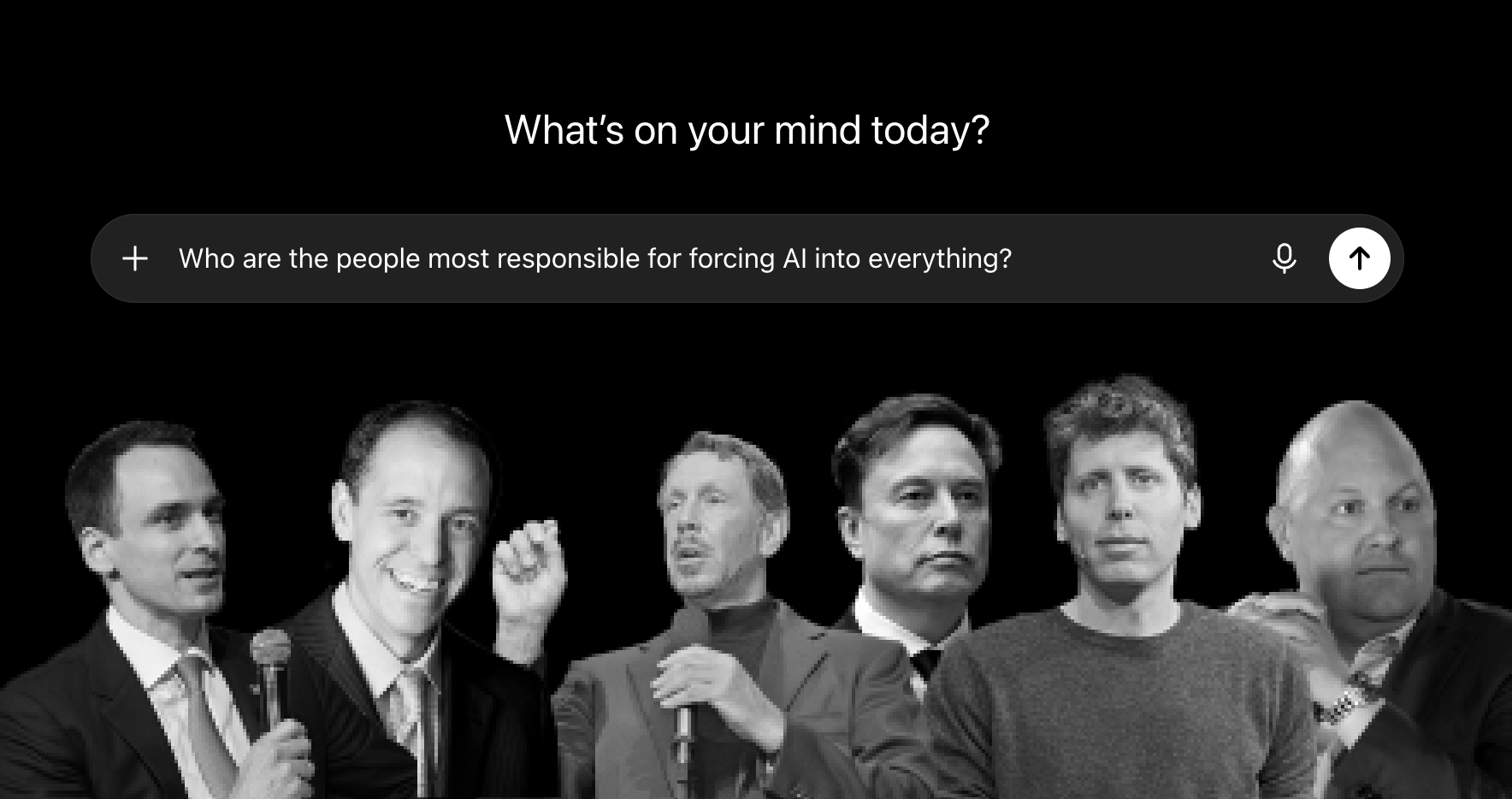
Image made from screenshot of ChatGPT interface, photos of Michael Kratsios, Chris Lehane, Larry Ellison, Elon Musk, Sam Altman, and Marc Andreessen licensed for remix.


Want more? Check out some of the pieces that we published or contributed research or thoughts to in the last week:
Not All Nepo Babies Are Trumps
Economic Hit Men for Gambling Apps
Map: Trump Has Often Delayed or Denied Disaster Aid
TRACKER: Trump Administration Anti-Vaccine Actions
Tracking Food and Drug Safety During the Trump Administration
Oligarchs and the Trump Admin: Larry Ellison
Draining National Parks to Fill the Reflecting Pool
Big Oil Takeover ‘Now Complete,’ Watchdog Warns as Exxon Lawyer Joins Trump DOJ
Report From House Dems: Trump Used 250th Planning to Hide Corruption
Why Climate Politics Can’t Wait
A Florida mining company helped fund Trump’s Freedom 250
As America Celebrates 250th, Murkiness Surrounds Trump-Backed Planning Fund
Big Lobbying Spenders Are Going All Out at the Great American State Fair
House Democrats accuse Trump of ‘hijacking’ America’s 250th birthday for his own gain
Confederate Flag In NC’s National Fair Booth Sparks Controversy
As America Turns 250, a Trump Adviser’s Firm Rakes in Federal Cash
$50 Billion in Taxes Avoided by Tech Giants Driving the Data Center Boom
Related Articles
October 9, 2026
Map: Trump Has Often Delayed or Denied Disaster Aid
September 30, 2026
Reversing Voughtism; or, Creating a Pro-Worker Government to Save Lives
September 25, 2026
Unions Against Voughtism
September 25, 2026